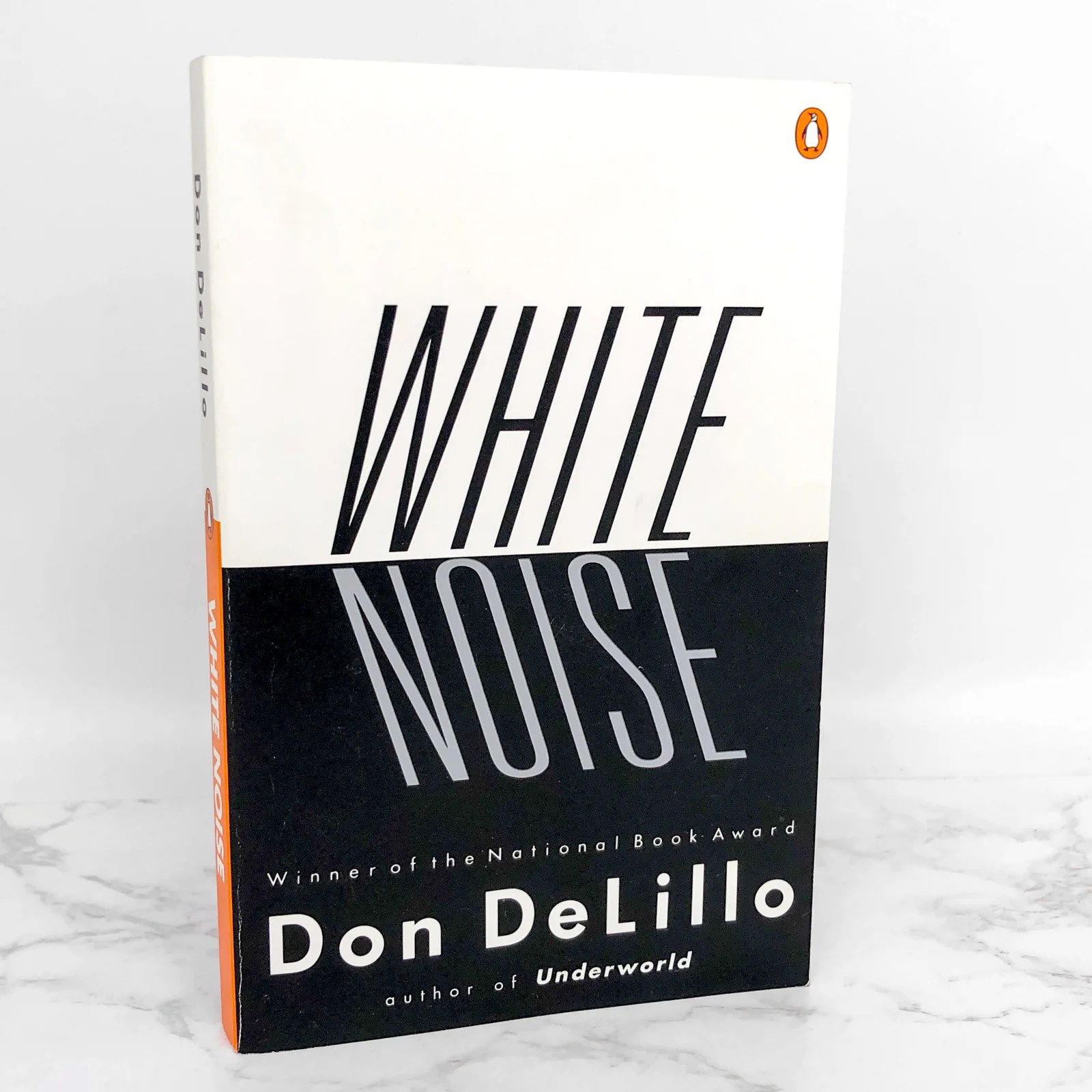
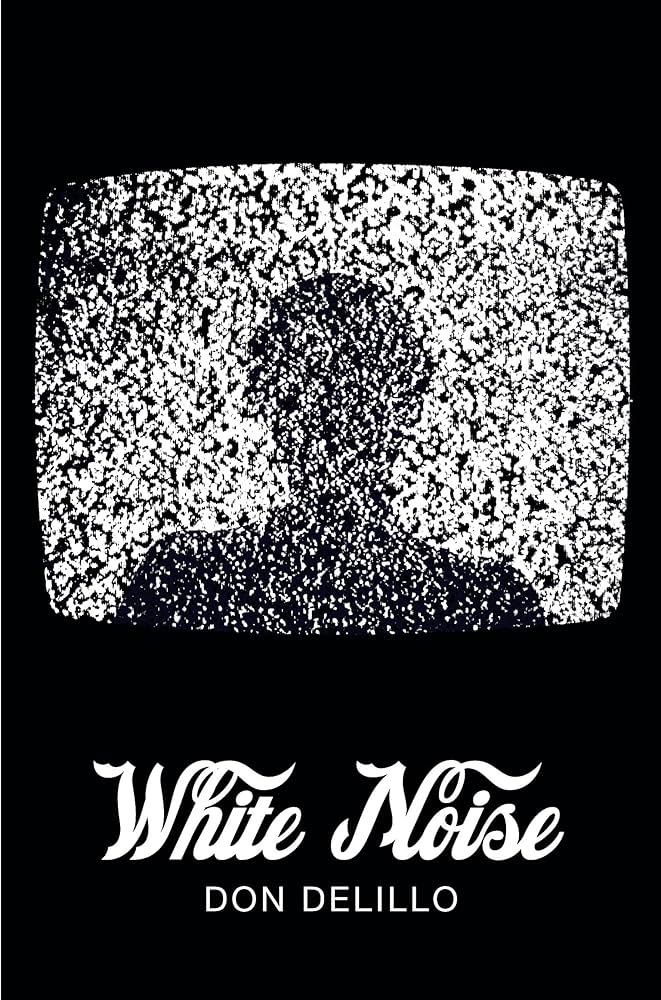

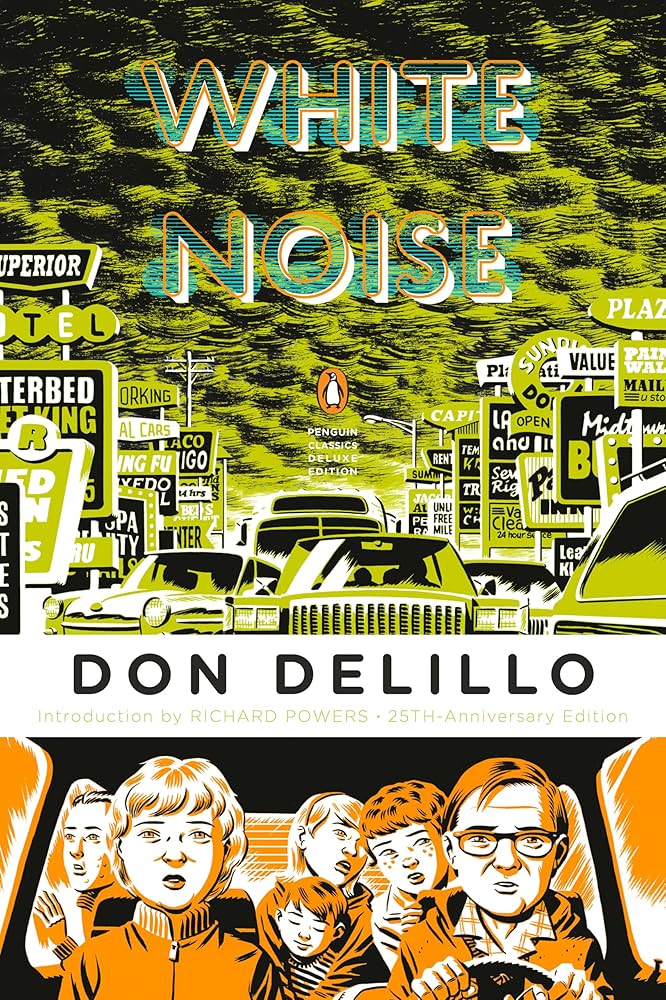
The human condition is filled with confusion, dread of impending death, and a yearning for a sense of peace to cope with the uncertainty. One author who has taken a stark look at these topics is Don DeLillo in his novel White Noise. When examined through both Marxist and Deconstructionist theoretical lenses, clear patterns emerge that reveal people caught in a cycle of consumerism and turning to technology for spiritual experience. One aspect of the Marxist concept of alienation applies to this novel because it considers the way in which people cannot live their best lives; they must spend all their time working to make money to buy things and then work more to continue the cycle. Another Marxist concept observed in White Noise is fetishism of commodities as pertains to equating objects with inherent value.
One deconstructionist concept that threads its way throughout the novel is hyperreality. Technology has become so interwoven into people’s lives, that symbols and representations of things are indistinguishable from the actual things themselves; technology can create spiritual connections that defy reason. Another deconstructionist idea is that of ambiguity or the impossibility of finding a definitive meaning through language. White Noise demonstrates that the disquiet caused by humanity’s fear of mortality can be comforted by participating in the cycle of consumerism, allowing objects to make us whole, experiencing the sublime using technology, and making peace with the random white noise inherent in existence.
For the characters in White Noise, consumerism is a panacea for both socioeconomic and existential angst. Purchases must occur as one of the economic functions necessary to perpetuate the cycle of consumerism. The Gladneys use the experience of shopping routinely throughout the novel to placate themselves. For example, in one passage of the book Jack decides to shop, and his family is enthused by his sudden interest. Jack says, “When I could not decide between two shirts they encouraged me to buy both. When I said I was hungry, they fed me pretzels…My family gloried in the event…” (DeLillo 3-4). Jack’s family enjoys using his purchasing power to meet each and every need or desire that arises. They revel in the experience of being consumers and helping Jack along in the process. The entire family seems to participate in the shopping experience each time they go to the supermarket, as well. “We moved together…Wilder sat in the shopping cart trying to grab items off the shelves…Steffie took my hand…” (DeLillo 35-36). They hold hands, stick together, and spend time as a family. Even the youngest child grabs items that interest him and adds them to the cart. Alienation (according to Marxism) has created a situation where families must carve out time together any way they can because work for survival has taken such a large chunk of time out of every day. One way the Gladneys have found time for each other is to shop together. They can purchase the items they need and spend time together in the process. This comforts them and helps them to bond.
Tom LeClair discusses this concept of using consumerism as a way to manage fear and comfort themselves in the face of uncertainty. It is a way for the Gladneys to enjoy time together in the outside world, but it is also a form of a sedative to dull their senses so they are not thinking about their real fears, including death (LeClair 394-395). The supermarket is also one of the spaces where Murray interacts with Jack; it is where Jack seems most susceptible to Murray’s suggestions. “This place recharges us spiritually…Here we don’t die, we shop” (DeLillo 37-38). There is a clear pattern in the novel of Murray’s ideas becoming Jack’s reality. In this instance, Murray’s ideas about shopping as a safe space where death is kept at bay seem to become a part of Jack’s way of thinking (Duvall 447). If shopping is a way to delay death, then more shopping will occur the more death is contemplated or feared. The experience of purchasing here is being used as a comfort when faced with the finality of mortality.
In order to create a continuation of the consumer cycle, there must be a phase of discarding old goods to make room for new goods. As Jack’s anxiety about death grows, he begins throwing away old possessions that he no longer thinks he needs. He says, “I threw away fishing lures, dead tennis balls, torn luggage…flinging things into cardboard boxes” (DeLillo 262). Ironically, his sense of security is always increased by having the resources to buy more and using his income to purchase whatever he wants. In another passage of the novel where he is throwing away random items, his musings end with more buying potential arriving in the mail. “I was…discarding used bars of soap, damp towels…In several days, your new automated banking card will arrive…” (DeLillo 294). The entire process is a never-ending loop of consumerism. Jack makes room for more goods by throwing away old ones. In the process he finds the bank card he will use to purchase more goods. LeClair points out that when Jack is getting more fearful about dying, he goes on sprees “throwing objects away, trying to ‘say goodbye to himself’” (DeLillo 294). When he checks his bank balance by moving through a complicated set of electronic instructions, Jack says, “The system had blessed my life” (LeClair 395). He is even alienated from his own money by a system in place to provide buying power via electronic means. Though he has done work to earn the money, he must use a card sent to him in the mail to access that money to purchase the goods that will provide him the comfort from having to do the work that earned the money in the first place. The cycle is constant and unending.
Fetishism of commodities also drives the need for more purchases in the novel. Adam Szetela addresses the phenomenon of commodity fetishism and explains how it connects to human psychology. “’The commodity image-system… provides…a vision of the world…self-validation that is…what one has rather than what one is (Jhally)’…a person ceases to be when they cease to have” (Szetela). Jack considers certain objects to be of weighty importance, like his glasses that are part of his persona as a professor. He doesn’t actually need them to see, but they make him look more professorial. “…I wore an academic gown and dark glasses day and night when I was on campus…” (DeLillo 32). If anything, dark glasses that he does not need would be a hindrance at night, but he wears them anyway because they make him feel more like a professor. They cover up his insecurities. Because Jack sees some objects as characteristics of a person rather than simply items one owns, he is embarrassed when a coworker sees him in a store and says he looks totally different. “You look different without your glasses and gown…A big, harmless, aging, indistinct sort of guy” (DeLillo 82-82). He immediately has to go buy items to “reestablish his identity” (Szetela). If he does not have his costume on and is not viewed as a professor, perhaps Jack does not know who he is. If he does not know who he is, he must purchase other items to try and determine his reality.
This same fetishism of commodities is apparent in the Gladney children, as well. For example, when “Denise was wearing a green visor…Something about the visor seemed to speak to her, to offer wholeness and identity” (DeLillo 37). Objects can make people feel whole and help them to create an identity. Denise wears this item everywhere she goes and does not feel right without it. It temporarily becomes a part of her, an extension of or representation of her reality. Jack understands this and is not bothered by Denise’s need to wear the visor everywhere she goes. Toward the end of the novel when Jack contemplates murder as a means to extend his own life, he begins to cling to his new object of choice, a weapon. “I started carrying my Zumwalt automatic to school…The gun created a second reality…” (DeLillo 297). The object becomes a new piece of his secret identity. He is considering murder and carrying around a gun ensures that future reality will come to pass. If life can be prolonged by another’s death, a gun is a logical security object.
Besides using objects and purchasing power to manage misery, technology increasingly takes a front seat as a primary comfort for the characters. Technology has replaced nature as the source of the sublime. The television is always on in the Gladney’s home and even moves about the house depending on who is claiming ownership at the moment. All important information is gleaned from the device. The spiritual moments in the novel emerge from technology’s ever-present influence on the characters. One moment is when Jack is watching over Steffie sleeping. “Steffie…muttered something in her sleep…words that seemed to have a ritual meaning, part of a verbal spell or ecstatic chant…Toyota Celica” (DeLillo 154-155).
Paul Maltby analyzes the concept of technology as the source of the sublime and calls Jack’s spiritual experiences “visionary moments.” Even in their dreams, children are murmuring prayer-like chants of commercials. “Henceforth, even the most personal visionary experience appears to be constituted by the promotional discourses of a consumer society” (Maltby 500). Jack is desperate for a spiritual encounter of any kind. He is looking for signs everywhere because he is continually in crisis. When he hears magical sounding words spoken aloud by his sleeping daughter, he takes it as something religious, imbued with meaning. In reality, she’s been watching tv and has ads running through her brain even while she’s sleeping. Technology has taken over the dreams of children. In another instance, a sublime encounter occurs when a family member appears disembodied before them on the television. “…they followed my gaze to the…TV…The face on the screen was Babette’s…What did it mean? What was she doing there, in black and white…was this her spirit…” (DeLillo 104). It is a spiritual encounter for all of the family members to see Babette on the screen. The hyperreality created by the image of her, a symbolic representation of their mother/wife is before them in two dimensional moving pictures and they are in awe of the magic of it all. She is not physically present, yet her essence fills the room in a way they do not understand. Thanks to technology, they share in a moment of awe together. It leaves them disoriented and with a feeling of strangeness, much like other forms of spiritual encounters people experience.
Even the machines that manage the characters’ money are imbued with a sense of the divine. After checking his balance at an ATM, Jack has a sublime encounter. “Waves of relief and gratitude flowed over me. The system had blessed my life. I felt its support and approval…What a pleasing interaction…The system was invisible…” (DeLillo 46). Jack experiences a sense of awe, gratitude, and joy at interacting with the machine that can confirm how much money he possesses. It is as though he and the machine have shared communion and are one. His spiritual experience is tied up in systems of technology, labor, and financial security, but he merely recognizes it as a good feeling.
All attempts to purchase, find comfort, and achieve connection with others or a sense of the sublime in the novel are shrouded in the fog of white noise. White noise in the form of random static nonsense is part of the reality in which the characters live and try to create meaning for themselves. Bonca analyzes the concept of white noise as a natural part of human interaction. He says, “White noise is media noise, the techno-static of a consumer culture that penetrates our homes and our minds…” (Bonca 463). White noise in the form of random soundbites from the news, unusual observations by the narrator, annoying arguments from teenagers, siren cries from children, diatribes by coworkers, radio, television, reading aloud, car horns, dog barks, etc. assault the senses and create a backdrop out of input. People have convinced themselves that this is normal and life must consist of stimuli. One passage in the supermarket exemplifies this idea. “I realized the place was awash in noise. The toneless systems…the cries of children. And…under it all, a dull and unlocatable roar, as of some form of swarming life just outside the range of human apprehension” (DeLillo 36). The supermarket is one of the locations where the Gladneys appease their worries. They purchase items and connect with family members while shopping. In this very sanctuary of comfort, white noise is ever present. At the famous “tourist attraction known as the most photographed barn in America” there is white noise in the form of tourists, flashes, cars, signs, and mostly, the clicking of camera shutters. Everywhere the Gladneys go, white noise seems to be present.
Another passage speaks directly to white noise and explains its significance. Jack is speaking to his wife and contemplating the great fear between them, death. “What if death is nothing but sound?” Then a few lines later he says, “Sometimes it sweeps over me…I try to talk to it. ‘Not now, Death’” (DeLillo 198-199). Bonca says that every example of white noise in the book “shares a passion…to bridge the lonely distances…the denial of death, as the evasion of what cannot be evaded” (Bonca 464). If white noise is the nonsensical sounds all around, the constant input from technology, people, and the busy world we inhabit, then white noise represents life. Death would be the absence of those sounds. From a deconstructionist perspective, Babette and Jack have recognized the randomness of death when they equate it to white noise. In attempting to describe death, their words miss the mark and no ultimate meaning can be found. They remain unable to accept their fates as demonstrated by their constant attempts to prolong life via illogical means like harming others, taking dangerous drugs, and purchasing unnecessary goods. To truly make peace with death, the Gladneys must come to understand that it is already a constant they experience every day in the form of the randomness of white noise.
Using the Marxist theoretical lens to analyze White Noise, comfort can be found in life by connecting with family through the shopping experience. Confusion and dread can be calmed with the pocketbook. People can create personas and become whole when chosen objects become a part of their identities. Through the deconstructionist theoretical lens, moments of awe can be experienced through technological “magic” that creates a bond between humanity and machines. There is no ultimate meaning in life, but the novel implies that accepting that reality brings humans one step closer to peace. The need to find meaning is part of the white noise (also known as death) and serves no purpose but to disquiet the soul. Making peace with the random white noise inherent in existence is the same as making peace with the reality of death. Perhaps some who can relate to the themes in White Noise may examine the farcical experiences of the characters and find comfort for their own disquiet.
Works Cited
Bonca, Cornel. “Don DeLillo’s White Noise: The Natural Language of the Species.” College Literature, 00933139, , Vol. 23, Issue 2
California State University, Fullerton. “Biography.” College of Humanities and Social Sciences, Department of English, Comparative Literature, and Linguistics, english.fullerton.edu/faculty/profile/c_bonca.aspx
Curry College. “Employee Directory.” www.curry.edu/directory/szetela-adam#:~:text=Adam%20Szetela%20is%20an%20associate,politics%20in%20the%20United%20States&text=His%20personal%20website%20is%20Adam%2DSzetela.com.
DeLillo, Don. White Noise. Penguin Books, 1998.
Duvall, John. “The (Super)Marketplace of Images: Television as Unmediated Mediation in DeLillo’s White Noise.” White Noise Text and Criticism Edited by Mark Osteen. Penguin Books, 1998.
Dziech, Billie. “Meet…Tom LeClair.” College of Arts and Sciences, University of Cincinnati, 14 June 2004, www.uc.edu/profiles/profile.asp?id=6373
Henneberg, Julian. “’Something Extraordinary Hovering Just Outside Our Touch’: The Technological Sublime in Don DeLillo’s White Noise.” Aspeers, April 2011 p 51-73, 23p
Jhally, Sut. “Image-Based Culture: Advertising and Popular Culture.” from “The World and I” July 1990, www.worldandilibrary.com
LaFave, Sandra. “The Marxist Critique of Consumer Culture.” 2 October, 2016, https://lafavephilosophy.x10host.com/marxism_and_culture.html#:~:text=As%20we%20have%20seen%20above,economic%20conditions%20have%20never%20existed.
Maltby, Paul. “The Romantic Metaphysics of Don DeLillo.” White Noise Text and Criticism Edited by Mark Osteen. Penguin Books, 1998.
Moffatt, Mike. “White Noise Process Definition – The Significance of White Noise in Economics.” ThoughtCo., 2 April 2018, www.thoughtco.com/white-noise-process-definition1147342#:~:text=White%20Noise%20in%20Economics%20%26%20in,relationship%20with%20any%20other%20phenomenon
Osteen, Mark. “Introduction” to DeLillo, Don. White Noise. Penguin Books, 1998.
“Postmodernism.” Standford Encyclopedia of Philosophy. 5 February, 2015, https://plato.stanford.edu/entries/postmodernism/#6
Rettew, Bill. “WCU Professor is First-Time Playwright.” Daily Local News, 16 Oct 2018, www.dailylocal.com/news/national/wcu-professor-is-first-time-playwright/article_ c43713e5-059c-59ad-abd3-dfd365fb3759.html
Szetela, Adam. “Fetishism and Form: Advertising and Ironic Distance in Don DeLillo’s White Noise.” European Journal of American Studies; London Vol. 13, Iss. 2, (Summer 2018). DOI:10.4000/ejas.12950


 rebekahjmarshall