TRIGGER WARNING: This essay discusses misogyny, sexist language, colonial violence, racism, and references to lynching and death. These topics are examined in a literary and analytical context.
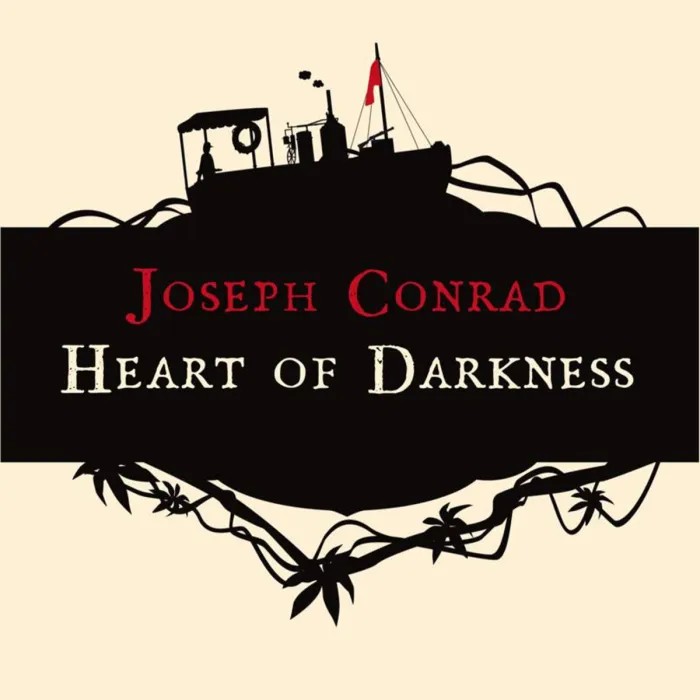
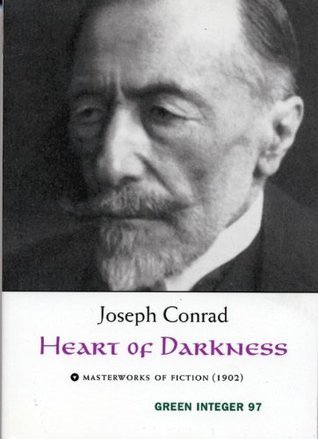
A feminist v. deconstructionist analysis of Heart of Darkness by Joseph Conrad reveals differing concepts relevant to the ideologies inherent in the worldview of the author. Because so few women are present in the text, a deconstructionist perspective is the more productive methodology for analysis; however, the few mentions of females exhibit misogynistic leanings.
Marlowe gets desperate for a job fitting his dreams and turns to a woman for help. “Then—would you believe it?—I tried the women. I…set the women to work—to get a job.” His comments reveal that he is ashamed of sinking to the level of someone who would need a woman’s help to procure employment, but her involvement works and successfully lands him the job he desires. He pays her a visit before heading for the jungle and is once again internally demeaning when she says, “You forget, dear Charlie, that the labourer is worthy of his hire.” He thinks, “It’s queer how out of touch with truth women are. They live in a world of their own… It is too beautiful altogether, and if they were to set it up it would go to pieces before the first sunset” (Conrad). Marlowe thinks women are unable to fathom the realities of his hard man’s world and create a nicer imaginary version with which to soothe their fragile nerves.
Kurtz seconds this mentality when he is quoted as saying, “Girl! What? Did I mention a girl? Oh, she is out of it—completely. They—the women, I mean—are out of it—should be out of it. We must help them to stay in that beautiful world of their own, lest ours gets worse” (Conrad). He implies that the separateness of their worlds somehow keeps the men less barbaric than they might become if the women join in on the mayhem, or perhaps holding on to the illusion that women are treasures to strive for helps the men to keep their sights on something more than the horrors of their realities. This form of sex segregation and defense of female virtue is similar to the reasoning that led to lynchings in the American South because white women needed protection (Jordan 568).
After Kurtz’s death, Marlow speaks to the girl who had to be left “out of it” and a deconstructionist lens shows a binary of illusion/reality. “’Who was not his friend who had heard him speak once?’ she was saying. ‘Yes, I know,’ I said with something like despair in my heart, but bowing my head before the faith that was in her, before that great and saving illusion that shone with an unearthly glow in the darkness…’ ‘And of all this,’ she went on mournfully, ‘of all his promise, and of all his greatness, of his generous mind, of his noble heart, nothing remains—nothing but a memory. You and I—’ ‘We shall always remember him,’ I said hastily” (Conrad). She does not realize the level of absurdity to which her words rise when speaking of Kurtz’s ability to win friends. He inspires devotion through fear and intimidation as far as the natives are concerned. She clings to the illusion that her love was a great man who was noble and generous. The meaning behind Marlowe’s insistence that he will remember Kurtz holds a completely different connotation than the mourner’s illusory memories. She mourns a man she thought she knew or knew when the man was in polite society surrounded by creature comforts and minimal moral dilemmas to face. Marlowe knew the man Kurtz became when thrust into the harsh environs of the jungle, left to discover his basest desires, with no moral arbiter to keep him in check.
A paradox arises from the different realities the two speakers experienced related to Kurtz. It is the dimension Plato invites us to analyze “of a pure becoming without measure, a veritable becoming‐mad, which never rests. It moves in both directions at once. It always eludes the present, causing future and past, more and less, too much and not enough to coincide in the simultaneity of a rebellious matter…The paradox of this pure becoming, with its capacity to elude the present, is the paradox of infinite identity” (Deleuze). This slippery reality can be traced through every scene in Heart of Darkness.
Works Cited
Conrad, Joseph. Heart of Darkness. The Project Gutenberg EBook. 2 March 2018, www.gutenberg.org/files/219/219-h/219-h.htm
Deleuze, Gilles. “What is Becoming.” Rivkin, Julie; Ryan, Michael. Literary Theory: An Anthology, 3rd edition. Wiley Blackwell.
Jordan, Emma. “Crossing the River of Blood Between Us: Lynching, Violence, Beauty, and the Paradox of Feminist History.” The Journal of Gender, Race & Justice, Georgetown University Law Center, pp.568, January 2010, scholarship.law.georgetown.edu/cgi/viewcontent.cgi?article=1117&context=facpub

 rebekahjmarshall