TRIGGER WARNING: This essay discusses misogyny, sexist language, colonial violence, racism, and references to lynching and death. These topics are examined in a literary and analytical context.
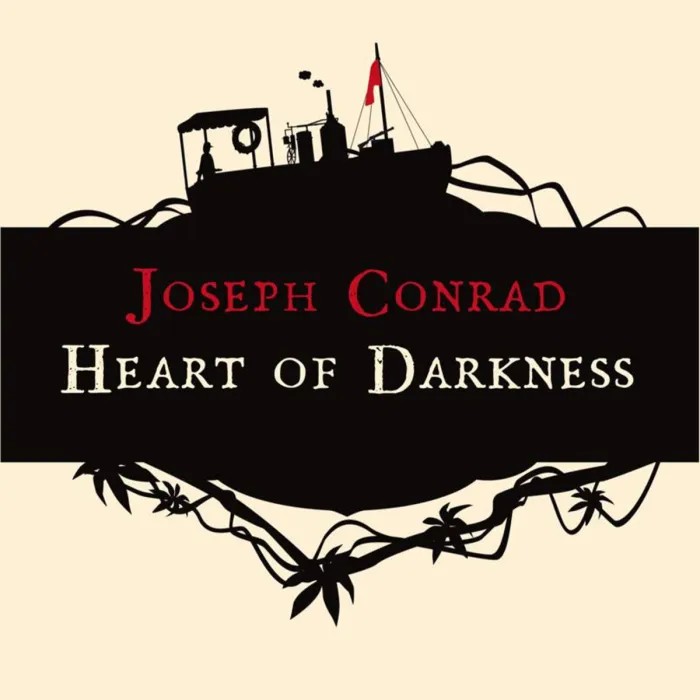
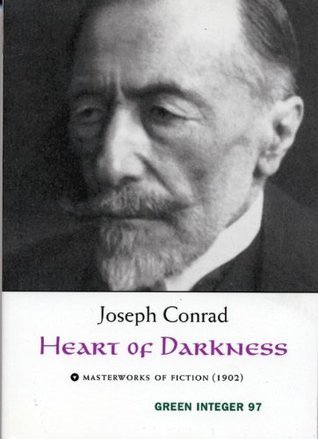
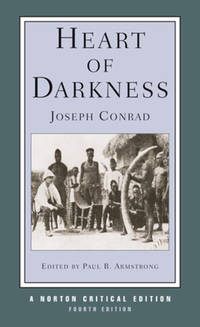
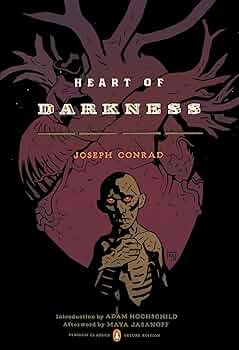
A feminist v. deconstructionist analysis of Heart of Darkness by Joseph Conrad reveals differing concepts relevant to the ideologies inherent in the worldview of the author. Because so few women are present in the text, a deconstructionist perspective is the more productive methodology for analysis; however, the few mentions of females exhibit misogynistic leanings.
Marlowe gets desperate for a job fitting his dreams and turns to a woman for help. “Then—would you believe it?—I tried the women. I…set the women to work—to get a job.” His comments reveal that he is ashamed of sinking to the level of someone who would need a woman’s help to procure employment, but her involvement works and successfully lands him the job he desires. He pays her a visit before heading for the jungle and is once again internally demeaning when she says, “You forget, dear Charlie, that the labourer is worthy of his hire.” He thinks, “It’s queer how out of touch with truth women are. They live in a world of their own… It is too beautiful altogether, and if they were to set it up it would go to pieces before the first sunset” (Conrad). Marlowe thinks women are unable to fathom the realities of his hard man’s world and create a nicer imaginary version with which to soothe their fragile nerves.
Kurtz seconds this mentality when he is quoted as saying, “Girl! What? Did I mention a girl? Oh, she is out of it—completely. They—the women, I mean—are out of it—should be out of it. We must help them to stay in that beautiful world of their own, lest ours gets worse” (Conrad). He implies that the separateness of their worlds somehow keeps the men less barbaric than they might become if the women join in on the mayhem, or perhaps holding on to the illusion that women are treasures to strive for helps the men to keep their sights on something more than the horrors of their realities. This form of sex segregation and defense of female virtue is similar to the reasoning that led to lynchings in the American South because white women needed protection (Jordan 568).
After Kurtz’s death, Marlow speaks to the girl who had to be left “out of it” and a deconstructionist lens shows a binary of illusion/reality. “’Who was not his friend who had heard him speak once?’ she was saying. ‘Yes, I know,’ I said with something like despair in my heart, but bowing my head before the faith that was in her, before that great and saving illusion that shone with an unearthly glow in the darkness…’ ‘And of all this,’ she went on mournfully, ‘of all his promise, and of all his greatness, of his generous mind, of his noble heart, nothing remains—nothing but a memory. You and I—’ ‘We shall always remember him,’ I said hastily” (Conrad). She does not realize the level of absurdity to which her words rise when speaking of Kurtz’s ability to win friends. He inspires devotion through fear and intimidation as far as the natives are concerned. She clings to the illusion that her love was a great man who was noble and generous. The meaning behind Marlowe’s insistence that he will remember Kurtz holds a completely different connotation than the mourner’s illusory memories. She mourns a man she thought she knew or knew when the man was in polite society surrounded by creature comforts and minimal moral dilemmas to face. Marlowe knew the man Kurtz became when thrust into the harsh environs of the jungle, left to discover his basest desires, with no moral arbiter to keep him in check.
A paradox arises from the different realities the two speakers experienced related to Kurtz. It is the dimension Plato invites us to analyze “of a pure becoming without measure, a veritable becoming‐mad, which never rests. It moves in both directions at once. It always eludes the present, causing future and past, more and less, too much and not enough to coincide in the simultaneity of a rebellious matter…The paradox of this pure becoming, with its capacity to elude the present, is the paradox of infinite identity” (Deleuze). This slippery reality can be traced through every scene in Heart of Darkness.
Deleuze, Gilles. “What is Becoming.” Rivkin, Julie; Ryan, Michael. Literary Theory: An Anthology, 3rd edition. Wiley Blackwell.
Jordan, Emma. “Crossing the River of Blood Between Us: Lynching, Violence, Beauty, and the Paradox of Feminist History.” The Journal of Gender, Race & Justice, Georgetown University Law Center, pp.568, January 2010, scholarship.law.georgetown.edu/cgi/viewcontent.cgi?article=1117&context=facpub
TRIGGER WARNING: This piece analyzes Heart of Darkness and includes references to colonial violence, racism, cannibalism, gender exclusion, and psychological themes. Reader discretion is advised.
A psychoanalytic reading of Joseph Conrad’s Heart of Darkness reveals the inner journey of a man immersed in the horrors of human evil. In one scene Marlowe connects with the natives who are fending off a supposed attack by creating a ruckus. “They howled and leaped, and spun, and made horrid faces; but what thrilled you was just the thought of their humanity—like yours—the thought of your remote kinship with this wild and passionate uproar. Ugly. Yes, it was ugly enough; but if you were man enough you would admit to yourself that there was in you just the faintest trace of a response to the terrible frankness of that noise, a dim suspicion of there being a meaning in it which you—you so remote from the night of first ages—could comprehend” (Conrad part II). He admits that somewhere within his subconscious there is a sense of recognition of the self, a primordial collective consciousness (Ivonin). When he realizes that the cannibals in his employ are probably getting hungry, he looks at the people through their eyes. “I perceived—in a new light, as it were—how unwholesome the pilgrims looked, and I hoped, yes, I positively hoped, that my aspect was not so—what shall I say?—so—unappetizing: a touch of fantastic vanity which fitted well with the dream-sensation that pervaded all my days at that time” (Conrad part II). Cannibalism falls into the category of taboos in western culture that may be forbidden partly because “we have a deep and primitive desire to do it” (Schutt). It is interesting that Marlowe is hoping he looks more appetizing, perhaps revealing an inner need to be desired that has not been fulfilled as some sort of displacement mechanism (Freud).
A feminist reading of these same passages reveals completely different possibilities. When Marlowe hears the natives howling in the jungle, he does not even conceive of the fact that women might be a part of that great cacophony. It is a plea from one man to another, a negotiation between men. From Marlowe’s patriarchal perspective, no women would be a part of that age-old discussion because he envisions women on the sidelines in their huts caring for their children. The reality is that any of those cries could be resounding from women or men; he has no way of knowing (Tyson). The “wild and passionate uproar” is as much a female cry as male (Conrad part II). As concerns the cannibals, women are once again left out of the discussion, but Marlowe has been away from any female sexual attention for a long time at this point. Perhaps any attention would be welcome, even from male cannibals. It could be that Marlowe is subconsciously forgetting gender assignments for a moment and thinking simply as a human (Rich). He may not even realize how desperately he wishes for someone to want him in this terrifying jungle.
It seems on a cursory reading that a psychoanalytic reading would reveal the most information because Marlowe is sharing his inner thoughts and opening the door to deep digging into his psyche. There is little mention of women in the piece, so most of the feminist critique will come from a place of absence. However, what little is said of women is prime for analysis because Marlowe’s observations are so clearly dismissive and fearful of women in a way that would be interesting to flay.
“Girl” by Jamaica Kincaid hints at the character of a caregiver to a young woman. In her attempts to teach the girl the ways of womanhood, she shows herself to be old-fashioned, strict in principle, and set in her views of gender roles. These qualities demonstrate her preferences. Little details in her lecturing show glimpses of her past like the fact that she knows how to grow crops, sew clothes, and run a household. She is savvy about interactions with men, has loved, has fallen out of love, and has given up on love. These qualities demonstrate her history. Her flaw is her suspicion of the girl. She cannot imagine that the girl is not making all the same mistakes she made. And with so much emphasis on avoiding the appearance of impropriety, it is surprising that she has possibly had an abortion (Kincaid).
The unique writing style of this piece develops the character in a manner that only gives a slice of information and entirely through dialogue. The reader must infer character traits and piece her story together with clues from her speech. This method does not permit as much character development as one might prefer and provides no physical description of the character. Enemies are vaguely hinted at as men who have bullied her and fake smiles given to people she doesn’t like. The story leaves one wanting more with no means of satisfaction. When I write characters, I hope to capture the voice and traits as well as Kincaid, but provide more physical descriptions and consider alliances during development.
Bonus Note: The woman accuses the girl of singing Benna in Sunday School and I laughed so hard when I looked it up on line. “Sexually suggestive, call and repeat style, telling scandalous gossip”…definitely not appropriate Sunday School music, but so funny to picture either one of them giving it a shot. https://www.youtube.com/watch?v=UOIlA9s6QxE
Works Cited
Kincaid, Jamaica. “Girl.” At the Bottom of the River, Farrar Straus Giroux, 1983, pp. 3-5.
TRIGGER WARNING: This essay discusses mental health (including OCD), grief, emotional distress, strong language, and social inequality as they appear in John Green’s novels.
Authors of young adult fiction have the difficult task of creating characters, situations, and dialogue that teenagers will believe. If a novel’s plot is boring, the characters lack development, or the dialogue sounds fake, teenagers are quick to toss the book aside and look for a different author. However, once an author captures their hearts, young adults create a loyal fan-base who will read every book the writer produces and pass them among friends like contraband. John Green has successfully built just such a fan base. An analysis of three of his novels reveals the techniques he uses to create a reality that young adults will believe using language that is authentic to their worldview. Looking for Alaska is one of Green’s earliest books, Turtles All The Way Down one of his newest, and An Abundance of Katherines one of his most unique. Each contains myriad examples of masterful writing to which teenagers connect.
One method is invented vocabulary through methods of functional shifting, combining, reanalysis, clipping, and suffixing. Another is changing syntax by manipulating the expected word order to indicate southern diction, English as a second language, and creative thinking. In the area of semantics, Green creates meaning using a variety of registers within different specializations, word choices with teen-geared connotations, and vague wording to leave meaning ambiguous at times when the characters are being mysterious. He also uses word choices to indicate various socio-economic classes of people and audience-specific dialogue that incorporates youthful diction and slang. John Green utilizes invented vocabulary, syntax, and semantic strategies in his novels to successfully appeal to young adults.
The use of invented vocabulary speaks to youth because people in this stage challenge rules and push boundaries, a sort of “verbal revolution” to quote Walt Whitman (Curzan 120). Green capitalizes on this invention of words to make young adults feel connected to his writing. In Looking for Alaska, Miles says he has come to boarding school “looking for a Great Perhaps” (Alaska 219). Changing perhaps from its usual part of speech as an adverb to a proper noun is a creative way of connecting the main character to a sense of adventure as he begins his search for meaning in life. At another point, Miles says he uses “the friend card” which is a popular phrase taking the noun friend and shifting it to use as an adjective (Alaska 77). Then Alaska calls Miles a “perv”, a clipping of the word pervert (Alaska 41). At the boarding school, Alaska invents the name of their favorite meal “a deep-fried bean burrito, the bufriedo” by combining the words burrito, fried, and beans. Miles goes on to talk about “savoring the bean-y crunch” and creates the word bean-y by suffixing or adding a y to the end of the word (Alaska 22). Some of the most entertaining inventions are the reanalysis of common sayings. At one point when discussing the destruction of Alaska’s books that she bought at garage sales, Miles says, “Ashes to Ashes. Garage sale to garage sale,” rather than stating the oft-quoted ashes to ashes; dust to dust (Alaska 154). At another point Miles mixes the sayings switch conversations and change horses midstream using reanalysis to claim that Alaska tended to “switch conversational horses midstream” (Alaska 53).
John Green plays with syntax in An Abundance of Katherines to show the speech patterns of an elderly man named Starnes from Tennessee who was born and raised in the country. He says, “Hollis…took good care of us every one” (Katherines 81). The usual word order for Standard English is took good care of every one of us. Placing the indefinite pronouns at the end of the sentence is more common among southern dialects of years past. Green also uses changes in word order to indicate broken English. Hassan pretends he is French and tells some girls that Colin has Tourette’s by saying, “He has the disease with the talking…I do not know how you say in English” (Katherines 52). He is trying to be funny but characteristic of English language learners who sometimes rearrange words and leave out words necessary to form complete sentences.
Green also permits characters to order their words interestingly to indicate intellect and creative/poetic thinking. In Turtles All the Way Down, Davis is a creative poet and writes with unique syntax for a teenager. One computer entry reads, “My mother’s footsteps/were so quiet/I barely heard her leave.” Placing the footsteps of his mother at the beginning of the poem creates more poignant imagery at the end when the reader realizes the mother is no longer around. Another says, “Gravity differs from affection: only one is constant” (Turtles 189). This quote could be put simply, Gravity is constant, but affection is fickle. Davis’s wording sets up a contrast that is meant to be pondered prior to providing an open-ended answer following the colon to ponder some more. In another entry, Davis types in response to Shakespeare’s quote Doubtthat the sun doth move, “It dothn’t move…not around us…Who knows what lies I believe…Who knows what we shouldn’t doubt” (Turtles 207-208). This could be written, Our faith may be unfounded. Things we doubt might be true. His method is more creative and permits the reader to play with the words, mulling them over for meaning.
Linguistic social markers are another technique Green uses to indicate different classes of people. In Turtles All the Way Down when a lawyer for a wealthy family is speaking, his diction is crisp and word choice selective. “Your concern is admirable, Ms. Holmes, but I assure you that everything is cared for…Do you have any other questions of pertinence to your situation” (Turtles 127). The attorney says pertinence which could be considered within his legal register of terminology and is a variation as he could have just as easily said simpler synonyms for a teenage audience (he was speaking to a teenager at the time.) Contrast his speech with Daisy’s. She is a poor teenager who hustles to get anything she wants and fills her sentences with slang, cursing, and different grammatical structures. Her vernacular is a stereotype of underprivileged teenagers. “You got a car and a laptop and all that shit, and you think it’s natural. You think it’s just normal to have a house with your own room and a mom who helps with your homework” (Turtles 216).
When demonstrating the intellect of a psychiatrist, Green gives Dr. Singh the ability to recall quotes from a philosopher in Latin. This ability in speech is a social marker of being well-educated in American society. “A fuller formation of Descartes’s philosophy would be Dubito, ergo cogito, ergo sum. I doubt, therefore I think, therefore I am” (Turtles 166). Along the same vein, when a teenager from a rich family is discussing a painting in his mansion, he shortens the name of the artist (Kerry James Marshall) in question to initials. This familiarity with an artist’s work implies wealth and privilege. “I really love KJM’s work” (Turtles 100). He also invites his friends to watch a movie in his home theater. He uses a word most teenagers have never uttered in the context of a home service. “When I was a kid, we had to have a projectionist come out, but now it’s all digital” (Turtles 98). These are indicators that his social experiences are quite different from the other teenagers in the book. In An Abundance of Katherines Hassan’s humor and intellect are demonstrated in the following exchange when he is invited to say “grace” in a Christian home, despite the fact that he is Muslim:
“Hassan cleared his throat. Bismillah. Then he picked up his fork.That’s it? Hollis wondered. That’s it. We are a terse people. Terse, and also hungry” (Katherines 62).
Average teenagers do not tend to use a word like terse. A more common phrase might be we don’t talk a lot.
More examples of slang and teenage diction in Green’s work permit young adult readers to connect with the characters. In An Abundance of Katherines, Hassan says, “Sup?” instead of What is up? (Katherines 128). Lindsey says, “I’m a’ight,” instead of I am alright (Katherines 99). At one point when Colin is being awakened by a rooster crowing Cock-a-doodle-do, Colin responds in typical annoyance. His witty response; however, is less than typical. “Cock-a-doodle-don’t, Motherfugger” (Katherines 77). The connotations of his invented words are obviously negative. In Looking for Alaska Takumi refers to the authorities with the slang term pig that is sometimes used in reference to the police. “The pigs can’t stop the fox” (Alaska 106). The group of teens make up names for each other, their cars, and different locations as young people are known to do. They call McDonald’s “McInedible” (Alaska 76). The leader of their group is called The Colonel, the authority figure who catches them and has the power to expel them is called The Eagle, and the skinny main character is ironically called Pudge. Green uses these name choices to show the way young people play with language and make it their own.
One character in Looking for Alaska named Alaska is described as moody and is meant to be mysterious, her motivations and goals unknown. The reader is left trying to solve her like a puzzle. The 1st person limited narrator Miles makes the interesting point about her, “…the way her mouth curled up on the right side all the time, like she was preparing to smirk, like she’d mastered the right half of the Mona Lisa’s inimitable smile…” (Alaska 30). He alludes to a mesmerizing painting, the subject of which has created generations to guess what that smile is about. The narrator is also perplexed in another scene by Alaska’s mood swings and thinks, “How could the girl who told that joke three hours before become a sobbing mess” (Alaska 86)? During a game, Alaska is supposed to describe the best day of her life. “Best day of my life was January 9, 1997. I was eight years old, and my mom and I went to the zoo on a class trip” (Alaska 115). When a friend tries to get to know her better and find out how she is, Alaska responds, “I’m really not up for questions that start with how, when, where, why, or what” (Alaska 68). When confronted by a confused friend who says, “I don’t get you,” she responds with, “You never get me. That’s the whole point” (Alaska 55). Green uses vague descriptions and non-committal vocabulary to keep the Alaska character a mystery for the other characters and the reader.
The ability to create realistic characters who can play with language as they speak with authentic teen dialogue and about topics young adults care about is what makes John Green’s books relatable. Readers are drawn into the minds and hearts of each person and the relationships they build while they struggle to make sense of the chaos of life. The universal questions tackled by Green are balanced with humor and enough teenage nonsense to keep the books from seeming pretentious. Miles says at the end of Looking for Alaska “I came here looking for the Great Perhaps…maybe the afterlife is just something we made up to ease the pain of loss…Thomas Edison’s last words were: It’s very beautiful over there. I don’t know where there is, but I believe it’s somewhere, and I hope it’s beautiful” (Alaska 220-221). The invented vocabulary, syntax and semantic choices John Green uses in his novels combine to create works that appeal to young adult readers due to authenticity and the ability to connect to teenage concerns.
Works Cited
Curzan, Anne and Michael P. Adams. How English works : a linguistic introduction – 3rd ed. p.cm. Glenview, IL: Pearson Education, Inc., 2012.
Green, John. An Abundance of Katherines. Dutton and Speak, 2006.
Green, John. Looking For Alaska. Dutton Juvenile, 2005.
Green, John. Turtles All The Way Down. Dutton Penguin, 2017.
Hurst, Mary Jane. The VOICE of the CHILD in American Literature: Linguistic Approaches to Fictional Child Language. The University Press of Kentucky, 1990.
Mohamed, Dr. Theresa. “Learning Modules”, Eng-550-Q4588 Grad Studies in English Lang 20TW4, Southern New Hampshire University, 2020, learn.snhu.edu/d2l/home/398756.
Nilsen, Aleen Pace; Donelson, Kenneth L. Literature for Today’s Young Adults, 8th Edition. Pearson, 2009.
















 rebekahjmarshall