
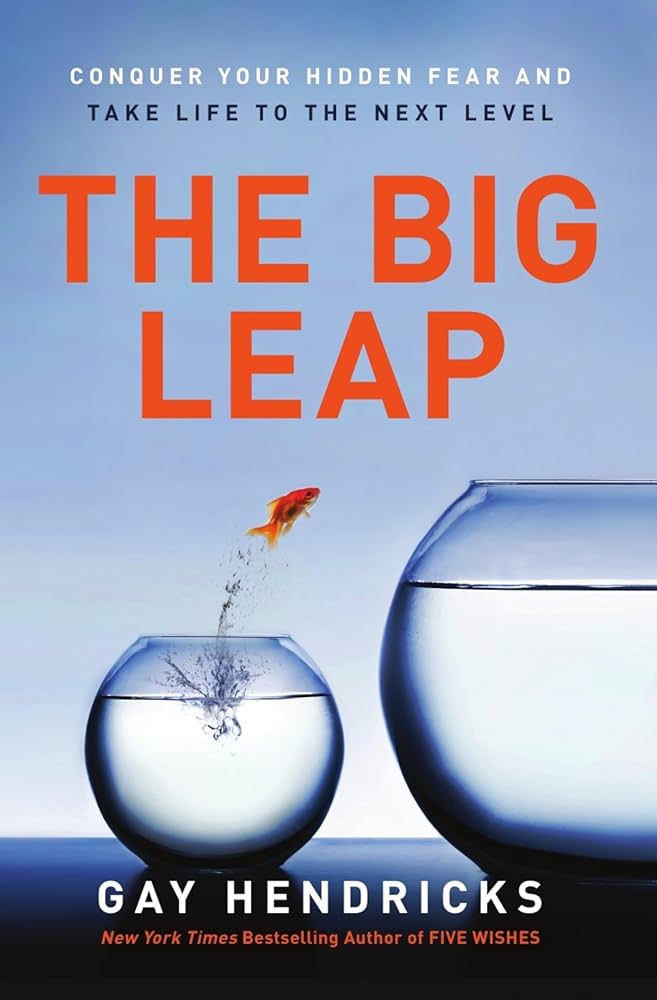
According to Gay Hendricks, PH.D., the only problem we need to solve is the Upper Limit Problem. He believes all avenues of discontent in life flow from the ways in which we limit ourselves or allow ourselves to be limited without breaking into our Zones of Genius. He posits that a universal human trait is the tendency to sabotage ourselves and others when artificial upper limits are exceeded.
The barriers we and society put in place are often unconsciously constructed by our upbringing, religion, politics, and education, but we buy into them and keep the scaffolding exactly where it’s always been. Phrases like, “She’s getting above her raising,” “He thinks he’s better than us,” “They aim too high,” “She’s greedy to want more,” “He needs to be brought down a peg,” “They didn’t do anything to earn that position,” etc. These aren’t phrases from his book, but common enough phrases in society that his hypothesis feels like commentary on most communities I know.
Whatever the complex social issues surrounding the lack of support for growth, he suggests there are ways to push beyond and live our best lives while still loving and supporting others. Instead of having a mindset of lack—lack of time, lack of money, lack of energy, lack of ideas, lack of community—we recognize that we are the creators of our realities and do our utmost to tap into our own genius.
The first step is to recognize the barriers and make conscious decisions to overcome them:
1. We are fundamentally flawed and don’t deserve success.
2. We are disloyal to expand beyond the expected norms of our families of origin.
3. We are a burden to others.
4. We must dim our brilliance, so we don’t outshine others.
Once we have expelled these faulty concepts from our thinking, we must find what our gifts are, find ways to express them, dislodge the notion that time is not on our side, and bring our best selves to the world. Only then will we be fulfilled in our relationships, our careers, our finances, and our spirituality.
I am intrigued, especially by his idea that time comes from within us, or at least the concept of time. It is only perception of time that makes each moment feel gruesome or fabulous. I’m sure he would agree that this concept does not apply in all circumstances because there are situations outside of our control and factors in this world that force time constraints on people against their will.
Disclaimers would have been appreciated that some of these deep concepts might not apply to people in the midst of horrific situations beyond their power, like war, extreme poverty, abuse, trauma, and other life-altering dilemmas that can create struggle. But given basic needs met, semi-peaceful conditions, and non-traumatic circumstances, his ideas are worth considering.
I for one commit to recognizing language of lack related to money, time, energy, etc. Instead of saying, “I can’t afford that,” or “I don’t have money for that,” I want to say, “I can buy that if I save for it,” or “I’m choosing to spend my money on something else.” It is a choice to reframe my language. Instead of saying, “I don’t have time to do that,” or “I wish there were more hours in the day,” I want to say, “I’m choosing to spend my time on other priorities,” or “I have plenty of time to do everything I am meant to do today.” The one I need to work the most on is energy. With chronic health issues, I am very aware of my energy levels and am known to complain about lack of energy. But Instead of saying, “I don’t have the energy to do this,” or “I wish I had more energy for x,y,z,” I want to say, “I have enough energy to do these things today, so I am going to prioritize them,” or “I have exactly the amount of energy I need and then I will take a nap to recharge.”
This self-development journey is fascinating. However much I learn, I always discover something more to expand my growth. The Big Leap is absolutely worth the read, but I recommend tackling it when things are at a fairly stable place in life. I would not have been willing to hear his ideas when I was at the apex of pain, in the middle of my divorce, during a crisis when my kids were teenagers, or when I was working 7 days a week to survive with no end in sight. These are concepts I am willing to consider with all bases covered and the privilege and opportunity to navel gaze and ponder things like expanding into my zone of genius.
Hendricks, Gay. The Big Leap, Harper Collins, 2009.
 rebekahjmarshall