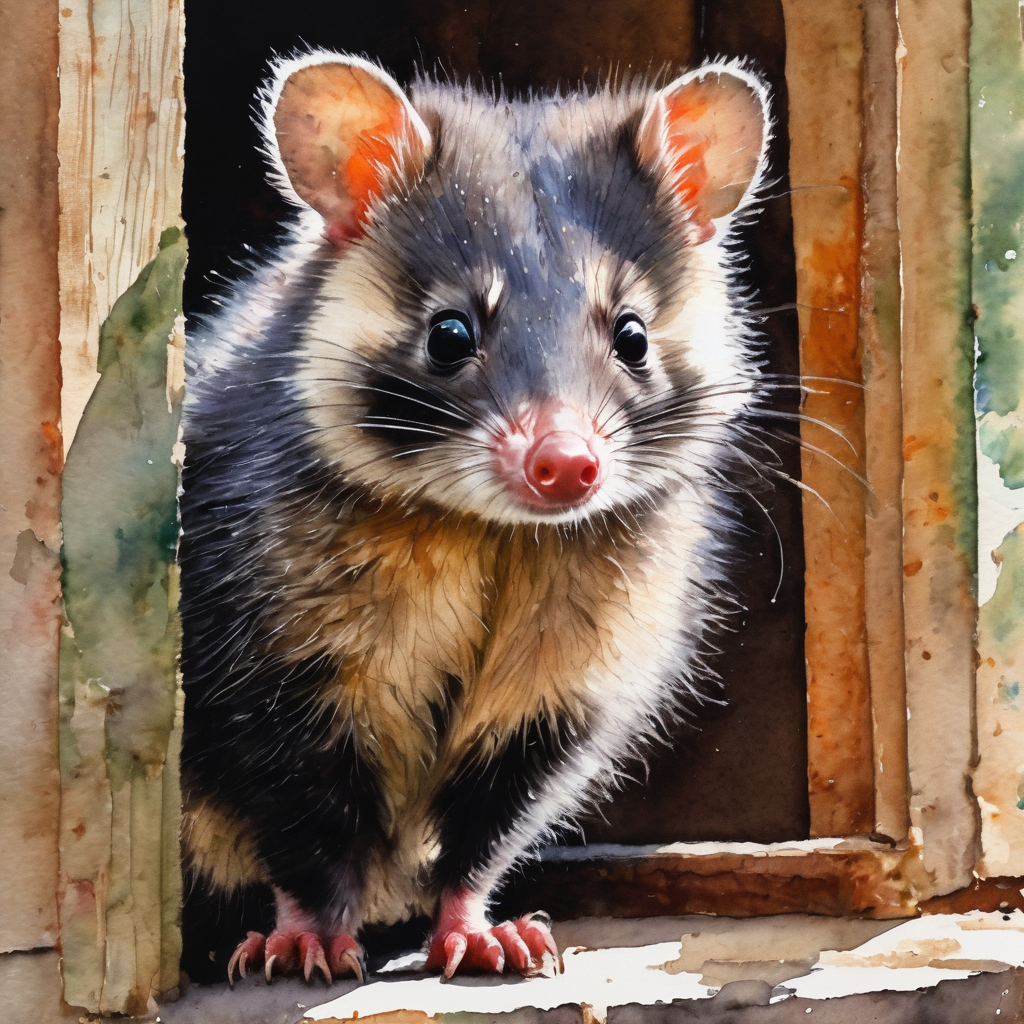
The dogs alerted me to an intruder they captured in the backyard this morning. One of my dogs grabbed the joey when I went to pick him up, but then released him on command and seemed perplexed that I wasn’t pleased with their efforts. His tiny body fit in the palm of my hand; it seemed rigor mortis had already set in. Then I realized he was still slightly warm, and was that a slight heartbeat I felt? That smart baby opossum was playing possum, and it probably saved his life. There I went down a rabbit hole on the internet, or should I say opossum hole? What do they drink, eat, need, and how do I begin to care for a pouchless baby? Darkness, quiet, snacks, warmth, soft towels, and a secure cardboard box. The dogs are very confused as to why I’m caring for the enemy, but keep sniffing the odd creature curiously.
@Home Studio – 97th poem of the year
Runner ups for the Opossum photos to accompany my poem:
Contentment is pajamas and a fan blowing straight on my bare shoulders, flickering candlelight, endless streaming of my favorite shows as long as I feel like watching them, sweet tea, lines of poetry, a chapter of a good novel, a cool spring breeze that rustles the tranquil curtains, salt and pepper kettle chips, the clickity clack of my keyboard when my fingers know what they want to type, my husband hobbying a few feet away from me, the dogs playing outside, the cats sleeping nearby, my kids and grandkids off doing their own things, and the complete absence of pain or discomfort.
@Home Studio – 96th poem of the year
Runner ups for the Contentment photos to accompany my poem:
I just woke up from nap number 8,943. My grandson was supposed to wake me up when my alarm went off on my phone he was borrowing to play his video games. He did not do his job, and I slept until fully rested for once. I had so much energy that I was able to clean out the cupboard under the stairs and organize the wrapping paper and vacuum the floor and sort the donations and more. I think I’m ready for nap number 8,944.
@Home Studio – 95th poem of the year
Runner ups for the Sleep photos to accompany my poem:
There’s nothing more refreshing than a cold glass of sweet iced tea when a body’s hot as blazes. My Mema insisted on unsweet, so we had to agree to disagree. Once, when I was up in Detroit, someone offered to make me a glass and poured powder into liquid; it was instant, they said. I had never heard of such an innovation and was baffled by the dehydrated concoction. Well, how do you make it? they asked, and were equally perplexed by my method of brewing a pot of tea, only to pour it over ice. The strange culture clash was more unsettling than yous guys instead of y’all, playing football in the snow, drinking milk out of bags, and eating ketchup chips. At least Mema and I agreed on the starting point for our tea with a fresh tea bag, a boiling pot of water, and a few minutes of conversation while you wait for it to steep. No need to rush. Take your time. Sit a spell.
Pain is not truth; it is simply what we must endure to find truth. This body we are experiencing is an embroidered flower, merely representative, beautiful, but artificial, not the full living embodiment of the flower. Thoughts are guests checking in and out of our quaint inn, just as this form is temporary, a visitor who will travel on. We take death so personally, spend a lifetime preventing loss, projecting fear from our own ignorance, denying our own place in the circle. It is only possible to lose what is not real. Even if we think we’ve lost everything, what remains is what is real.
@Home Studio – 93rd poem of the year
Chopra, Deepak. The Way of the Wizard: Twenty Spiritual Lessons for Creating the Life You Want. New York, United States of America, Harmony Books, 1995, pp. 96-101.
Runner ups for the circle of life photos to accompany my poem:
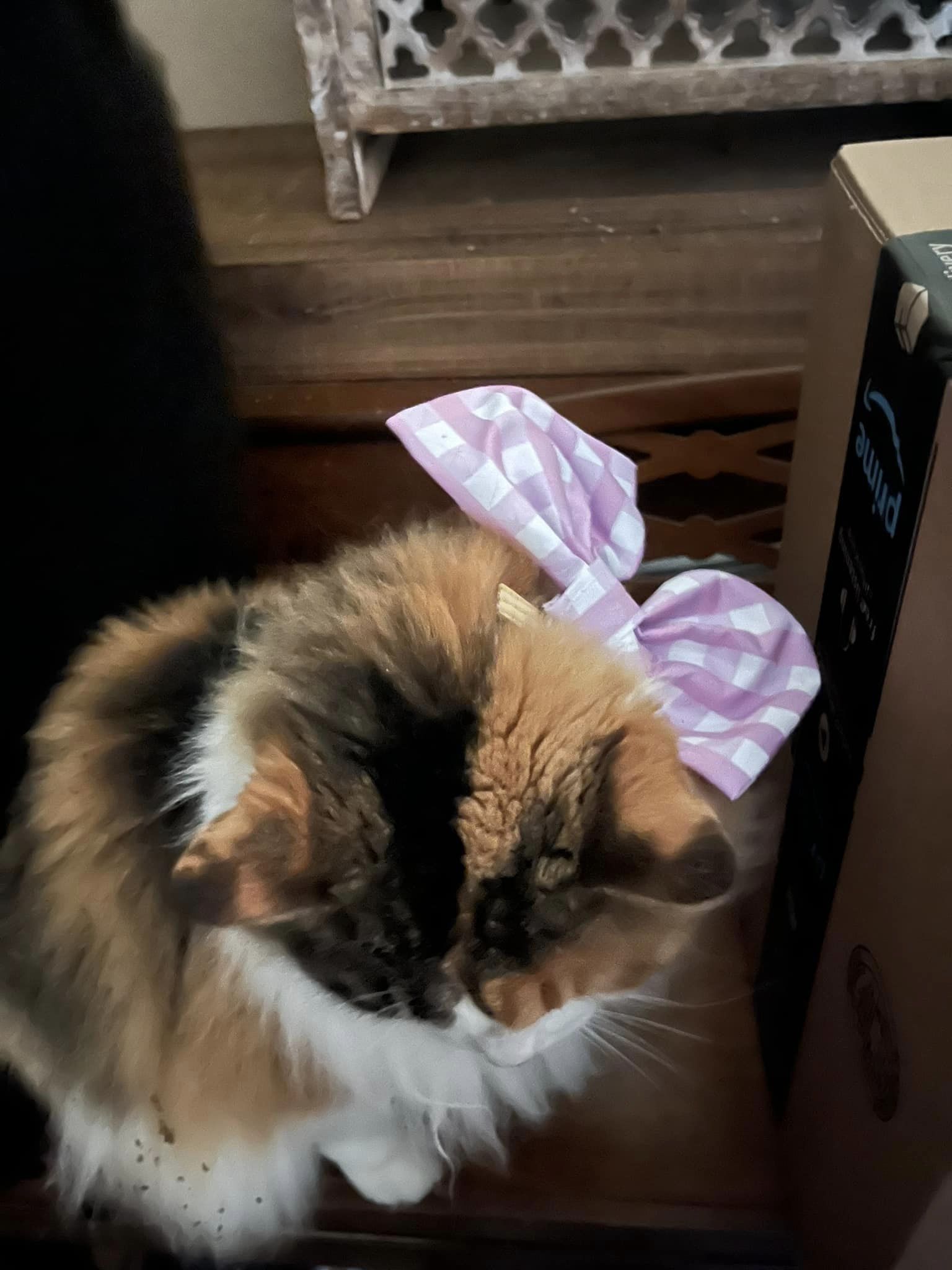
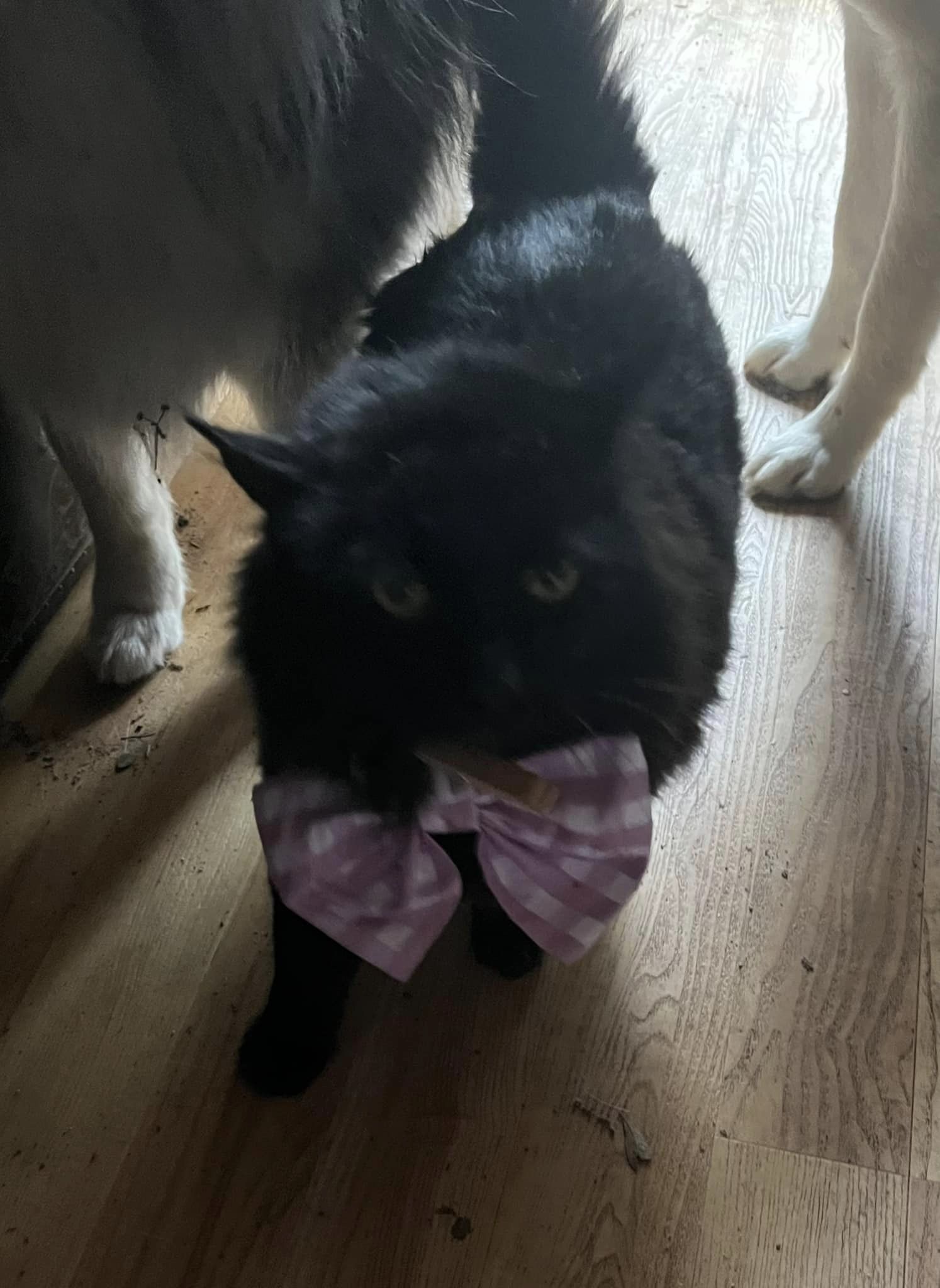
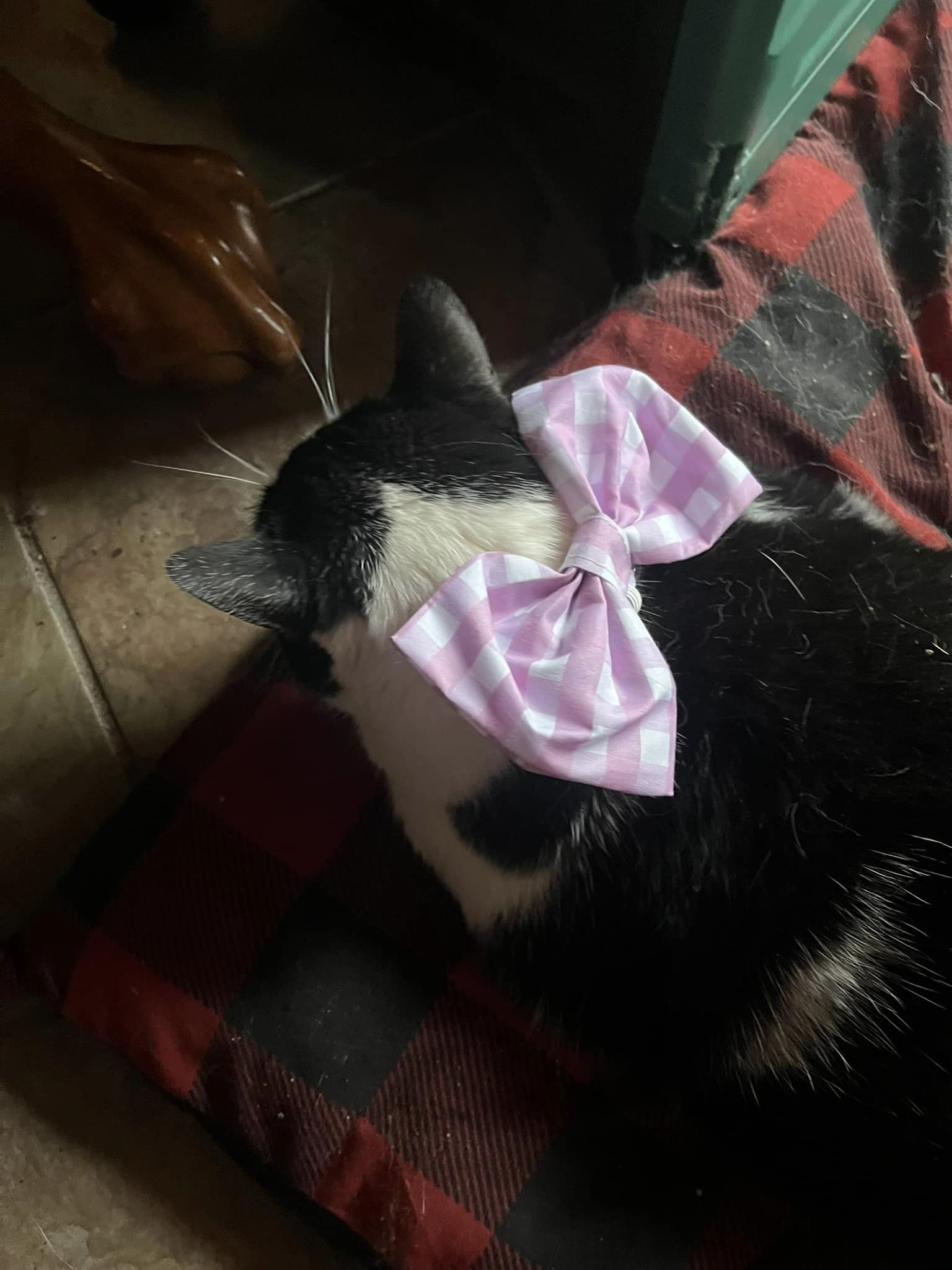
Beauty wearing an Easter bow.Kenji wearing an Easter tie.Kage wearing an Easter tie.Aiko wearing an Easter bow.Chika wearing an Easter bow.
Kenji was a gentleman, ready to cooperate for the camera, looking debonair. Aiko said, no thank you, but endured with a put- upon dejected expression. Kage was an expert at striking a pose, seemed familiar with formal attire. Beauty was immediately disgruntled and vexed, gave me one brief chance. I didn’t dare warn Chika, simply snuck a photo before she could even react. The boys definitely won the day with their professional behavior. The girls were divas whose attitudes left little to be desired, as expected.
English pagans gave us the name of the celebration Easter from their goddess Eostre. Germans gave us the egg-laying bunny, the cutest addition, in my opinion. Jews gave us the lamb and the traditions of Passover to intertwine. Christians gave us The Lamb to make it all about. The Easter lilies, we took from Japan, sometime after WWI. An Ottoman Sultan’s sweet tooth may have brought future jellybeans in the form of Turkish delight. A Russian invented Peeps in Bethlehem, Pennsylvania. New Yorkers started the Easter Parade, strolling down Fifth Avenue in their spring fashions after church. In Malta, they carry Mary through the streets. In Ireland, they eat a special breakfast. In Spain, they celebrate for an entire week. In Italy, they eat bread shaped like a dove. In the Vatican, the Pope gives a blessing. In Australia, Easter Bilbies are all the rage. In The United Kingdom, you must have hot cross buns. In my house, it’s a Cadbury Cream Egg. All over the world, through time and place, may your Easter be blessed by family and good fortune.
@Home Studio – 91st poem of the year
Runner ups for the AI hands photos to accompany my poem:
“God made this world, so it must be interesting enough to keep His attention. If you find things growing tired or stale or predictable, perhaps it is you who have lost the capacity to be interested.” Merlin-Deepak Chopra’s The Way of the Wizard
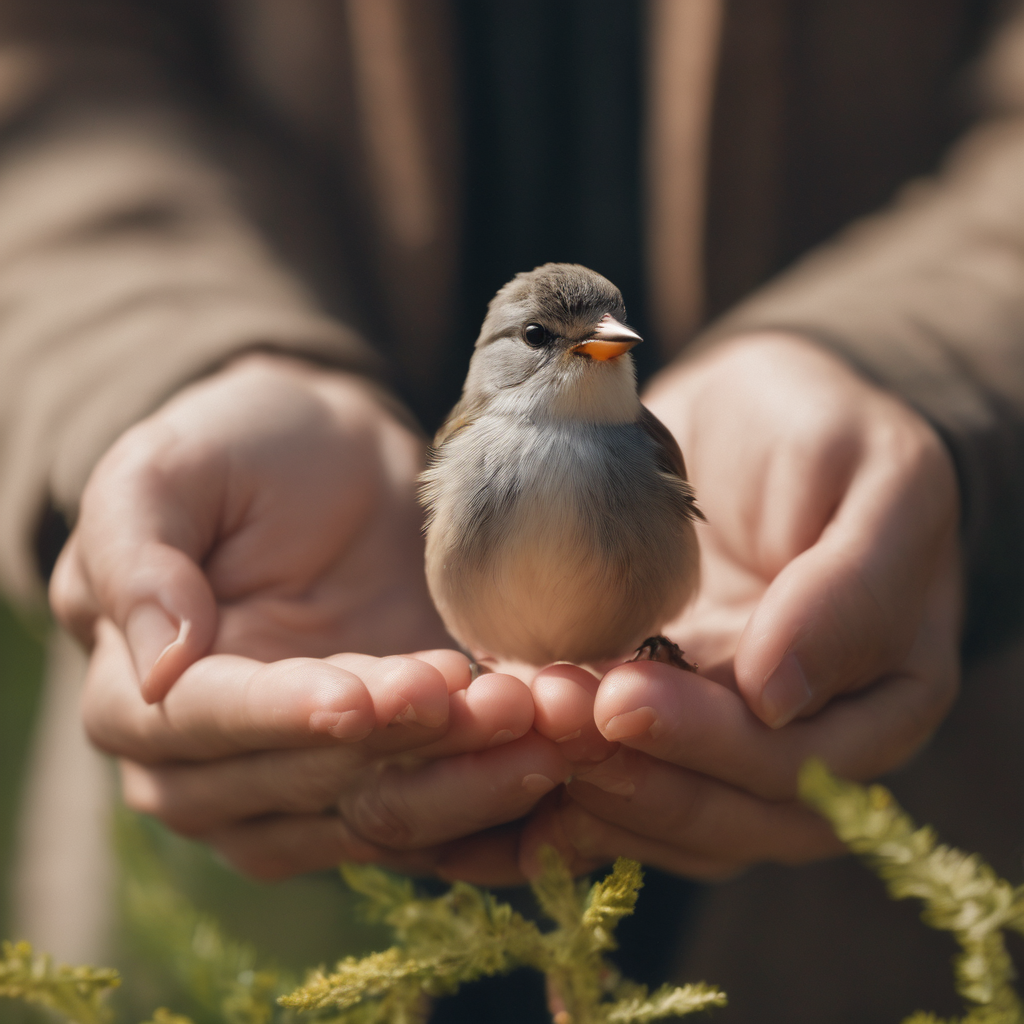
This shadow world we grope through in darkness must be illuminated inwardly to see the real. Once we know something to be true and bind the experience with the label of words, the trap has sprung. Reality is the trembling of a delicate bird we have caught, its heart thumping in our hands like a quivering reed, who will perish if we hold it too long. To go beyond the frontier of the known, we must “forget everything and anticipate nothing.” Only then will we pierce the boundary of perception that challenges our familiarity with our limitations, reveal spaces enmeshed in our everyday awareness that are nuances, textures, aromas of beyond. The unknown will beckon us from our shadow prisons, and we will fly away, release by our own hands.
@Home Studio – 90th poem of the year
Chopra, Deepak. The Way of the Wizard: Twenty Spiritual Lessons for Creating the Life You Want. New York, United States of America, Harmony Books, 1995, pp. 90-95.
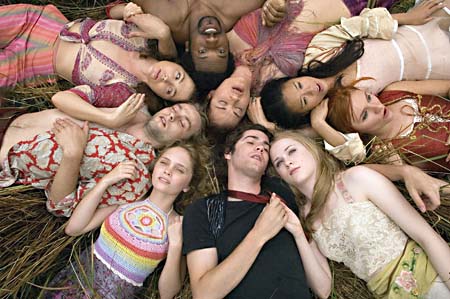
Actors (clockwise from top C) Martin Luther McCoy, Dana Fuchs, T.V. Carpio, Ekaterina Sknavina, Evan Rachel Wood, Jim Sturgess, Kiva Dawson, Joe Anderson and Halley Wegryn Gross are shown in a scene from the film “Across The Universe” in this undated publicity photograph. https://images.app.goo.gl/VGx3qPKwxrQnu3xp6
i’m just a Girl standing here wanting you to Hold Me Tight so i can give you All My Loving. I Want to Hold Your Hand. though i endure tough times With a Little Help From my Friends, It Won’t Be Long before i need more than they can give, but I’ve Just Seen a Face that i can never forget, and that is saying a lot for me. i pray that god will Let It Be our destiny that we will Come Together forever, and if we ever get married, Why Don’t We Do It in the Rain? If I Fell, would you catch me? I Want You to be the one who always catches me, not the one who says, “She’s So Heavy”, and shirks the hard parts of love. Dear Prudence will be our saving grace, for our future will never lack with us in it. we’ll be Flying high the Blue Jay Way over the rainbow and off to neverland where I Am the Walrus and you are the Being for the Benefit of Mr. Kite because you make my heart soar. Something you said to me changed my perspective forever, Oh! Darling. you loved me as i was, freckles and paleness, green-eyed simplicity, and Strawberry Fields Forever. it was a Revolution to be loved for myself and celebrated for my curves. you love me when i suffer, and While My Guitar Gently Weeps, you hold and comfort me, transporting my grief Across the Universe. you love me when my anger has turned our world Helter Skelter and i have forgotten Happiness is a Warm Gun aimed at a Blackbird the only way to handle strife? no, you have shown me that it’s ok to walk away, to pause, to let things simmer down, then say Hey Jude-iciously discuss our differences. Don’t Let Me Down, my love. don’t ever become someone other than who you are. whoever said, All You Need Is Love, never got a divorce. you also need the right person, a person who makes you feel like Lucy in the Sky with Diamonds when things are rough and you feel like lana in the dirt with slime.
@Home Studio – 89th poem of the year
Todd, Suzanne., et al. Across the Universe Widescreen., Sony Pictures Home Entertainment, 2009.
Hadassah’s fate was sealed by her beauty, to become queen of the Persians and Medes. Though Jewish blood ran through her veins, Ahasuerus supplied all her needs.
She was put in place to save her people from Haman, a vindictive and hateful man who wanted to kill her entire race with a conniving and evil master plan.
By purim’s luck, the date was set to exterminate every Jew in the land, but Esther’s favor with the king bought grace, which allowed her people to take a stand.
And on that day so long ago when soldiers attacked the Jews, they were ready with weapons to defend themselves thanks to the king’s brave Jewish muse.

























 rebekahjmarshall