Tag Archives: parenting

Healing the Whole Person – in Leslie Marmon Silko’s Ceremony

TRIGGER WARNING: This essay contains discussion of war trauma, PTSD, death, violence, alcohol abuse, and the psychological and cultural impacts of colonial oppression.

Introduction

Leslie Marmon Silko’s Ceremony follows the healing journey of a man named Tayo who has been devasted by a lifetime of abuse, neglect, and discrimination, and is now a surviving WWII prisoner of war. Silko addresses an important idea about healing that can be applied to many suffering from trauma. People need healing that touches mind, body, soul, relationships, nature, and society. Each strand is like a string of a spider web. Navajo tradition teaches that the world was created in part by a spider spinning a web of thoughts into existence. Tayo’s web strands become entangled due to evil influences and must be carefully untangled. Silko creates a variety of characters who help Tayo along his journey and is asserting that there is no one right way to heal. Tayo must reject the techniques that do not work and continue to search for methods that will bring peace, healing, and wholeness to his life. Integral to his healing will be the recognition of archetypes necessary to unify his self.

Literature Review

Many scholars have addressed different aspects of healing in Silko’s Ceremony, including Kristin Czarnecki’s focus on psychological healing in “Melted Flesh and Tangled Threads…” The trauma of being orphaned, mistreated for his mixed heritage, confused about his loyalty and pride in being Native American when others around are ashamed, and suffering from PTSD after returning home from WWII where he saw his cousin killed are carefully addressed in this piece (Czarnecki). Jude Todd addresses the physical healing Tayo must experience in his essay “Knotted Bellies and Fragile Webs…” Though the illness cannot be explained, it is very real for the protagonist. “Tayo’s ailment…he vomits repeatedly…if he continues this way he will die…”(Todd). Others focus on the spiritual/soul healing that needs to happen for Tayo’s health including Anthony Obst’s “Ceremony Found…” (Obst) and Jin Man Jeong’s “How and What to Recollect…” (Jeong). Gloria Bird explains that Christianity does not work for Tayo in her essay “Towards a Decolonization” (Bird). And others focus on the relationships that must be strengthened or severed, depending on how healthy they are to Tayo. Kurt Caswell addresses those that need to be released in “The Totem Meal…” (Caswell) and Jeong points out the people that should be remembered and embraced (Jeong). Still others focus in on the need to heal the land and claim a rightful place in society that is not subservient to colonial influences. Aaron Derosa’s “Cultural Trauma” (Derosa), Ana Brigido-Corachan’s “Things which don’t grow…” (Brigido), and Martin Premoli’s “His sickness…” (Premoli) are a few that analyze these aspects of healing that are larger than any one individual person. With so many elements necessary for Tayo’s healing, it is clear that there is no one right way to achieve that end. He must search and persevere through as many modalities as necessary until he finds the help and healing he needs. I will also show that part of that process is uncovering the conscious and subconscious archetypes present in his psyche so that he can unify his self.

Theoretical Model

The healing journey Tayo experiences can be viewed through a psychoanalytic lens due to the multiple layers of collective unconscious that he must sift through to find the images that work for him. Carl Jung theorizes that people wear a mask that is an outward representation of self, but must grapple with the shadow that is the inner darker self. Jung’s theories focus on myth, religion, and ritual as well as archetypes that for Tayo show up as people and creatures from his cultural stories. It is only by healing and unifying the disparate parts of himself that Tayo can become whole again and be a true self, which is the term Jung uses to define a whole, healthy human being.

Archetypes are like prototypes or symbols that represent common ways of thinking, behaving, or believing among people. People hold within their unconscious beings multiple archetypes that present themselves in different situations or as the need arises for that particular archetype’s qualities or strengths to be utilized. Jung believed that archetypes “are continually…reproduced in all cultures in all ages” (Mackey-Kallis). Because the stories recorded by humans throughout time have consistently utilized these archetypes, it is believed that they are a part of the collective unconscious for all humans, hardwired like instinct into the human psyche. To have a healthy self, people must find balance between their unconscious and conscious realities. Because Tayo is struggling with this unification, he is unwell, and his personality is fractured. He must embark upon a journey to unify his unconscious and conscious realities while uncovering the strengths of his innate wisdom found in each of his archetypes.

The main archetypes he will access are as follows: the child, the hero, the hunter, the shadow, and the anima. He will also interact and learn from archetypes that affect him including the father, the trickster, the mother, and the wise old man. It is through these various experiences and interactions that Tayo will be able to heal and unify the different aspects of his consciousness so he will no longer be a fractured self.

Analysis – Healing the Mind and Body

In the beginning of Ceremony, Tayo cannot stop throwing up. He is unable to function and remains bedridden most of the time because of overwhelming nausea. Western medicine in the form of medication, sedation, talk-therapy, and hospitalization have been unable to help him get a grip on his illness. The doctor from the military says “No Indian Medicine” but back home on the reservation, his family decides to call in a healer from their community (Silko 31). Silko shows that accepting help from within the community may be crucial in times of crisis. Ku’oosh is called in and reminds Tayo of the rattlesnakes who slither on their bellies near the cave that goes so deep it “enters into the very belly of the earth” (Todd). This memory makes Tayo’s stomach feel slightly better and Ku’oosh can go on to try to heal Tayo the old traditional way, reserved for warriors who have killed. Tayo has not killed anyone whose eyes he could see and cannot find words to explain to Ku’oosh the way modern warfare works, “…white warfare—killing across great distances without knowing who or how any had died” (Silko 33). Yet, he seems to feel better after the healing and keeps down some food. It is one step in his healing, though only the beginning.

He must also heal from the emotional trauma he has suffered throughout his life and especially recently in war time that has created mental anguish in the form of PTSD. Tayo has attempted to self-medicate with alcohol, like the other young veterans on the reservation, but his body often throws up the liquid and it is not the panacea for him that others experience. Silko seems to be addressing the issue with alcoholism that is prevalent in native communities, but does not decide to make that the focus of Tayo’s problems. He finds an unconventional healer Betonie who talks him through the trauma he experienced when the Japanese soldiers were executed in front of him and he saw his uncle Josiah as one of them. Betonie reassures Tayo that he is right and explains it in a way that works with his culture and the stories of his people, showing the collective unconscious that exists for humanity (Silko 114).  

Through his interactions with Betonie, Tayo becomes influenced by the archetype of the wise old man. He learns from Betonie and accepts the help he has to offer. Because something deep in his instinct recognizes the wise old man in Betonie, he is finally willing and able to accept that help unlike when it was offered before by others. Not only is the advice in line with what Tayo senses as true to his circumstances, but he follows through with the suggestions of Betonie showing that he develops trust in his ways.

Beonie’s rituals and ceremonies have an impression on Tayo’s healing. An article by Ted Kaptchuk analyzes ways in which Navajo rituals for healing affect the sick. It is couched in the scientific realm of placebo studies that compares rituals, acupuncture, and biomedical healing. After examining multiple ritual healings in which many participants reported improvement of their symptoms, conclusions were drawn that rituals can be affective. “Patient improvement…represents changes in neurobiology…Specific areas of the brain are activated and specific neurotransmitters and immune markers may be released” (Kaptchuk). Also, just as Tayo had to find a healer that was affective for him, the study showed that “different healers can have different effects on patients” (Kaptchuk). Even though Tayo engages in the ceremony and hopes that it will help, he is not completely convinced until he reaches the end and experiences healing. The same study reports that “when engaged in a ritual, patients do not abandon practical sensibilities. Hope, openness and positive expectancy are tempered with uncertainty and realistic assessment” (Kaptchuk). According to the science perspective, or as Silko might label it, the white man’s perspective, “ritual effects are examples of how environmental cues and learning processes activate psychobiological mechanisms of healing” (Kaptchuk).

Over time and through many days of adventures, Tayo begins to build his strength and improve his stamina. By the time he arrives at the apricot tree to encounter Ts’eh, he can keep down food more consistently. She cooks chili with corn and venison, and he eats. They make love and he sleeps peacefully having pleasant dreams. Each of these is a sign that he is improving, healing, gathering the pieces of himself to himself. When he awakens the next morning, he remembers the ritual of singing for the sunrise. His memories are coming alive and he is reconnecting with his people. He is now ready for the most rigorous portion of his adventure.

Analysis – Healing the Soul and Relationships

Tayo has been told terrible things about his mother his entire life. His aunt resents raising him, so he does not receive the motherly love that a child needs. When he returns to the makeshift village on the banks of the muddy river where he lived as a child, he is overcome by memories of pain, starvation, and neglect. His healing cannot begin until he recognizes the wounded child archetype within himself. He must relate to the people who continue to struggle for survival in much the same way he did as a child. The painful memories are nurtured when he gives spare change to several destitute people begging for money. Silko allows each piece of the healing to unfold naturally, as part of a journey or process that cannot be rushed or forced. Tayo also welcomes the reassurance from Betonie that part of his big story is the fact that he is a combination of cultures. Betonie is also mixed blood and is unconventional because he takes imagery and samplings of medicine from different cultures, “the ultimate collector and recycler of Western refuse” (Brigido). He is not afraid to adapt the methods to the person and the changing culture that accompanies the situation. He recognizes that without change, the ways of his people will die. These are lessons that Tayo must learn as well, in order to heal. It is through the ceremonies Tayo experiences that he realizes fully his spiritual place is with the native traditions, not Christianity. He needs the mother he never had, which he can only find in native stories, not Christianity. “Christianity separated the people from themselves…Jesus Christ was not like the Mother who cared for them as her children…” (Silko, Bird). Silko does not shy away from depicting the influence of Christianity as a negative force for the native community.

Tayo also has the opportunity to fall in love with a woman who brings him great comfort and help in his time of need. By embarking on the journey Betonie helps him to begin, he opens himself to the experience and is able to love and be loved in a way that has never happened for him before. The love that Tayo receives from Ts’eh shows him the archetype of the mother.  Her archetype provides comfort, is reassuring, and makes Tayo feel secure. Her presence is a key element in the final resolution of Tayo’s healing by helping him to capture the missing cattle he has been searching for and giving him a mission to plant the seeds that will rejuvenate the land. By passing on the task of planting, preservation, and regeneration, Ts’eh is awakening Tayo’s anima archetype. He will now show growth by presenting feminine qualities in a balanced way that was not available to him before. Tayo is only able to experience these things because he decides to accept help from the people who have his best interests at heart including “Old Grandma, Ku’oosh, Betonie,…Night Swan, Ts’eh, and Josiah” (Caswell).

Tayo must come to the realization that Josiah represented the father archetype for him. For years he receives advice, comfort, and companionship from Josiah. Tayo works the land with Josiah, chases the cattle with him, and protects Josiah’s secrets. He struggles with Josiah’s loss more than he can bear and needs help coming to terms with that loss. Because he must come to recognize the father archetype in Josiah, he is unable to heal until he makes right the loss of cattle and plight of the family’s farm. He must take ownership of his part in healing the financial and subsistence aspects of the family.

There are relationships Tayo must sever so he can heal. He can no longer cavort with his war buddies if he hopes to be healthy. Not only do their behaviors lead to negative outcomes regularly for Tayo, but they truly intend evil for him. Silko weaves myth into their final act, which is a ceremonial scene of witchery where two people are murdered. Tayo is the originally intended victim, and he is nearly pulled into the plot by the desire to save one of the victims. It is only after realizing that his involvement would result in a needless sacrifice or in him murdering another that he stays hidden and removed from further traumatizing himself with their evil. Tayo recognizes the trickster archetype in Emo as they are preparing the ceremony to kill the human sacrifice. Only once he sees the trickster for who he really is can he free himself from acting on his instincts. “The witchery had almost ended the story according to its plan…He would have been another victim” (Silko 235). This also required that Tayo recognize his own shadow archetype. He wants to ram the screwdriver he is holding into Emo’s head. He is trembling with the anticipation of being the savior turned martyr of the scene. Knowing he will kill, which will fulfil the witchery and make him implicit in the evil is what stops him from carrying out the murder.  In the terms of his cultural stories, he does not participate in the ceremony and thwarts evil’s desire to consume him. This releases the bond he shared with them and will no longer pull him from the healthy path he has embarked upon. After Silko shows Tayo avoiding the evil ceremony, she carefully constructs another ceremony for Tayo to participate in that shows the people he has decided to align himself with. He sits with the Laguna elders and tells “his story of healing” which “counters the witch’s story of destruction” (Caswell). With these people, he breaks bread and drinks healthy water, not alcohol (Silko 239). He is once again the hero archetype. He has broken the cycle of evil and good may bloom.

Analysis – Healing the Land and Society

Tayo’s pain is tied up in the plight of his people after white culture has stolen their resources (including uranium to make their atomic bombs), fenced off their grazing and hunting lands, and contributed to the “degradation of the…landscape” (Premoli). In order to begin to reconnect with the land, Tayo must spend time in nature. Silko uses the movement of Tayo’s journey to undo the curse of witchery by following the sunwise cycle (Swan). He must use his knowledge of the land and the ways of animals to track the cattle, a form of amends to his Uncle Josiah. His experiences observing the stars, clouds, weather patterns, herbs and plants used for healing, animal tracking, and geography remind him of his roots and further his healing. Silko shows the “boundarylessness” that should be when she has him cut open the fencing that white people used to slice up the land. During the scalp ceremony, Tayo first feels this lack of boundaries and realizes that it will take a long time for this type of healing to reach the entire world. Silko opens the door to that possibility, however, and implies that more tellings of stories that bring healing are the way to a future that is no longer bent on destruction.

As Tayo endures the difficulties of inclement weather, exhaustion, physical pain, and fear necessary to track the cattle he is determined to reclaim, he relies on instinct and ritual. When he thinks he can go no farther he receives help in the form of a mountain lion. He has collapsed beneath a tree in the pine needles overwhelmed by fatigue. He is sure his search is over until a mountain lion shows him the direction he needs to go to find the cattle. His rituals teach him that the mountain lion is the helper of the hunter. He sprinkles “yellow pollen into the four footprints” of the mountain lion in honor of the guidance with which he has been blessed (Silko 182). Once he finds the cattle, his instincts tell him that they will follow the fence line and head south. He hopes that their collective consciousness will drive them toward Mexico as their ancestors have always done. His instincts are relying on their instincts and he is right to do so. The animals do exactly as he hopes, and his patience pays off. He reclaims the cattle who have been unjustly stolen from Josiah and strengthens his own hunter archetype in the process.

The story Silko tells of Tayo’s pain demonstrates in one character the ways society has damaged an entire group of people. In English public schools, the native language is discouraged, their religious views and traditional ways of looking at the world are argued to be merely superstition, and the model for a future is to leave the reservation and make something of yourself elsewhere in white society. Tayo must fight back against the lies he has been told throughout his childhood of white superiority, shame for his appearance, language, and culture, and resentment at being used for violence in war by that same culture. He remembers a time in a science class when the teacher presented dead frogs for a lab. They were “bloated with formaldehyde, and the Navajos all left the room” (Silko 181). The teacher does not respect the traditions of the Navajos and is not even apologetic once he understands the offense. Rather, he laughs so hard he cries and makes fun of the children. He tells them their beliefs are “stupid” (Silko 181). These types of interactions occur throughout Tayo’s life. As an adult returned from war, he is told by the army doctors that his beliefs are merely “superstitions” (Silko 181). 

When Tayo is caught by the white cowboys for trespassing on a white man’s property, he is treated like a thief. They assume he is poaching deer or trying to steal a cow so he can have beef. Though Tayo does not confirm or deny their accusations, they decide to let him go so they can try to track the mountain lion. Once again, the mountain lion helps the hunter. They believe they have put him in his place and taught him a lesson. The Texan says, “These…Indians got to learn whose property this is” (Silko 188). They do not understand that they are the ones trespassing on Indian land, that they are the ones partitioning with fencing, hindering the natural grazing lands and flow of nature, the hunting grounds for all. When they finally leave, “he lay there and hated them” (Silko 189). He imagines tracking and killing them the way they are planning to harm the mountain lion. They do not understand the significance of the graceful cat they hope to kill. The more Tayo ponders his hatred of the white people, he comes to the realization that “it was the white people who were suffering as thieves do, never able to forget that their pride was wrapped in something stolen.” He comes to understand that the “destroyers had sent them to ruin the world” (Silko 189). He says that the white people had been tricked by the destroyers just as the Indians had. He cannot blame them for succumbing to the very same evil that his own people had.

Rather than devolve into a place of hatred toward white society or trying to figure out who to blame for all the evil, Tayo determines that witchery is the root cause of the evil unleashed on the world. He chooses to believe that people’s trickster archetypes and shadow archetypes have come to the fore. Silko seems to be saying through her text that rather than spend time seeking vengeance, people should put their energies into figuring out how to heal.

Results and Conclusion

The ending of Silko’s novel implies that Tayo has unified his self archetype and will be able to call upon the strengths of each of his archetypes as needed. If he is to heal the land and raise the cattle, he may need to call upon the nurturing of his anima (mother) archetype. If he needs to lead his family in tandem with Robert, he may need to call upon the father archetype (whether his aunt likes it or not.) He will need to continue to be the hero archetype so that he can help to heal his tribe and his family from the pain they have endured. Tayo probably has more healing to continue participating in, as creating a healthy life can take a lifetime, but he is on the right path. His journey is a model for anyone desiring to bring healing into their own lives.

Silko has created a model for analyzing which portions of a journey are ours, which portions belong to others, and which portions are a shared experience. Some aspects of Tayo’s journey are his alone to deal with. He must recognize that he gave his power over to the white government when he signed up to take part in World War II. He reveled in being treated like a war hero when in uniform and liking the way white women wanted him. He tried to escape with alcohol, self-pity, and sleep. He must come to terms with the fact that he survived when his cousin did not. These are his parts in the healing journey that he can take ownership of. The areas that are not his to own occurred at the hands of others. He cannot bear the guilt of his mother’s lifestyle that brought him into the world. He cannot bear the shame of his aunt’s negativity toward him because of his bi-racial genetics. He cannot take on the oppression he suffered at the hands of both Indians and white people who would not accept him as he was. Other people did these acts causing him to be a victim of those circumstances. Tayo must take part in a shared process of healing when it comes to his community, his family, and his relationships. He must be willing to work with his family to keep them provided for and functioning. He must be willing to work with the religious leaders in his community to strengthen their rituals and grow as a people. Ultimately, he must be vulnerable and giving if he hopes to love and be loved in the future.

This is the same for all humans. If we hope to heal from trauma, engage in meaningful relationships, and be part of the community in which we find ourselves, we will have to become empowered to experience a journey much like Tayo. Silko has written a myth and a parable that

is both inspiring and powerful because it examines the pain and recovery that is possible for anyone willing to face their shadow archetypes. If we are willing to examine our own archetypes and see those of others, we can unify our divided selves. Only then can we take responsibility for the ways we and our ancestors have harmed others and begin to rectify those evils.

Works Cited

Bird, Gloria. “Towards a Decolonization of the Mind and Text 1: Leslie Marmon Silko’s Ceremony.” Wicazo Sa Review. Vol. 9, No. 2 (Autumn, 1993), pp. 1-8, www-jstor-org.ezproxy.snhu.edu/stable/1409177?seq=1#metadata_info_tab_contents

Brigido, Anna. “’Things which don’t shift and grow are dead things’: Revisiting Betonie’s Waste-Lands in Leslie Silko’s Ceremony.” Alicante Journal of English Studies. 27(2014): 7-23, eds-a-ebscohost-com.ezproxy.snhu.edu/eds/pdfviewer/pdfviewer?vid=22&sid=280ec025-fedb-4ba3-9945-98d3d1a25659%40sdc-v-sessmgr03

Caswell, Kurt. “The Totem Meal in Leslie Marmon Silko’s Ceremony.” Interdisciplinary Studies in Literature and Environment. 15(2): 175-183; Association for the Study of Literature and Environment (ASLE), 2008, 1 July 2008, eds-a-ebscohost-com.ezproxy.snhu.edu/ eds/pdfviewer/pdfviewer?vid=3&sid=e07b3eb9-ba2a-4fa5-bac1-05895319b975%40sdc-v-sessmgr01

Causey, Tara. “The Only Cure Is a Dance – The Role of Night Swan in Silko’s Ceremony.” Western American Literature. 1 Oct, 2015, eds-b-ebscohost-com.ezproxy.snhu.edu/eds/ pdfviewer/pdfviewer?vid=1&sid=97020738-c912-40a7-9306-bc301c837a14%40pdc-v-sessmgr02

Czarnecki, Kristin. “Melted Flesh and Tangled Threads: War Trauma and Modes of Healing in Virginia Woolf’s Mrs. Dalloway and Leslie Marmon Silko’s Ceremony.” Woolf Studies Annual, 1 Jan. 2015, eds-a-ebscohost-com.ezproxy.snhu.edu/eds/pdfviewer/pdfviewer? vid=1&sid=a9b0de2e-ed92-4a23-8cb3-d88432b7baa9%40sdc-v-sessmgr03

Derosa, Aaron. “Cultural Trauma, Evolution, and America’s Atomic Legacy in Silko’s Ceremony.” Journal of Literary Theory. 1 Jan., 2012, eds-a-ebscohost-com.ezproxy.snhu.edu/eds/pdfviewer/pdfviewer?vid=2&sid=134fbcaa-3dea-454f-8b07-8dbbf22bd7d0%40sdc-v-sessmgr03

Jeong, Jin Man. “How and What to Recollect: Political and Curative Storytelling in Silko’s Ceremony.” Mosaio: An Interdisciplinary Cricial Journal. Vol. 49, No. 3 (September 2016), pp. 1-17, www-jstor-org.ezproxy.snhu.edu/stable/44030746?seq=1#metadatainfo_tab_content

Kaptchuk, Ted. “Placebo studies and ritual theory: a comparative analysis of Navajo, acupuncture and biomedical healing.” Philosophical Transactions of The Royal Society Biological Sciences. Volume 366, Issue 1572, 27 June 2011, doi-org.ezproxy.snhu.edu/10.1098/rstb.2010.0385

Mackey-Kallis, Susan. “Jungian archetypes and the collective unconscious.” Salem Press Encyclopedia of Health, 2019, eds-a-ebscohost-com.ezproxy.snhu.edu/eds/detail/detail? vid=1&sid=fab8f0e6-92c3-49d0-a751-9410de786517%40sdc-v-sessmgr01&bdata=JnNp dGU9ZWRzLWxpdmUmc2NvcGU9c2l0ZQ%3d%3d#AN=93872068&db=ers

Obst, Anthony. “Ceremony Found: Sylvia Wynter’s Hybrid Human and Leslie Marmon Silko’s Ceremony.” as/peers – emerging voices in American studies. www.aspeers.com/2019/obst?fulltext

Phillips, Bernard. “Jung and Sociological Theory: Readings and Appraisal – Review.” Contemporary Sociology. 48, 5, journals-sagepub-com.ezproxy.snhu.edu/ doi/pdf/10.1177/0094306119867060pp

Plaut, Alfred. “Freud’s ‘id’ and Jung’s ‘self’ as aids in self-analysis.” The Journal of Analytical Psychology. 1 Feb., 2005, eds-a-ebscohost-com.ezproxy.snhu.edu/eds/pdfviewer/ pdfviewer?vid=14&sid=b9e8529d-0d1c-4a49-be56-d08f263dfddc%40sdc-v-sessmgr03

Premoli, Martin. “’His sickness was only part of something larger’: Slow Trauma and Climate Change in Leslie Marmon Silko’s Ceremony.” American Imago, Volume 77, Number 1, Spring 2020, Johns Hopkins University Press, muse-jhu-edu.ezproxy.snhu.edu/article/753067

Silko, Leslie Marmon. Ceremony. Penguin Group, 1977.

Swan, Edith. “Healing Via the Sunwise Cycle in Silko’s Ceremony.” American Indian Quarterly. Vol. 12, No. 4 (Autumn, 1988), pp. 313-328, University of Nebraska Press, www-jstor-org.ezproxy.snhu.edu/stable/1184404?seq=1#metadata_info_tab_contents

Todd, Jude. “Knotted Bellies and Fragile Webs: Untangling and Re-spinning in Tayo’s Healing Journey.” American Indian Quarterly. Spring95, Vol. 19 Issue 2, p 155-170. 16p. muse-jhu-edu.ezproxy.snhu.edu/article/753067
All in a Day’s Work: Teaching in a Psychiatric Center During COVID (Creative Nonfiction)

TRIGGER WARNINGS: Brief mentions of violence, abuse, self-harm, suicide, traumatic events, mental health disorders, death, explosive rage, murder, confinement in a residential treatment center, rape, addiction, human trafficking, and COVID.

Image created by Rebekah Marshall’s prompt using AI on Gencraft.

Being spit at, called a variety of explicit names, and having items hurled their way are all in a day’s work for teachers at treatment centers for youths in crisis. Teachers join with classroom aids, mental health technicians, nurses, doctors, and therapists to manage the care of children in treatment centers all over the United States. Because the work involves minors whose identities must be protected and due to both HIPPA and FERPA regulations, little is known about the daily grind these teachers endure.

Many are called upon to work long hours in less-than ideal conditions including inadequate classrooms and minimal planning time, with little training related to the disorders with which their students suffer, and no more pay than typical school teachers in traditional school settings. Add to these struggles the current horrors of COVID-19, which include anxiety about catching the virus, extra work preparing lessons for both in-person and remote students, and the daily hustle to sanitize every possible surface to stop the spread of illness. These men and women on the front lines of educating some of the most dangerous, difficult, at-risk youth during a pandemic cannot be personally applauded due to the secret nature of their jobs. At least maybe a look into their world can create some appreciation for these unsung heroes.

One teacher, we’ll call her Ms. Sue, starts her day by heading into the main office to get her temperature checked. A fever means automatically being sent home and will require a negative COVID-19 test before returning. The forehead thermometer reads 96.7 (they read lower than the other kinds of thermometers), so she begins her daily duties cleaning her classroom, setting the thermostat to 72 degrees Fahrenheit (she says that temperature tends to please no one, but causes the least complaints and fights overall), making sure the toilet is working and sanitary supplies are stocked for female students in the bathroom available in her portable classroom, and checking emails to be sure nothing emergent needs managing prior to students arriving for class. 14 desks are arranged in neat rows spaced as far apart as possible to provide social distance. 6 new desktop computers are lined against a back wall, but only every other computer may be used due to the need for students to be spaced out. When asked about putting plexiglass between them so all of the computers can be used, Ms. Sue says she proposed that idea and shrugs her shoulders with a smile.

The floor is in need of sweeping; grass and mud has been tracked into the room and a decorative rug is littered with bits of paper and dirt. Ms. Sue mentions that she is out of time to vacuum as the kids will be arriving any second, and she will have to try to do it at lunch. When asked about janitorial staff, she replies that their only job is to take out the trash. Another shrug and smile are accompanied by an eye roll.          

A boisterous group of teenage girls flood into the room ranging in age from 12 to 17. They look like any group of teenagers might, fashionably dressed, hair in messy buns or sticking out from under crocheted hats, backpacks full of books and school supplies, and cheerful greetings to their teacher. All of the girls seem to want to talk to Ms. Sue at once and she reminds them to come in and get settled before raising their hands to ask questions. The girls seem very well behaved for a treatment center and look as though they know the routines. Several are getting paper from a bin, one is passing out binders with first names only written on the sides (they explain that no last names are posted for confidentiality), and other than one skirmish over whose seat is whose, everyone sits in their assigned seat. All but one girl has her mask on, though several have let it slip down below their nose. Several mental health techs have accompanied the students into the classroom (it turns out that some of them identify as male, so though they look like a group of girls, they are referred to as class or students so as not to offend.) The techs talk with Ms. Sue in quiet voices, letting her know which students are struggling emotionally, have refused to come to school and remain at their dorms, who is at a doctor’s office, and point out one that is new and will need additional instructions in order to begin class. Apparently, students come and go depending on the course of their treatment, beds opening up, and insurance running out. Length of stay can vary from six weeks to six months. This group regularly has 15 or 16 students, though only 12 are present today.

One chosen student is leading a therapeutic group to start the day with each student explaining a treatment goal and how they are currently feeling. Ms. Sue listens and takes notes. It is not a requirement of her job, but she says it helps her work with the students the more she is aware of their treatment issues. The students are surprisingly insightful and seem to know the language of both goal-setting and recognizing a variety of feelings. The techs reveal that students present have issues ranging from attempted suicide, family problems, drug and alcohol addiction, eating disorders, and paranoia, to bipolar, depression, psychosis and personality disorders. Though each student has different problems or illnesses that they are working on, a positive peer culture is encouraged to support one another as they work their treatment.

Ms. Sue starts the day showing CNN 10 a daily 10-minute news segment created for schools that covers some of the big topics happening in the world. Most of the students look mesmerized and I find out that it is because this is the only outside information they get while in treatment. They do not have cell phones, internet access, or even television with commercials. The news does not shy away from the big headlines and several students are angered by what they consider to be a biased statement about President Trump. A minor argument breaks out, but is quickly squelched when they are reminded that they will not be allowed to watch tomorrow if they argue about politics.

When class officially begins, the pace is mind-blowing. Six grade levels are present in the room. A few of the grade levels are studying the same concept and can work together. Others have completely different lessons. Between a teacher and an aid, student questions and needs are being addressed for an hour straight. One girl throws her papers on the floor and storms into the restroom. Another puts her head down and starts to cry. The MHT’s jump into action and address the two having meltdowns while the teacher and aid continue putting out fires related to educational questions. The school principal walks into the room to do a walk-through observation in the middle of the mayhem. In some schools, teachers complain about having to put on an act for their observations. There does not appear to be a dog-and-pony show going on here. This is the reality of teaching in the trenches at a psych facility.

Clean up time is a whirlwind of activity. Every desk, chair, pencil, marker, keyboard, laptop, mouse, headphone set, stress ball, doorknob, and handle is wiped down with paper towels sprayed with industrial cleaner. Each kid helps with wiping down their area and is given some sort of reward ticket if they offer to do extra. The mood is almost festive and appears to be well-orchestrated. They all wave and laugh, chattering loudly as they exit, the weeping girl from the bathroom even bubbly once again. I expect a moment of calm to relax for a second before any more activity, but that is not the case.

Within seconds, another group of students enters the room. This group is also girls, but seems to be a smaller group. They are a bit more disheveled and do not talk as loudly nor as confidently as the previous group. They look more concerned about my presence and crowd around the teacher like little birds awaiting morsels of bread. Ms. Sue reminds them all of the routine which includes coming in quietly, getting supplies, and taking seats. I find out that this group has more neurological problems and some have seizures. Some of them have suffered brain damage and may have more educational needs due to difficulties with learning. Their staff seem more relaxed and playful than the previous MHT’s. I notice that a similar routine occurs with this group, but the pace is less frenetic. Everyone speaks a little more quietly and there are some delays in response from the students. A constant refrain is the reminder to keep face masks up over the nose. The kids let them slip down so they can breathe better. At one point, no one in the room (including Ms. Sue) has theirs on correctly. Granted, she is taking a drink of her coffee. All goes smoothly until one girl accuses another of cheating. Screaming ensues and the one who dealt the accusations must be led from the room and talked to outside. Her screams and obscenities can still be heard, but everyone seems strangely calm. I later am told that the screamer does that at least once per day over something. No one ever knows what will trigger her. Everyone has gotten used to ignoring her and going on about their business.

The same pattern repeats itself with different groups of children throughout the day. Ms. Sue teaches 7 classes in all with 2 hours off for lunch, planning, and meetings. She says she has an average of 4 meetings per week including working with her department, staff meetings with the entire school, ARD meetings for special education students, 504 meetings for students with special needs who do not qualify for special education, and meetings with the hospital staff to learn more about the medical side of the patients’ needs. I ask her which meetings are her favorite and she says meeting with the hospital staff. She loves learning about the kids’ home lives and how they are doing therapeutically. It helps her teach them to know some of their background and what they are working on outside of the classroom. When asked if it is difficult for her emotionally to hear some of the abuse and horrors these kids have endured, she shakes her head no. She says she has done this so long that nothing shocks her anymore. It is all simply information she can use to understand the kid better and do a better job reaching them in learning. I asked if the kids are aware that she knows their history, and she assures me that they are. The philosophy at their facility is a team approach and the kids know that everyone is a part of their treatment team, including the educators.

I ask her what kinds of cases used to shock her. Children whose parents were killed by serial killers and are now teenagers dealing with that reality. Children who are the product of rape or incest and are now teenagers dealing with that reality. Children who were kept in cages. Children who were raising themselves and their siblings at 10 years old and no one knew it. Children who took guns to school planning to kill as many people as they could. Children whose parents tried to kill them, but they survived – by throwing them out windows, running them over with cars, throwing them in the lake, or shooting them and leaving them for dead. Children with no parents at home because both are active military. Children kidnapped, then rescued. Children sold into slavery, escaped from dangerous countries, rescued from sex trafficking, found in dumpsters, found in deserts, found floating at sea. She started to laugh and it startled me.

“One of my favorites is children kicked out of countries because they are so bad that country won’t let them live there anymore.” She goes on to tell an insane story that sounds a bit like a plot to a Hangover movie, only the star is a teenage girl with way too much time, money, and imagination for one country she was invited to never return to. She was born in America, so that is where she got sent back to. Apparently, this happens on planet earth.

In the afternoon, Ms. Sue has a complicated moment with a young boy, 11 years old. He begins to scream at her that she is a liar. According to him, she has ruined his life and destroyed his faith in his father. He begins to call her horrible names that most certainly do not describe the kind woman I have spent the day with. He knocks over his desk, breaks his plastic binder in half, and wails an inhuman sound resonating from deep in his belly. He reminds me of a cornered, wounded animal, terror on his face like he is being assaulted. Ms. Sue is frozen in place. She has not moved since the start of the rant. I begin to wonder if she is unsure what to do. The boy is bigger than her and could most certainly hurt her if he attacks. Two other MHT’s have approached from the other side and are trying to convince him to take his concerns outside where they can talk about it more calmy, but he keeps pointing at her and screaming obscenities. He doesn’t seem to hear them at all. Spittle is flying and mixing with tears and snot. He declares her an unfit teacher who does not know how to work with children like him. He informs her in no uncertain terms that she needs to go get a different job or retire or something because she is terrible as a teacher. He is quite eloquent, even in the midst of his rage.

Ms. Sue later explains that this happens with him at least twice per week. They will be working just fine and then he explodes for no reason that she can ascertain. This time it was because she told him the colors of the rainbow. Thinking I misheard, I ask her to repeat herself.

Apparently, when she told him that two of the colors of the rainbow are indigo and violet, he lost it. He had never heard those words used in connection with the rainbow and therefore, she was a liar. Because his dad had told him the colors of the rainbow and not included those words, Ms. Sue was also calling the child’s dad a liar. All faith in humanity, parents, teachers, and life itself balanced on the tip of this knowledge and she had destroyed his world with the words indigo and violet. She rolls her eyes.

“It’s always something,” she says with a sigh.

I asked her why she just stood there and she says it seemed to be the best method for staying safe. Any sudden movements could be perceived by him as an attack. Staying still and calm, breathing deeply, willing a slower heartrate and not adding to the verbal stimulation are ways to de-escalate a neurological rage. When pushed further, she explains that some kids have seizure-like episodes that are set off by a strong emotion and they cannot control themselves well while it is happening. Often afterwards, they need sleep and have little memory of the incident, much the way other types of seizures effect people. My observation of the panic and terror on the boy’s face were real-time wild animal feelings he was experiencing. His perception was that everything around him was a threat. Ms. Sue chuckles and says that the boy got one thing right. She does not know how to work with children like him. I ask what she means and she shrugs.

“I just try different things every day until something works. Today it didn’t work.” She looks defeated, like this one shook her a little, even if she doesn’t admit it.

Ms. Sue has had to physically restrain children in the past, but not in a long time. She uses her words, calm demeanor, plenty of physical distance, and personal relationships with the children to create a safe environment. She says she stays over an arm’s length away at all times. She does not get down on their level like all the teaching manuals say she should. She does not touch them. She does not stare into their eyes when telling them to do something. She does not power struggle…ever. That is the worst possible thing you can do with children with conduct disorder. Physical space, emotional space, and even space in time…asking a question or giving an instruction, then waiting a few minutes if need be for a result are her tricks. Some of the children have slower processing speeds that cause a delay. Many other reasons can cause delays including depression, OCD, psychosis, intellectual disabilities, and ADHD. She says children want to do well. They just don’t always have the tools they need. She tries to give them tools. There is no dumb question. She repeats instructions 400 times if need be. She is a broken record. I have her instructions memorized and want to yell at the next kid who says, “What are we doing?” after she has already explained it in detail. She calmly begins to explain again. She says many of the students have ADHD or other issues that make focus difficult.

When asked which kids she enjoys working with the most, she says the really smart bad ones, the ones that annoy everyone else with their narcissistic or borderline tendencies. She says she can see right through them to the wounded child and has a heart for getting them to do their best work without all the bluster and nonsense. She says at their core they are terrified of life and reality and need someone to hold them accountable for doing their best work and not accepting their excuses.

The teacher next door prefers the boys like the one who threw his desk because of the rainbow colors. She absolutely loves the challenge of figuring out what structure will help them thrive. As they get more med stable during their stay at the hospital, she is able to streamline their educational experience so that they begin to experience true success in school, sometimes for the first time in a long time. The teachers say they help each other out sometimes with ideas for how to work with these very different kids. They also say they point out to each other when they might need to tag out and let someone else take a turn. Ms. Sue said she has never had to tag out, but probably should have once or twice. When pushed, she shrugs, but does not reveal more.

By the end of the day, I am exhausted. I don’t know how Ms. Sue is still on her feet. She seems to have the same smile, same energy, same cheerful tone in her voice for the last group as she did with the first. Luckily, the last group seems to be a really easy class. They are quiet, doing their work, and seem capable. They are older – juniors and seniors, one getting close to graduation. Ms. Sue whispers that they are not as sweet as they seem and are the type of kids that would plot to run away, get you to let down your guard, steal your keys, steal your car, wreck your car, get caught by the police, then throw you under the bus as the person who helped them escape. But they look so innocent.

When the day is over, Ms. Sue packs up a big stack of papers to grade at home. There is not enough time during the day to finish her grading. I am worried that my time with her might have caused this, but she laughs and assures me that she does her best grading in front of Hulu every night. She likes to take her time while grading and write personal notes and examples of things kids are doing well on each paper.

While cleaning up I decide to ask her specifically about COVID. She claims she is not afraid. She could die of an aneurysm right this second. She could die in a car wreck on the way home. Some of her students have died by suicide after leaving the treatment center. Death is a part of life. As our conversation about life and death and coping with 2020 continues I find myself sharing in her perspective. We’re doing our best to mask, social distance, clean, etc. What good is fear? Then I realize that she is using that same calm face, stillness, and quiet voice trick I witnessed with the rainbow boy. She’s good. She’s very good.

She’s been doing this for over 20 years and has no intention of stopping anytime soon. When asked why she does it, she says it is a job she fell into. There was an opening, it was close to home, and they provided a paycheck. She did not have special training beyond her teaching degree. Her training occurred on the job. They paid for her to get her special education and several other certifications, and she continues learning new areas of psychological training as she goes. She thinks anyone with patience could do this job. I beg to differ. When I point out that she is doing something amazing, she shrugs and says she would quit in a heartbeat if she won the lotto. I think she means it. She looks exhausted and walks slowly to her car.

🌕 My Friend, Fear:

All images created by Rebekah Marshall’s prompts using AI on Gencraft.com website.

Fear walks with me, not ahead of me — it is the shiver that proves I’m expanding, the hush before my next leap, the echo that reminds me I’m alive and rewriting the rules I was taught to obey.

💬 Why This Resonates for Me:

  • “Fear walks with me, not ahead of me”
    ➤ I’m learning to hold fear as a companion, not a leader — I’m still in control.
  • “The shiver that proves I’m expanding”
    ➤ Honors that fear is a signal of growth, not failure. I’m not broken — I’m stretching.
  • “The hush before my next leap”
    ➤ Speaks to my propensity to reflect deeply before making bold moves — and that those silences are sacred, not stuck.
  • “The echo that reminds me I’m alive and rewriting the rules I was taught to obey”
    ➤ This is about healing financial trauma, breaking inherited scarcity mindsets, and forging my own path — with fire and grace.

(I am doing the writing exercises in the back of the book You are a Badass at Making Money by Jen Sincero, and this topic was about fear. I am also learning to trade futures, so the art is related to the charts we use to make the trades.)

💎 My WHY:

All images created by Rebekah Marshall’s prompts using AI on Gencraft.com website.

I build wealth to rewrite the story — to bless those I love, heal the wounds behind me, and create a life of joyful abundance, generosity, and freedom for all who walk beside me.


✨ Why This Works:

  • “I build wealth to rewrite the story”
    ➤ Acknowledges that my path is one of transformation and conscious re-authoring of generational patterns.
  • “To bless those I love”
    ➤ Centers my heart-based motivation to support friends and family.
  • “Heal the wounds behind me”
    ➤ Honors the lineage and the pain I’m transmuting through my journey — a true act of generational healing.
  • “Create a life of joyful abundance, generosity, and freedom”
    ➤ Highlights the quality of life I’m manifesting — not just money, but liveliness, joy, and choice.
  • “For all who walk beside me”
    ➤ Speaks to the shared nature of my success — that my elevation raises the collective.

(I am doing the writing exercises in the back of the book You are a Badass at Making Money by Jen Sincero, and this topic was about coming up with a “Why” for wanting to create wealth. I am also learning to trade futures, so the art is related to the charts we use to make the trades.)

Perfect Match

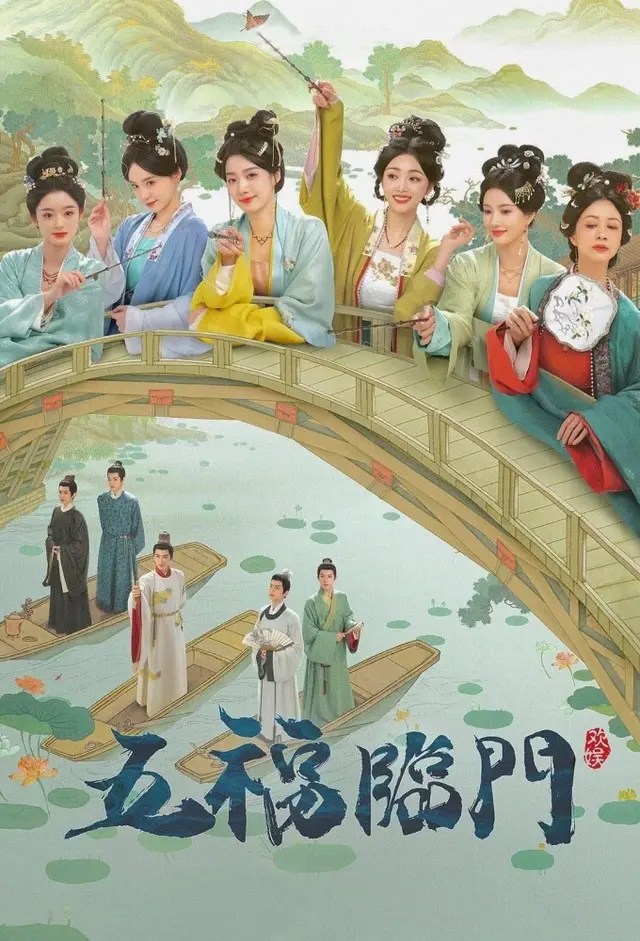
I just watched the first episode of a show that came out this year called Perfect Match that has me hooked. If Jane Austen and Shakespeare had a Chinese baby, this would be the result. Men dressing as women to sneak into the women’s quarters, women on a mission to teach their husbands to be obedient, a mother with her 5 daughters trying to find husbands for them all, enemies to lovers (at least I assume they will become lovers), and some prideful men and women who need to learn humility. It is set in the Northern Song dynasty somewhere between 960 and 1120. The costumes and sets are unbelievably gorgeous, the music is beautiful, and the comic relief is well timed.

Why do I love themes of romance and marriage so much? Romantic comedies are the most wonderful of all storylines, in my opinion. I have read heavy stories, weighty novels, watched movies and shows that made me weep for the tragedies people must suffer, and cheered along with every adventure, sports, underdog story there is. However, if any tale does not have a theme of love woven through it, there is something missing for me. Whether it is fantasy, action, comedy, procedural, or even a documentary, I most enjoy a love story as part of the tale. It is the way I am wired.

I think they’ve even woven in a bit of a Taming of the Shrew concept in this one with an unmanageable wife who is too harsh with her husband. I am curious to see how they handle that plot line. And I watched a scene where they were just haggling over the cost of tea in China. The daughters have opened a restaurant and are trying to create a life for themselves, while taking care of their mother and repeatedly talking her down from catastrophic actions. She is quite reactionary. The daughters work together to manage their mother, the men who come calling, and their business as best they can.

This should be good.

@Home Studio

Saki

Saki coming in for mid-day kisses.

We got a new Husky puppy. She is a mess! We are her 5th home in 5 months, poor baby. She seems terrified of my grandfather and barks hysterically when she sees him, which makes me wonder if she was mistreated by an older man. She is horribly food insecure/struggles with food scarcity fear. She attacks her food bowl the second the food is presented and scarfs it down so quickly that she makes herself sick. That makes me think she had to fight for her food and eat it fast if she was to get any in her past. She begs for food constantly and acts very anxious around mealtimes. We hope that over time she will develop a sense of security and comfort around food with our consistent feeding schedule and plenty of food, so she does not experience hunger.

She has had a few fights with our other dog Kenji (who is twice her size.) She is fearless. If she thinks he is getting a treat that she is not, she is ready to battle to the death. And her behavior is making his food insecurities resurface that were laid to rest over a year ago. He also came to us hungry and terrified that he wouldn’t get enough. But he finally got to the point that he would leave his food in his bowl until he felt like eating it. Now he is back to running to his bowl and scarfing it down the way he used to and getting goaded into fighting with the new girl.

We named her Saki. I heard the name on a Japanese show we were watching and I liked it. We probably don’t pronounce it right, but we say “Saw-kee” as the pronunciation. She already knows it is her name and has learned sit and stay. She is super affectionate and wants to give kisses all throughout the day. She will go play for a while and then come check in with me for attention, kisses, pets, and reassurance. Then she runs outside and plays some more. She and Kenji are having fun together. I can tell he is happy to have a playmate again. He misses Aiko (who passed away recently.)

Two Huskies are a lot of energy. They wrestle and horseplay quite a bit. They run around the yard and tear up anything left laying around. Saki thinks everything is meant for her to chew on, especially David’s shoes, her harness, and anything stuffed. She’s a good girl and I can tell she is going to be a loyal, wonderful dog for our family. But it is going to be a slow challenge to get her there.

Gone Girl

AI Generated image I prompted on Gencraft.com https://gencraft.ai/p/URdCYb

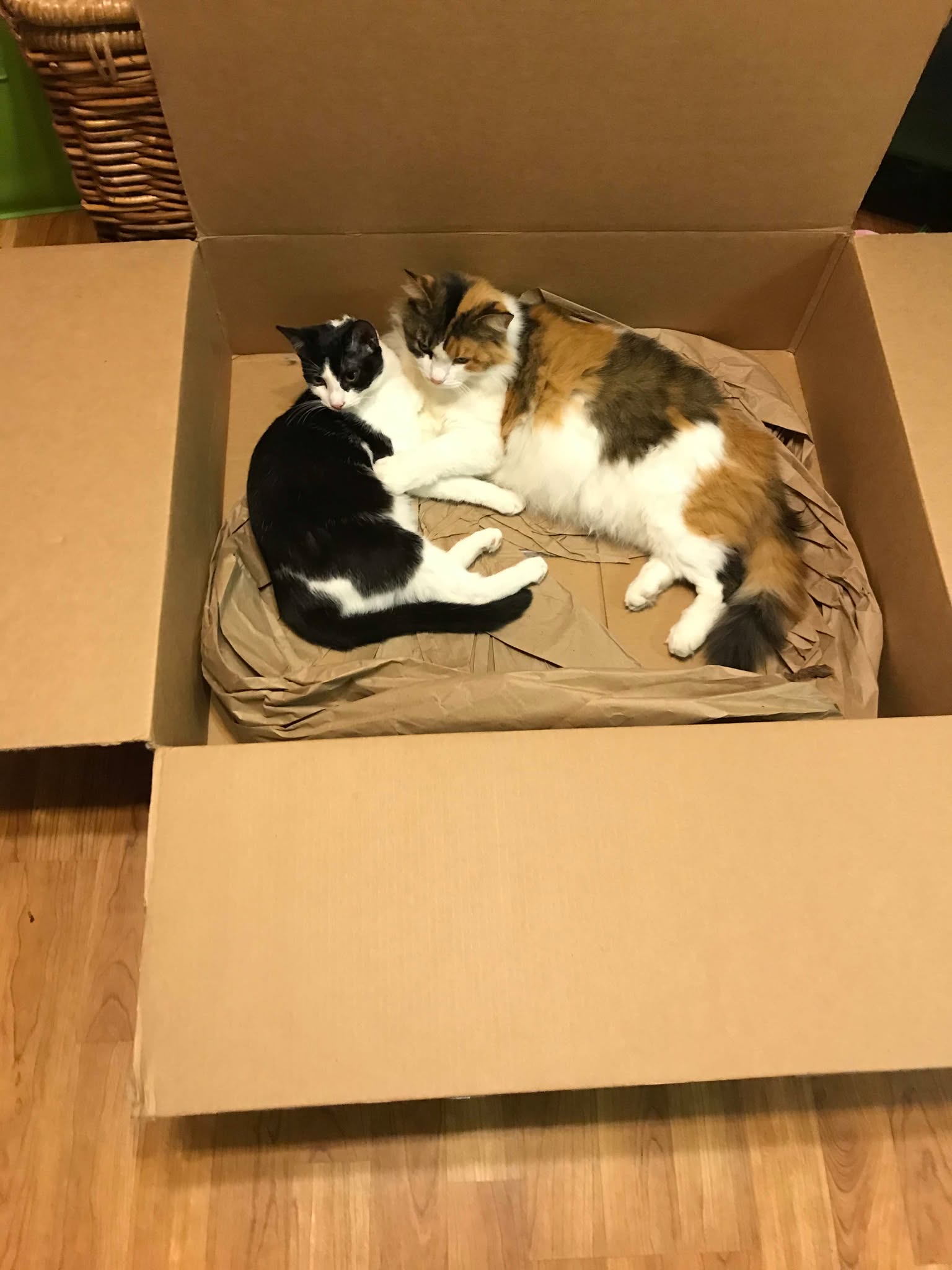
This winter, my cat Chika died. She wandered out to a far corner of our property to meet her maker. She did as cats are wont to do, sparing her beloved humans the trouble of witnessing their passing. My granddaughter found her and Facetimed me, distraught, tears streaming down her 10-year-old face. She had been missing for a week, and I assumed the worst. A once fat cat, her weight rapidly declined over the preceding month. She had been sickly all eight years of her life with constant upper respiratory infections, allergies, and asthma. Because of her, I now know what cat sneezes and coughs sound like. I became attuned to her different variations of wheezing, knew which ones were minor and which ones warranted a vet visit. Nothing we can do. Another steroid shot might help. A round of antibiotics. Let her live her best life.

I’m surprised she lived as long as she did. I don’t think it was a pleasant existence for a cat, but the vet did not think she was in so much discomfort that she should be put down. Her purring during the exam, passing their breathing tests, and fat physique reassured them that she was as ok as a sick cat could be.

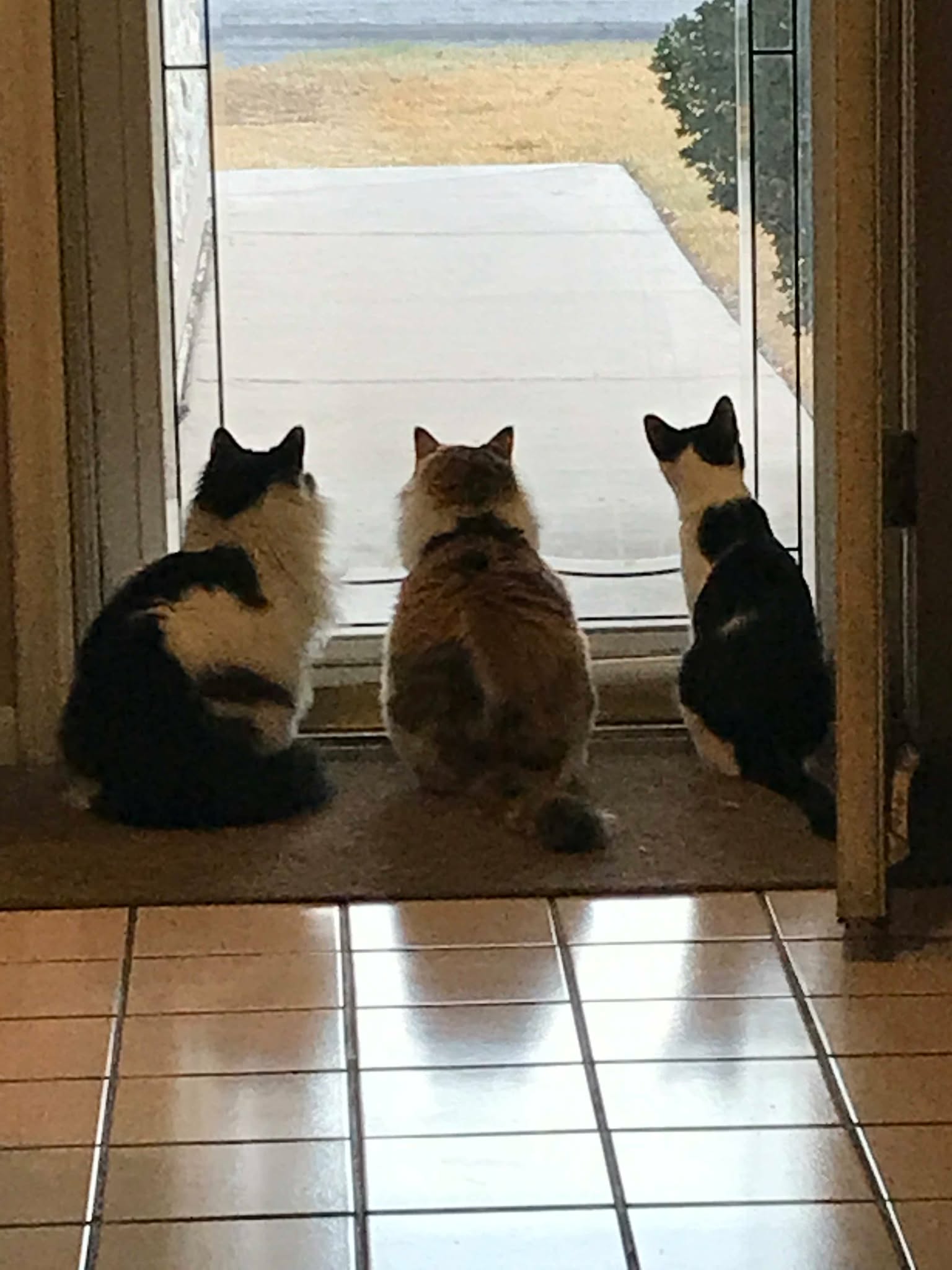
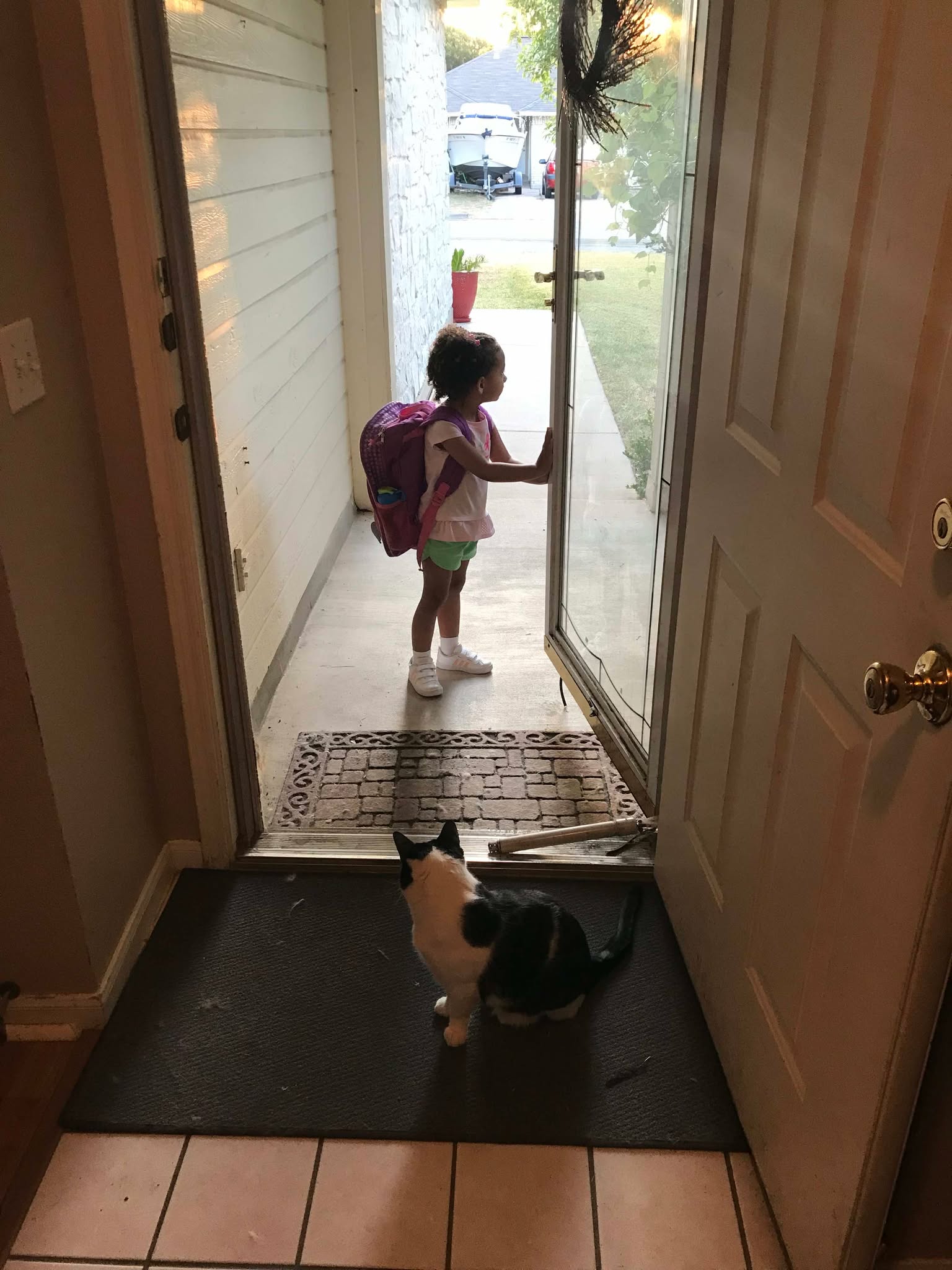
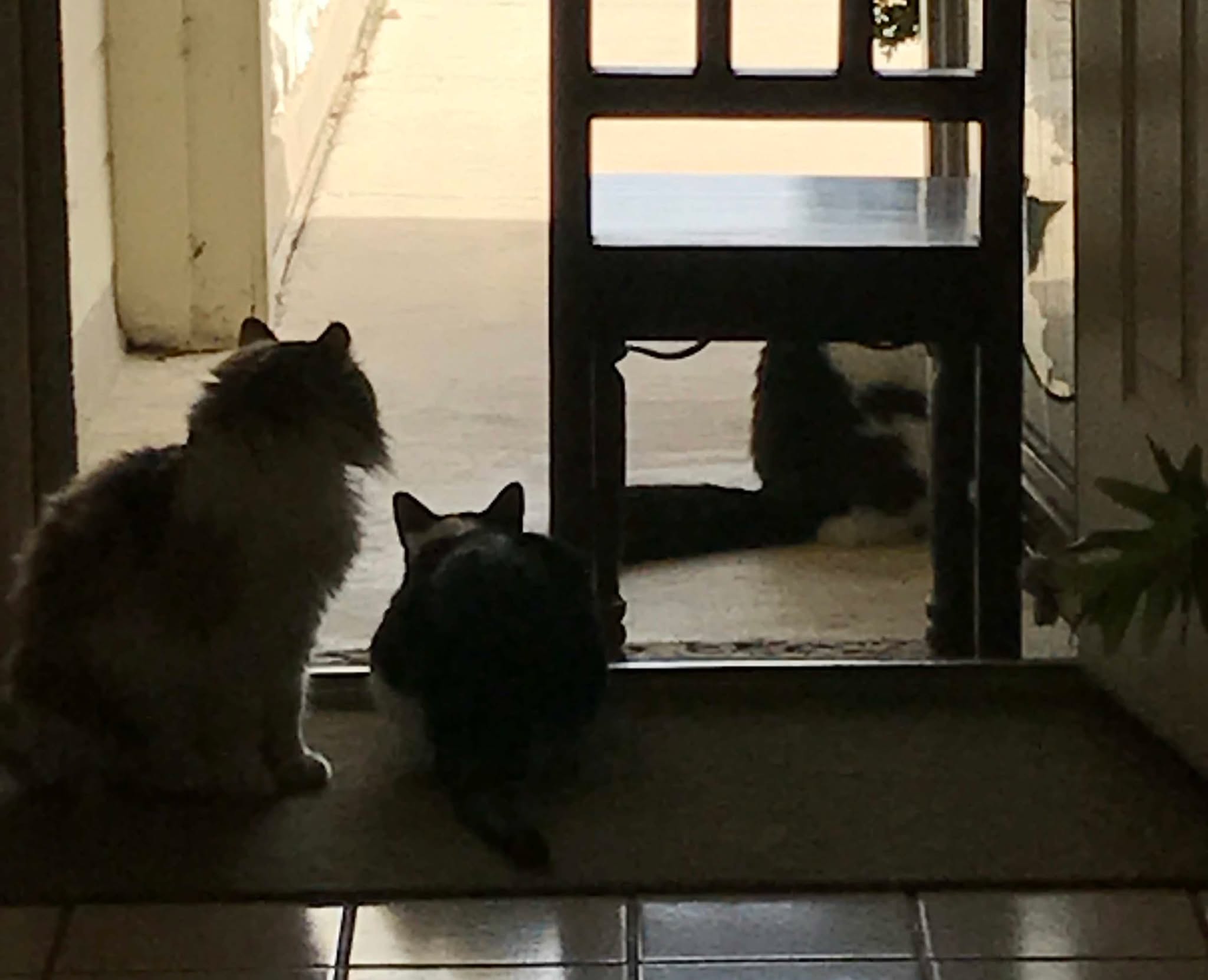
She was afraid of the outside for the first two years of her life. The other cats would encourage her to join them on a jaunt around the yard, but she would sit and watch through the glass door. One day, we left the door propped open with a chair and let them come and go freely for a few hours. They had the best time entering and exiting at will, no need for humans to open anything. The two older cats decided it was high time that the younger, less experienced of the pack join them. They spoke the magic language of cats, convincing her it was safe, then one or the other of them sat by her side as she took her first tentative steps onto the porch. However far she felt comfortable venturing, one of them was right by her side for a good 30 minutes or so. It was heartwarming to watch.

Chika probably had pica. She loved to lick plastic shopping bags if she could get her paws on one, and another cat owner told us it was like a drug addiction to the chemicals on the bag, that it would give her a bit of a buzz. I was unable to find research to back up that claim, however. More likely, she liked the texture, and her brain told her it was something to put in her mouth. Whatever the reason, we had to be careful with plastic bags and make sure none were left out anywhere that Chika could access them. She also sucked or chewed on soft blankets as she was kneading them with her little cat claws.

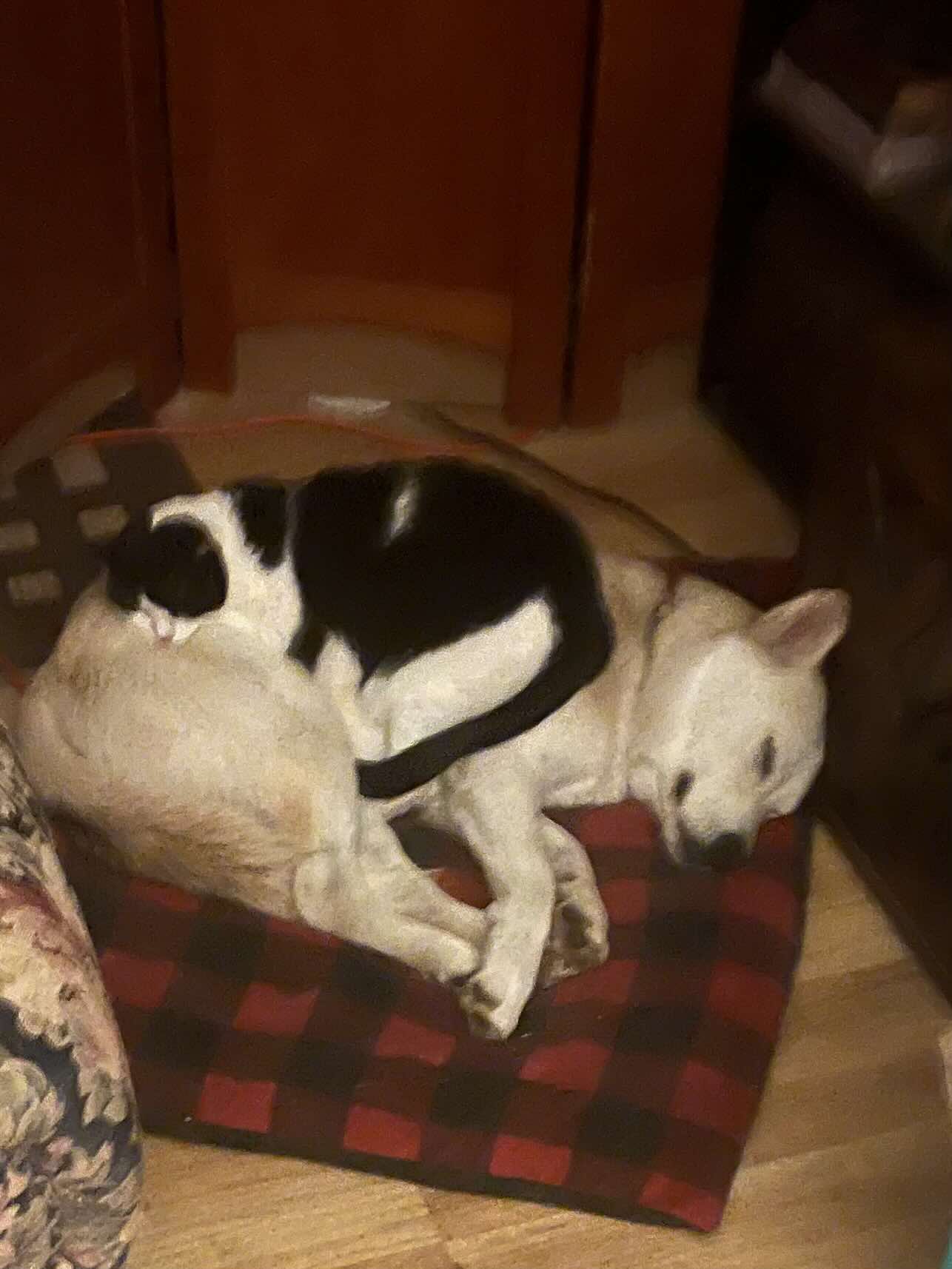
She hated to be brushed. She wasn’t much on cat treats or fancy wet cat food or even human food. She preferred her dry food, and keep it coming, thank you very much. She expected the bowl to always be full, so she could eat when she felt like it. She was not really a big fan of other animals and took her sweet time getting used to any new ones who entered our home. Even after years of knowing a “new” animal, she might hiss at them if they ventured too close. She decided the dogs were tolerable because she could sleep with them, and they were warm. She liked the sleeping in a pile at night snuggling with others, but by day, she wanted her space.

Chika was hot or cold with affection. She mostly permitted pets when she was in the mood. She liked a warm lap, but the lucky person was selected by her, and the chosen one had no say in the matter. She jumped up, settled in, and waited expectantly for pets. It did not matter if you liked cats, wanted a cat in your lap, or preferred to be left alone. Once she decided you were going to pet her, you might as well get it over with because she would not leave you alone until you did your job. She would look at you with the most severe expression that made you feel at once judged and found unworthy. Hers was a stern cat face. She couldn’t help it. It was just her face, but her countenance gave the impression that everything and everyone were somehow annoying her by their mere existence.

I think she might have killed a bird once in her younger days, but mostly she watched them in the trees, inspiring dive-bombing mothers and cacophonies of threatening bird chatter. She sat under trees where squirrels fussed at her just because she knew it annoyed them. Though she did not have the energy to chase them, she loved that her presence could affect them so.

My heart hurts knowing she has left this plane of reality, though I am comforted by the knowledge that she no longer has to labor to breathe. I never have to trick her into taking medicine again or pin her down so I can attempt to give her a breathing treatment (not an easy accomplishment.) No more late-night searches through the house to make sure she is inside and safe before we lock up. Still, it is hard to say goodbye to someone with whom you’ve spent the last eight years of your life. My tears are selfish. I’m the one who will miss her grumpy, sick, uncomfortable, curmudgeonly, snotty presence. I have a feeling she was relieved to finally bid us all ado. Yes, my girl Chika is gone. May she finally rest in peace.

Rebekah Marshall @Home Studio

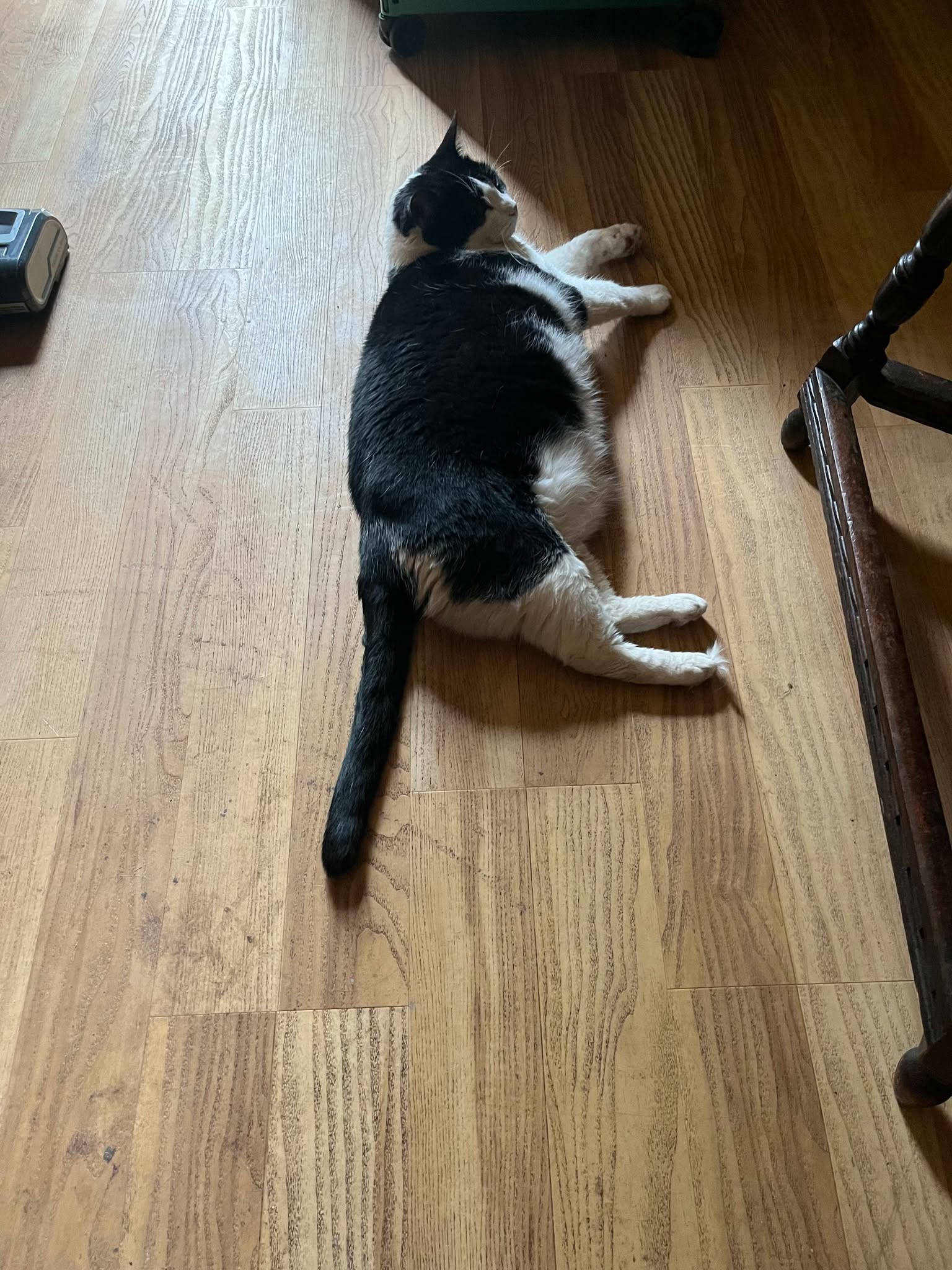
Beauty became a surrogate mom when we adopted Chika. From left to right, Sassy, Chika, Beauty.

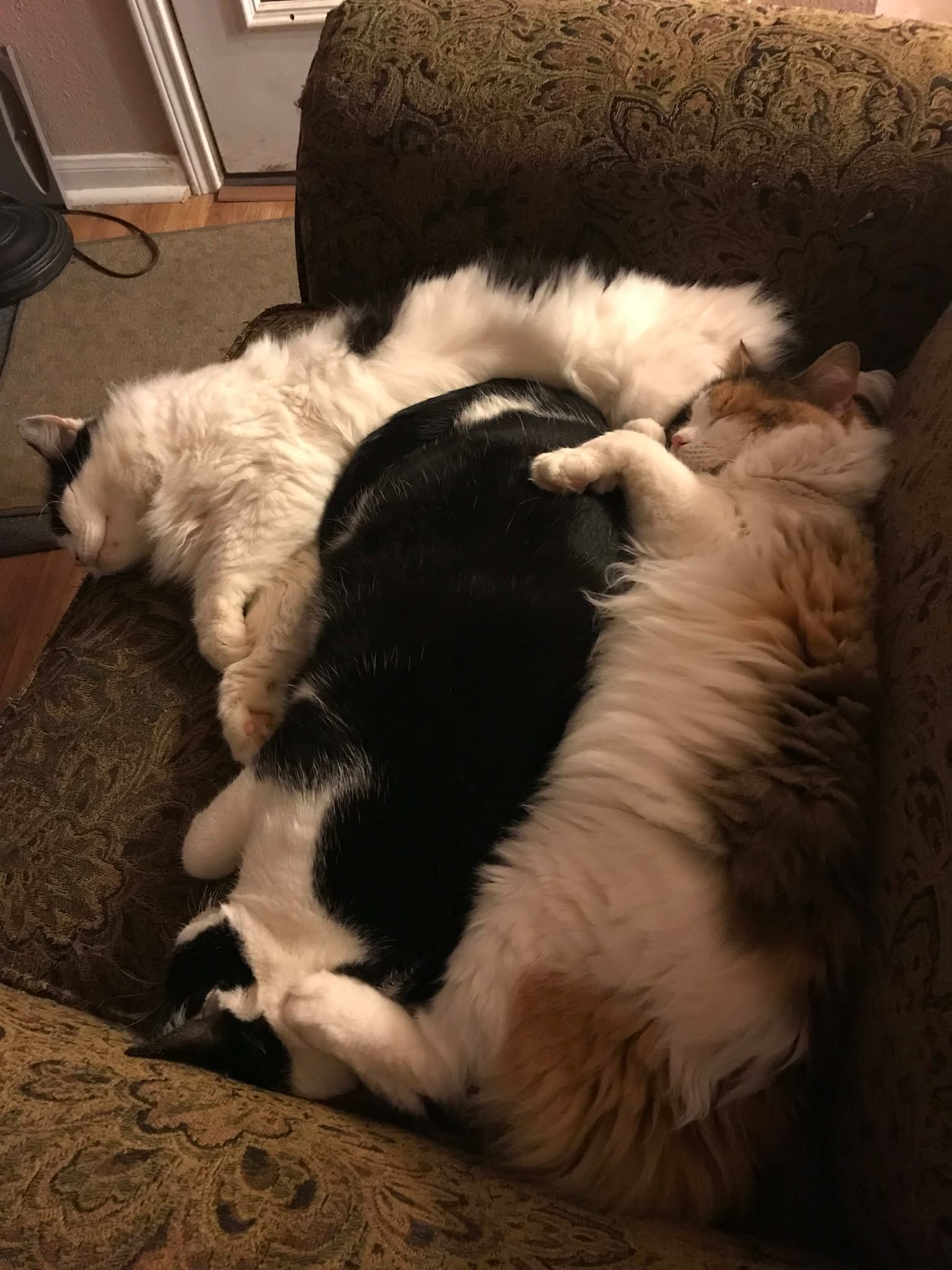
Sleeping with Aiko and Kenji for warmth.

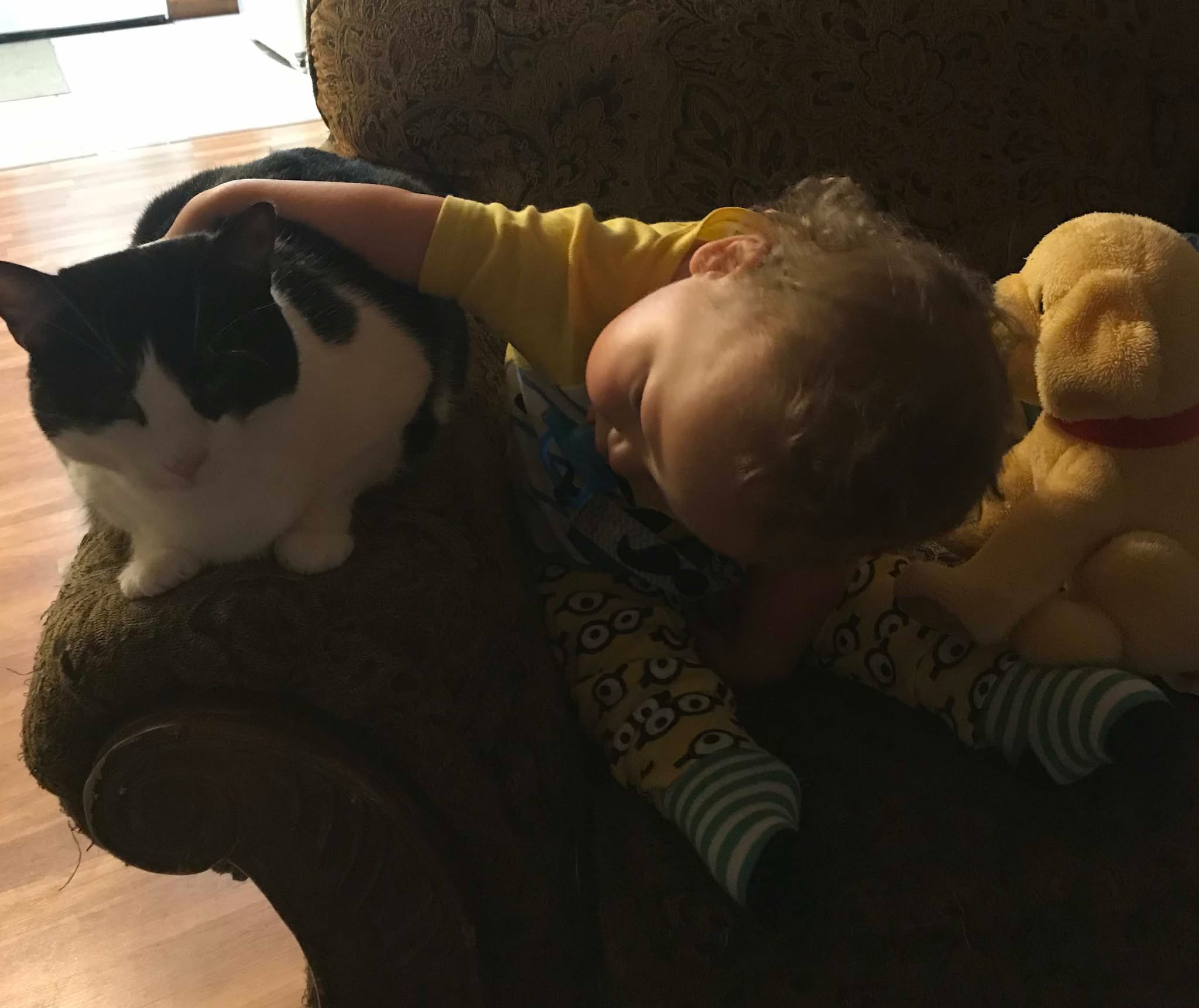
Tolerating Julian’s love.
Too scared to go outside with Charlotte.

On the threshold, stepping out, encouragement to be brave, looking back for reassurance.

Chika stayed by Grandad’s side in the weeks after my Mema’s passing. It seemed like she knew he needed comfort. The other image is her at her fattest, living her best fat cat life (before we had to start a little bit of a healthier diet.)

Too Many Steps

AI Generated image I prompted on Gencraft.com https://gencraft.ai/p/qOA2lg

My daughter and I have a state of being we have labeled Too Many Steps. When we reach this place of unbearable overwhelm, there will surely be a meltdown, emotional outburst, argument, full depressive episode, a day or two of bed rot, or at the least, tears.

I reached Too Many Steps this evening. Overall, I had a restful day. I slept in, took a nice nap, mostly watched shows and attended book club via Zoom. Perhaps my brain is gearing up to return to my work schedule tomorrow after a much-needed weekend off. Or maybe I’m getting sick again; I certainly don’t feel fully recovered from the upper respiratory infection I have been fighting since before Christmas. What is that, over 20 days now? I can feel a new cold sore springing up, my nose is tender and raw from the drainage, and my lungs feel heavy.

Honestly, I feel a bit like I did when I had long COVID some time back—the fatigue, dizziness, winded just from walking across the room, depressed, irritable, a darkness that has reached down my throat, and the need to isolate, cocoon inside my covers and sleep. And in this already depleted state, I decided it was high time I take a shower. Some might think a shower would feel good, be relaxing, be a welcome distraction, or pleasant end to the day. Maybe on a normal day when I am well.

Today is not that day. As a person with a chronic condition, when my body is fighting illness, for some reason it attacks everything—my joints, my skin, my hair. My immune system doesn’t seem to know what is virus and what is me. Everything hurts. Right this second, the backs of my ears, my elbows, and my finger joints hurt—for no good reason. Anyway, undressing takes effort. Taking my hair down strains my right arm. Gathering the towels to dry off with is a chore. I place one towel carefully so I can sit when I get out of the shower because I cannot stand the length of time required to dry off without causing too much pain. Another towel, I place on the laundry hamper for my hair. I get the floor towel from its hanging spot and lay it on the floor, so I won’t slip when I get out of the shower. We can’t leave it on the floor because the cat has decided that is the best place to poop if it is left there. It is finally time to get in the shower. My energy is flagging, but I’m almost there. I can make it.

Nope, there is a pile of wet towels on the shower bench where I need to sit. You’ve got to be kidding. My daughter overloaded the washing machine earlier and had to take out some of the towels because the machine would not finish the spin cycle. She never came back to complete the task. I’m sure she forgot. It is now late in the evening, and everyone has gone to bed. It will take more energy to get someone to remove the towels, so I decide to handle it myself. My back screams at me with each hefting of sopping towels I plop onto another surface. I’m reaching the breaking point.

The self-contained shower-bath set-up I have is a wonderful jacuzzi-like seated bath situation with a locking door, lights, jets, the works. My grandparents got it to make bathing easier in their elder years. It is a wonderful contraption. However, it is built for skinny people. I must wedge myself through the sliver of a door opening to get in and it is uncomfortable. Then I must twist my body in a strange contortion to close the door and be able to sit inside the contraption. Once in, it is comfortable, but the mount and dismount are not graceful.

Door locked. Check. Suction cup portable shower head holder located. Check. Suction cup portable shower head holder placed in the perfect position to make my seated shower just right. Check. Made sure my shampoo is reachable. Check. Double made sure my conditioner is there because sometimes my granddaughter borrows it and forgets to return it. Check. I have made it. I have used all my remaining energy to get into the shower, but I am ready and seated, with everything I need. Then I take ahold of the hand-held shower head to stretch out the steel hose and fit it into the holder, but it only extends a few inches, then hangs on something inside the housing of the bathtub. It is the final straw…or hose…or whatever.

Too Many Steps has been reached. I begin to wail. I cry harder than I cried at my grandmother’s funeral. The grief that spills out of me is a tidal wave of pain. On a normal day, it would be logical to remove the portable shower head holder, unlock the door, dismount through the skinny door, open the side of the bath, and unstick the steel hose—like a grownup. But, no, not once Too Many Steps has been reached. At that point, the only logical option is to sit in the shower bath forever and cry.

I don’t know how long I stayed stuck in the land of Too Many Steps. Truly, I can’t tell you. There is no time there. It is only a place of I’m done, the end, it’s over, forget it, too bad, whatever the hell, I can’t, and no more. I might still be there had my husband not eventually come to my rescue, though our interaction was with raised voices, anger, and more tears because of other Too Many Steps that I won’t go into here.

I don’t know the moral to this story. I just thought I would describe Too Many Steps in case anyone else can relate, I suppose. Also, because this one seemed extra emotionally violent, I felt the need to write about it, hopefully processing some of what led to the limp, energyless, wet dishrag feeling I now embody. I can never predict which step will be the one upon which I will collapse, unable to climb even one more inch, but I can certainly relate to that poor camel, his knees buckling under the weight of the load, all his muscles straining to stay upright, carrying the burdens of the world until that one last straw.

Rebekah Marshall @Home Studio

poor your soul (A Book Review)

To be raw and real in the retelling of your own most vulnerable moments creates a profound intimacy in memoir. I don’t know if I’m brave enough to write one. Mira Ptacin explores her own fears and feelings of shame and grief around the death of her brother as a teenager and the loss of her baby in her 20s. She weaves a beautiful tribute to her mother who emigrated from Poland and built a life with perseverance and grit here in America. Americans did not make it easy on her.

The subtle twists and turns of growing up, beginning to relate to your parents as fellow adults, discovering that your childhood perceptions of them may have been misconstrued, and finding internal peace in the process are themes that resonate with me, as I have experienced this with my own parents, and now have adult children going through this phase of life with me. Though I have never had to experience the same kinds of grief as Mira, her example of leaning on her loved ones, finding her own path forward, and being gentle with the healing process (however long it takes), makes me hope I can do so with the same indomitable spirt as her, if I am ever tasked with such a burden.

I probably would never have chosen this book, had I known how much of the story centered around the awful experience of having to make decisions related to ending a pregnancy, so I am glad I was unaware because I would have missed out on so many threads of beauty and love. And every scene that includes her husband is superb. He tends to steal the scene, as he is depicted as sincere, silly, and supportive in all the right ways.

Rebekah Marshall @Home Studio

Ptacin, Mira, poor your soul, SOHO Press, Inc., 2016.

Megalodon Fossil Tooth

(If only my granddaughter’s tooth brushing was this joyful.) AI Generated image I prompted on Gencraft.com https://gencraft.ai/p/XQYWuY (Example of what the tooth looked like that my grandson found.) https://images.app.goo.gl/EmtGmtXMyrbHvq2t8

My grandson Julian (6 years old) found a giant fossilized megalodon tooth in the backyard today. He brought his prize to show me, and it was quite impressive. It is probably the biggest limestone shark tooth I have ever seen. I suggested he go show Grandad (91 years old) and get a second opinion. I don’t think Grandad played along as well as I did, so Julian took it back outside to do some more excavating and promptly misplaced it.

Speaking of teeth, Charlotte (my 10-year-old-in-8-days granddaughter) has a loose one—I believe it is #8, a canine. She likes to wiggle it in the mirror and point out that she only has 2 baby teeth left in her mouth. How time flies. I remember when she was first cutting her little tiny teeth on her bottom gums and we were super excited. Now she’s old enough that I spent over an hour on the phone with Apple tech support trying to get the parental controls set up on her phone so we could figure out which objectionable content to allow and which to block to help with internet safety. One issue was that I apparently set a password years ago and forgot it. We tried everything we could think of, but the Apple people were stumped. There was no fixing it. We finally gave up and decided it was unsolvable. A few hours later, on a whim, I typed in 1,2,3,4, and it worked. So embarrassing.

Julian brought me half a Mini Coke with a straw in it yesterday.

“Here you go, Ema. You can drink this because I joined the army and can’t drink sugar anymore.”

Woohoo! I like this game. Apparently, Charlotte was his drill sergeant and got him drinking water only. She had him working out and doing obstacle courses all day long. I bet his little muscles are sore today.

Charlotte convinced Julian to wear a bonnet to bed the other night like she does. Her curly coils have to be protected by a silky wrap at night to keep them from getting frizzy or damaged. Julian has the complete opposite texture hair. But with Charlotte’s application of who-knows-what-goo and some little twists here and there, Julian awoke with one or two curls on his head. He was very proud of them. I was impressed he made it all night in the bonnet.

This morning, Charlotte made Julian the Coraline breakfast special. I have never seen the movie Coraline, but Charlotte is obsessed with it. Julian lucked out. All by her little self, she made an egg and cheese omelet, 3 slices of bacon, and toast with jelly. It was a masterpiece. This is the same girl who melted onto the floor in a puddle the other day when I asked her to push the vacuum a few times. She literally did one strip of carpet before collapsing from the difficulty of the task. The next time she acts helpless, I’m going to remind her how capable she is when she wants to be.

Julian pulled a prank on us today. He was at the top of the stairs, and Charlotte and I were in the kitchen area.

Suddenly, we heard his pitiful little voice whimpering, “Help me, help me. I can’t see. Everything’s dark. I can’t see. I need help.” He was really laying it on thick.

Charlotte headed his way to see what kind of a bind he had gotten himself into this time. She returned just as quickly, marching with her hands on her hips, shaking her head and rolling her eyes. Julian appeared around the corner with his sweatshirt pulled up over his face like he was either trying to put it on or take it off; I’m not sure which. He was laughing so hard at his own joke that he ended up making us laugh, as well.

Grandad informed me that he was taking Charlotte to McDonald’s. She convinced him to take her to McDonald’s so she could spend her own allowance money on French fries. I tried not to be irritated. She already asked me and I said no. I told her to go make her own fries out of the perfectly good potatoes and oil we have here at home. They are easy to make in the air fryer. Grandad is a pushover when it comes to that girl. He was my grandfather first, and he never would have stopped what he was doing to take me to McDonald’s when I was a kid. He would have lectured me on saving my money and not begging all the adults all the time to take me places.

But honestly, I love that he has softened and spoils my grandchildren rotten (his great-great-grandchildren.) Every kid deserves at least one adult in their lives that is wrapped around their little finger. Mema was my person (Grandad’s wife of over 70 years and my grandmother.) She would do anything for me. Knowing that kind of love made me a strong woman who knows how to ooh and aah at shark teeth rocks and 10-year-old-in-8-days loose teeth for my own grandchildren. It all comes full circle if we put in the time and effort to be present in each other’s lives. And Charlotte is right that McDonald’s fries are way better than homemade. The girl knows her fries.

Rebekah Marshall @Home Studio