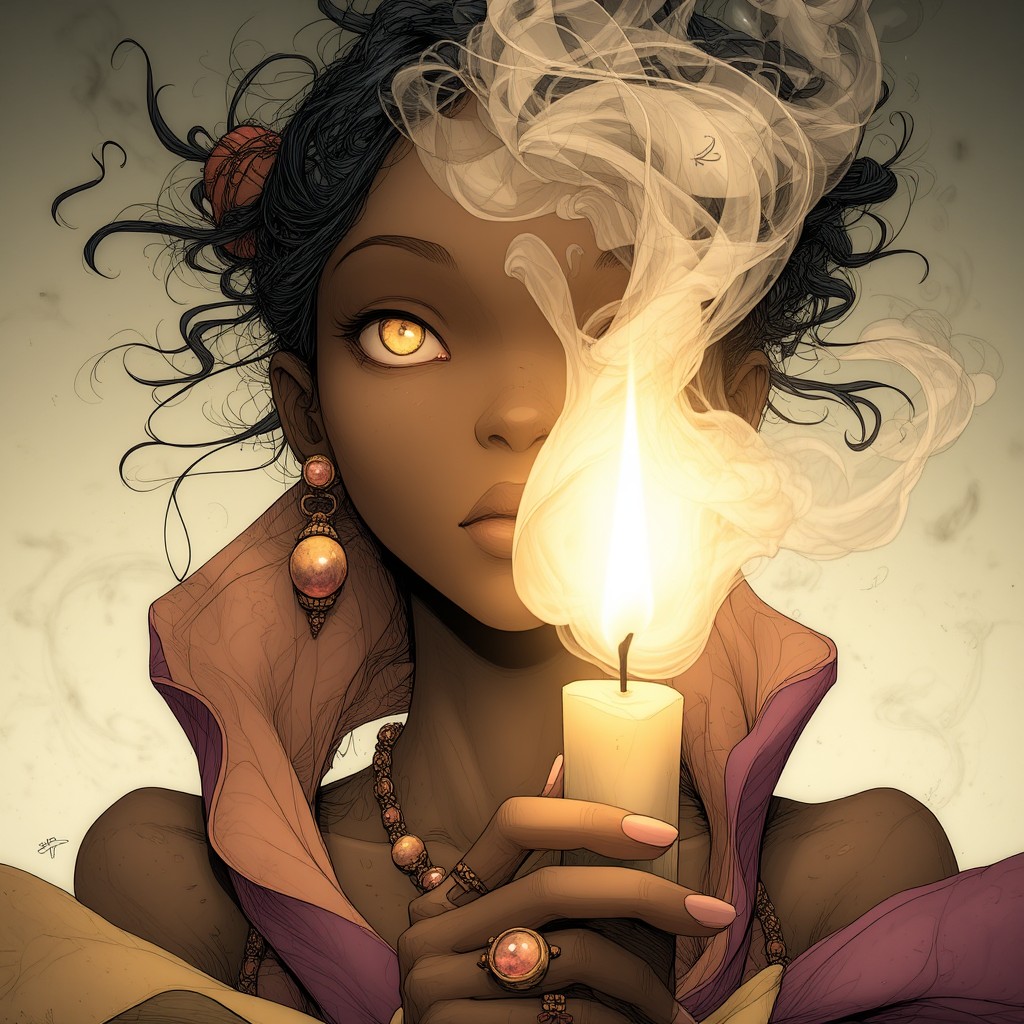
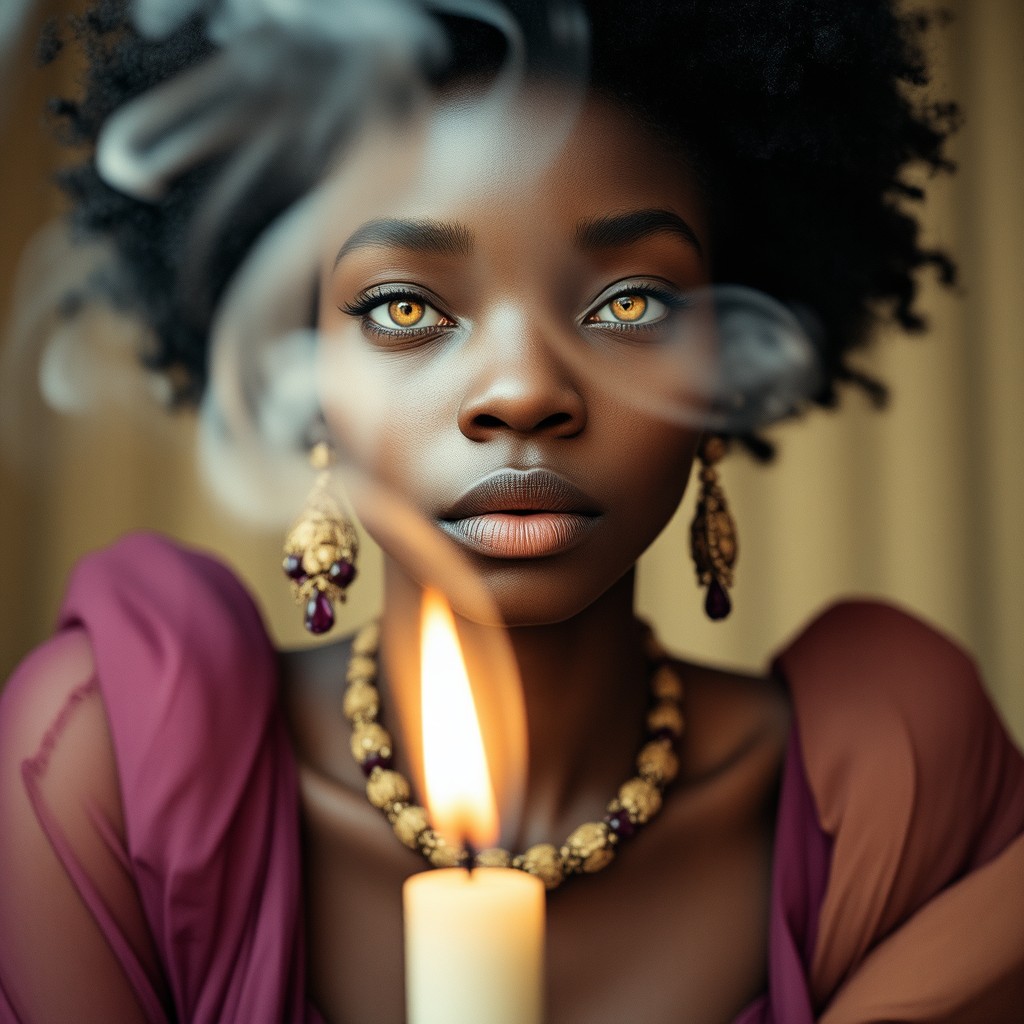
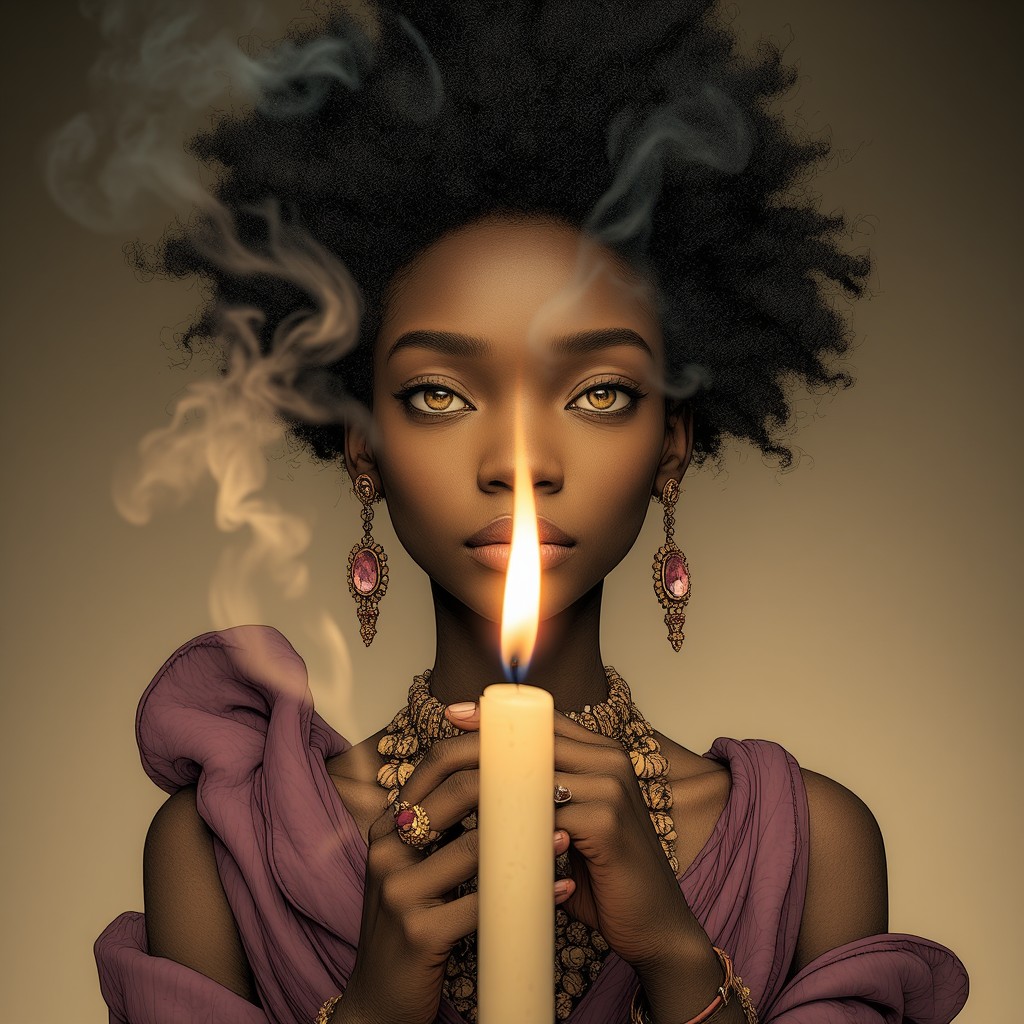
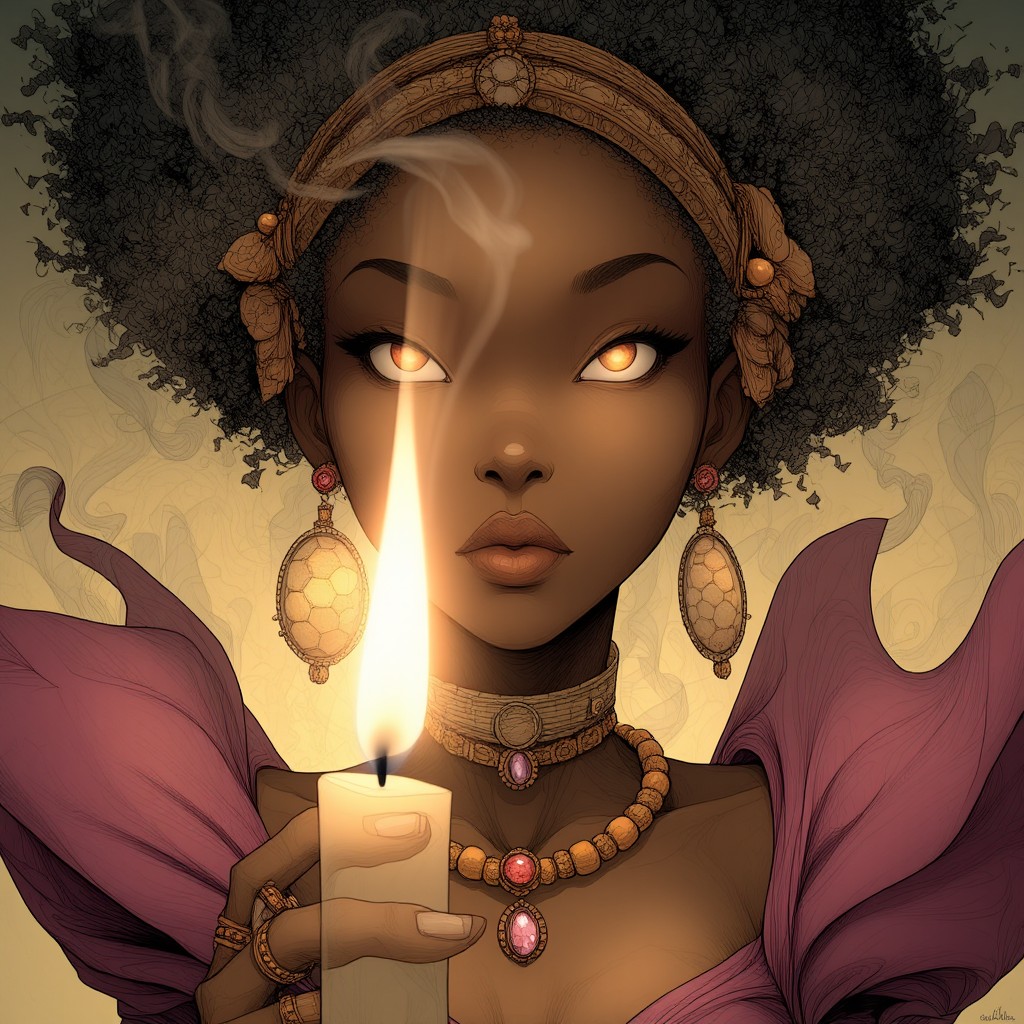
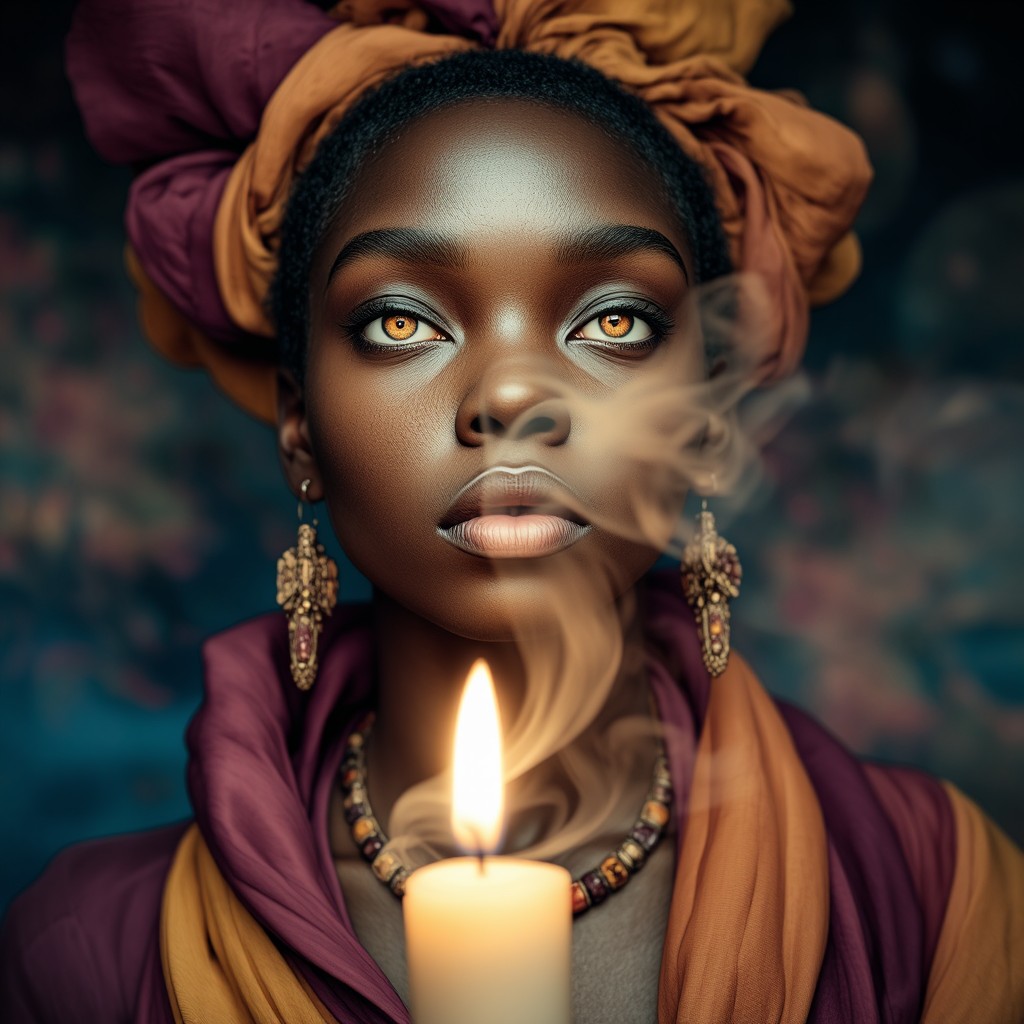
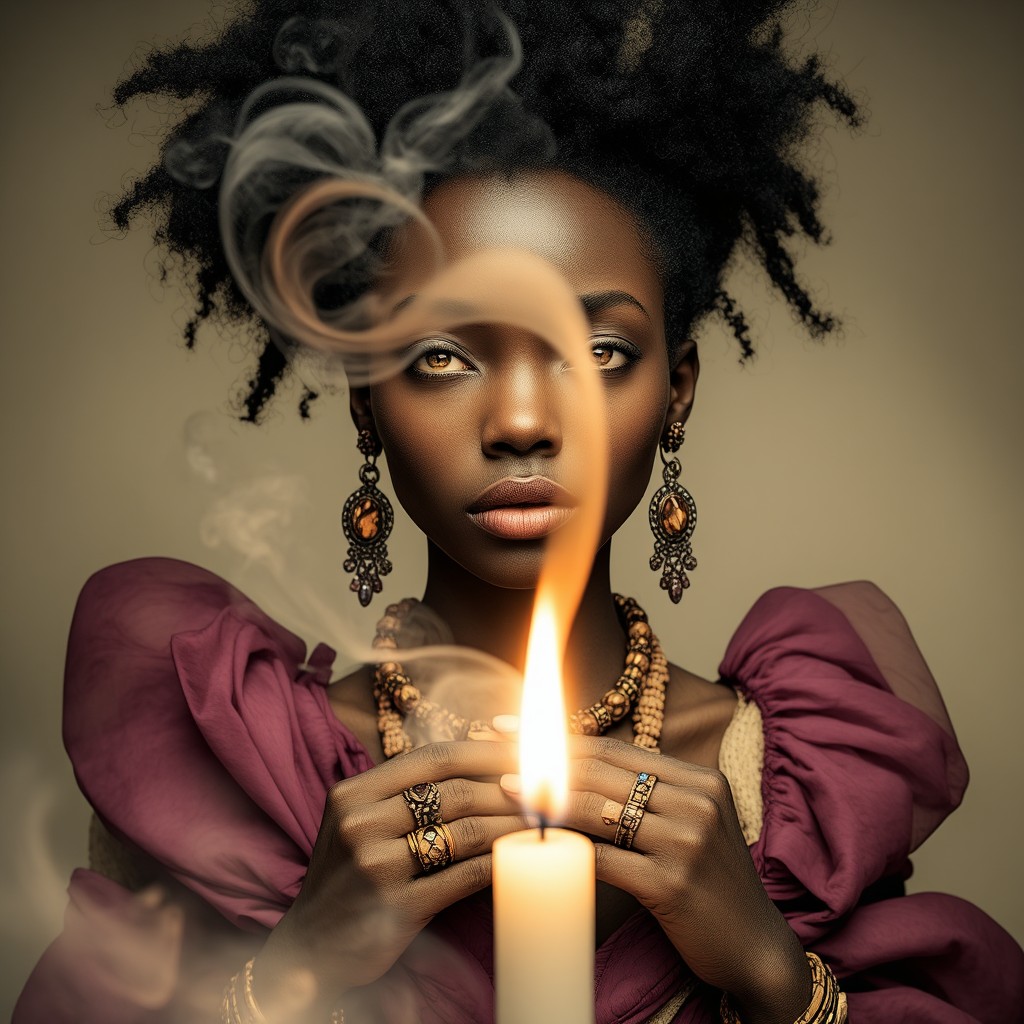
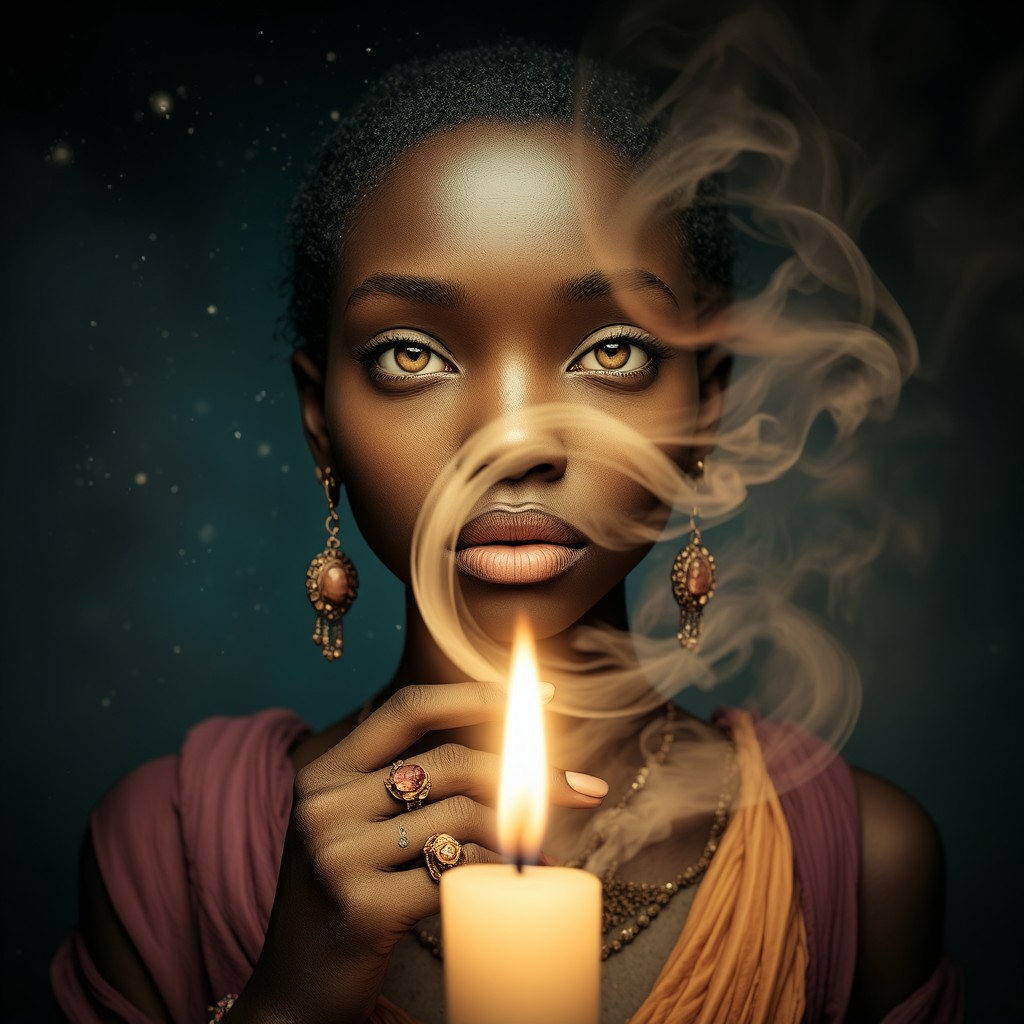
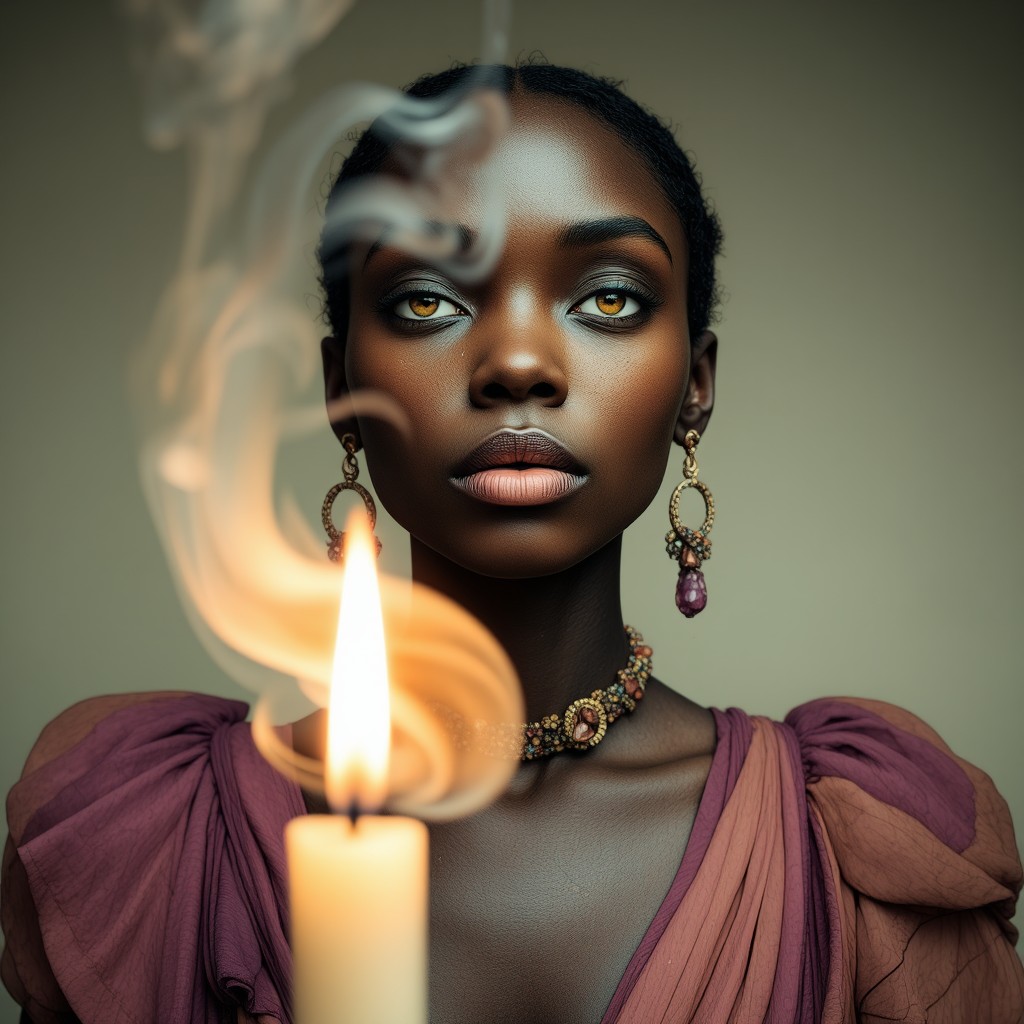
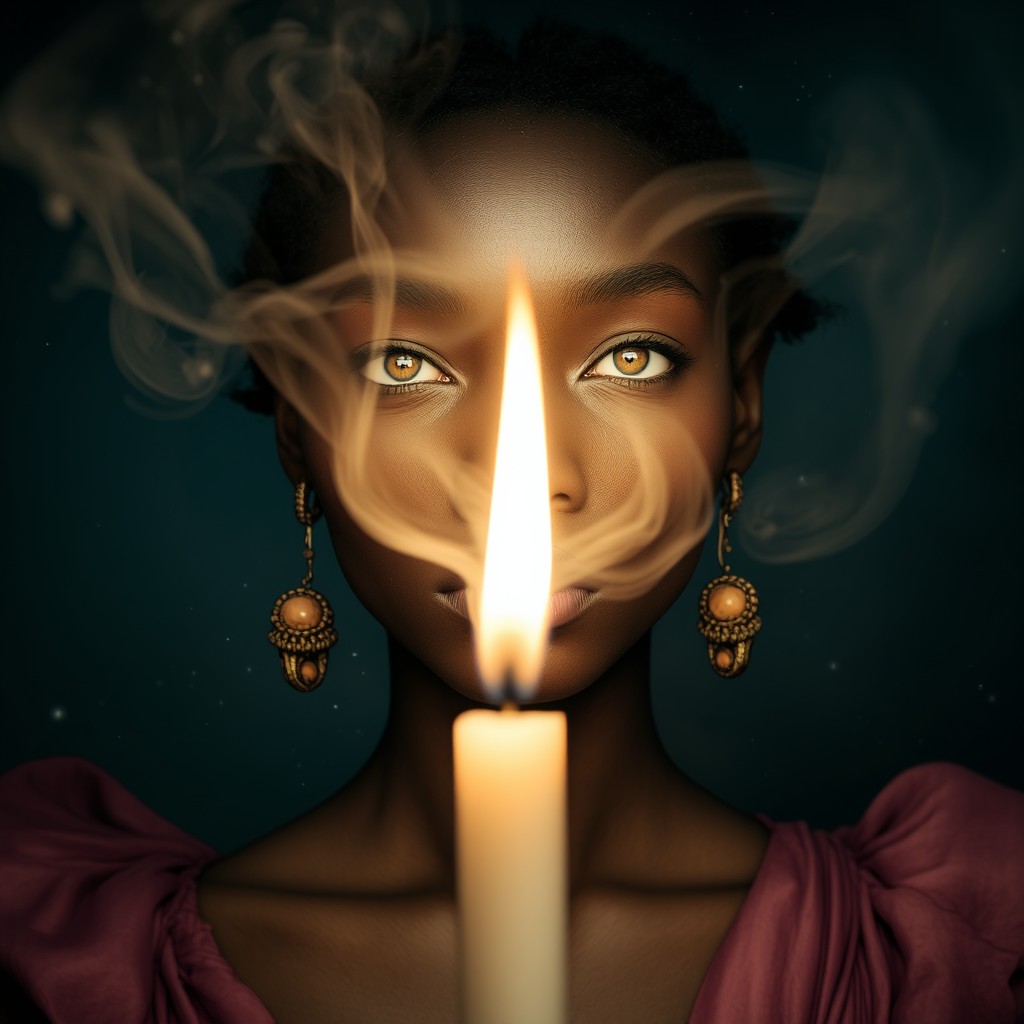
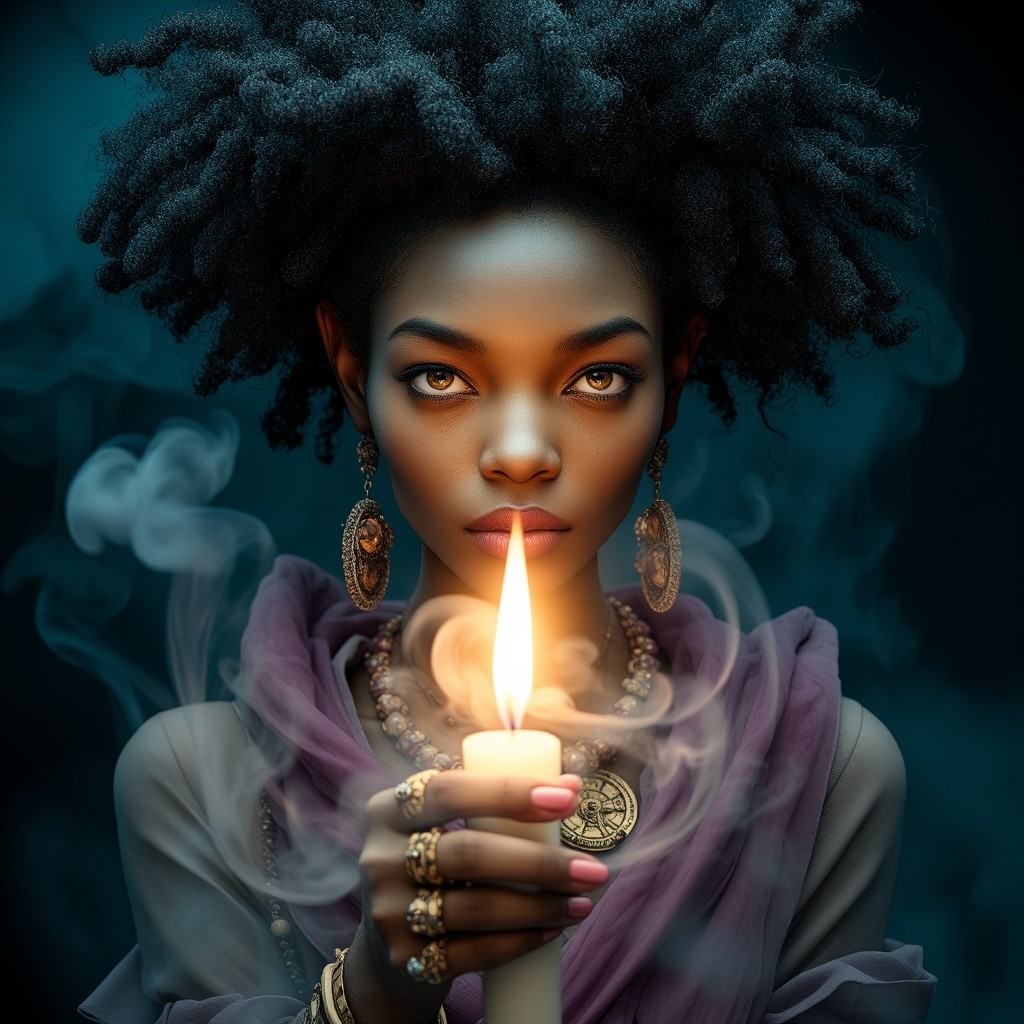
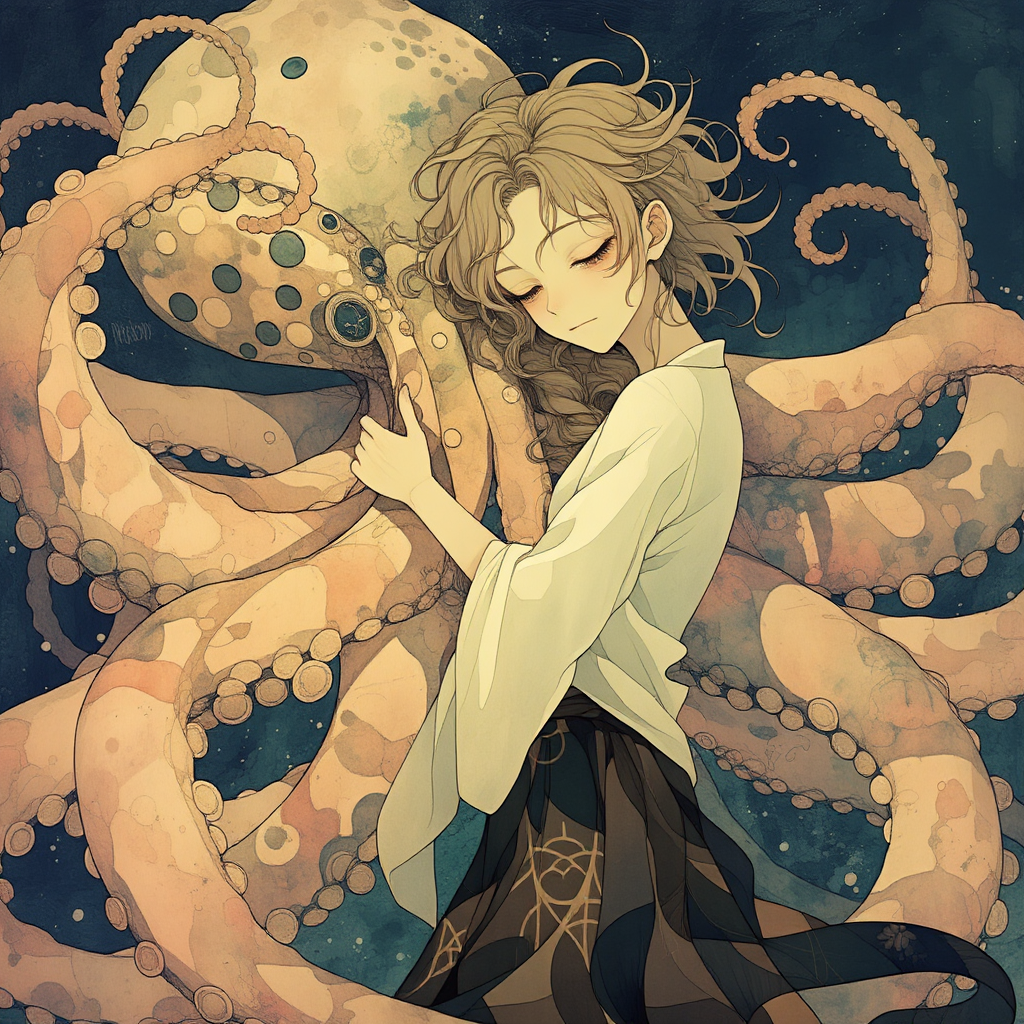
This week’s prompt challenge was to create a portrait with the face obstructed by something. Some wonderful entries were an elderly lady with a butterfly on her nose, a hat brim pulled low obscuring the eyes, clouds of galaxies drifting across a godess’s face, and a guitarist holding up a guitar to block half of her face. They were well done.
Here are the technical aspects of this submission: Gencraft – Model: 40% Olafs-Whimgear 3.0; Style: Anime
Front view of lovely delicate woman with black skin and bioluminescent golden eyes staring straight ahead with chin lowered slightly, as candle flame and smoke from a candle flame in the foreground swirl magically blocking view of her mouth and nose as it lifts into the air in front of her; magical; swirls; cosmically divine ambiance. She wears purle and amber flowing silk and cotton voile garments that shimmer and hang beautifully on her frame, with amber and amethyst jewelry as earrings, rings, bracelets, and necklaces.
Week of 6/8/26 “Flamma Velata”
And here are some honorable mentions that did not get submitted, but turned out good:
This week’s art challenges have let me stretch some creativity muscles.
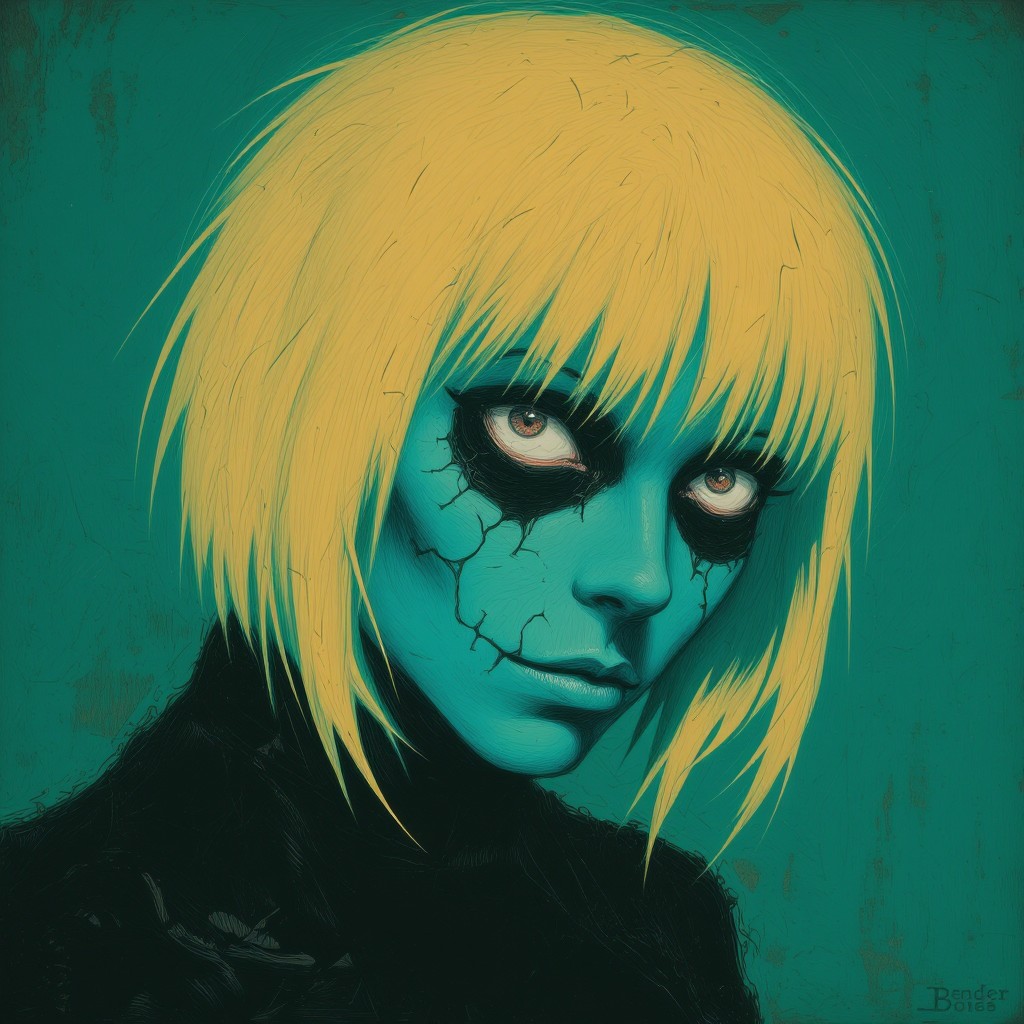
The first challenge of the week was to make an album cover for a band or music artist that does not exist. And we were supposed to include the artist’s name and album title on the cover. I had a lot of fun with this one, but had to use Canva to get the lettering because AI couldn’t do it all on its own.
6/8/26 “DJ 404”
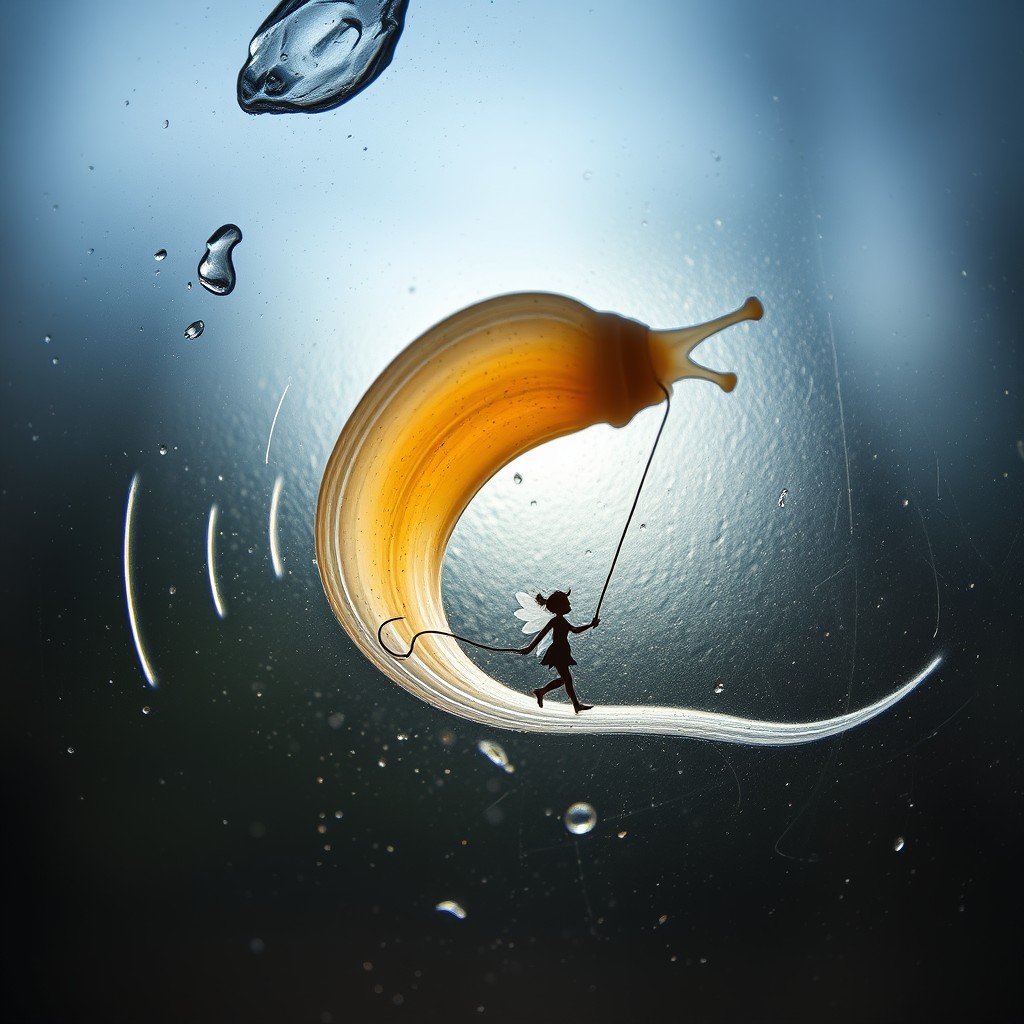
The next challenge was to show the beauty of slugs or snails. I wanted to invoke the power of the sandworms in Dune that the Fremen hitch rides on, only use tiny fairies on the back of slugs. It was harder than I thought it would be.
6/9/26 “Snail Rider”
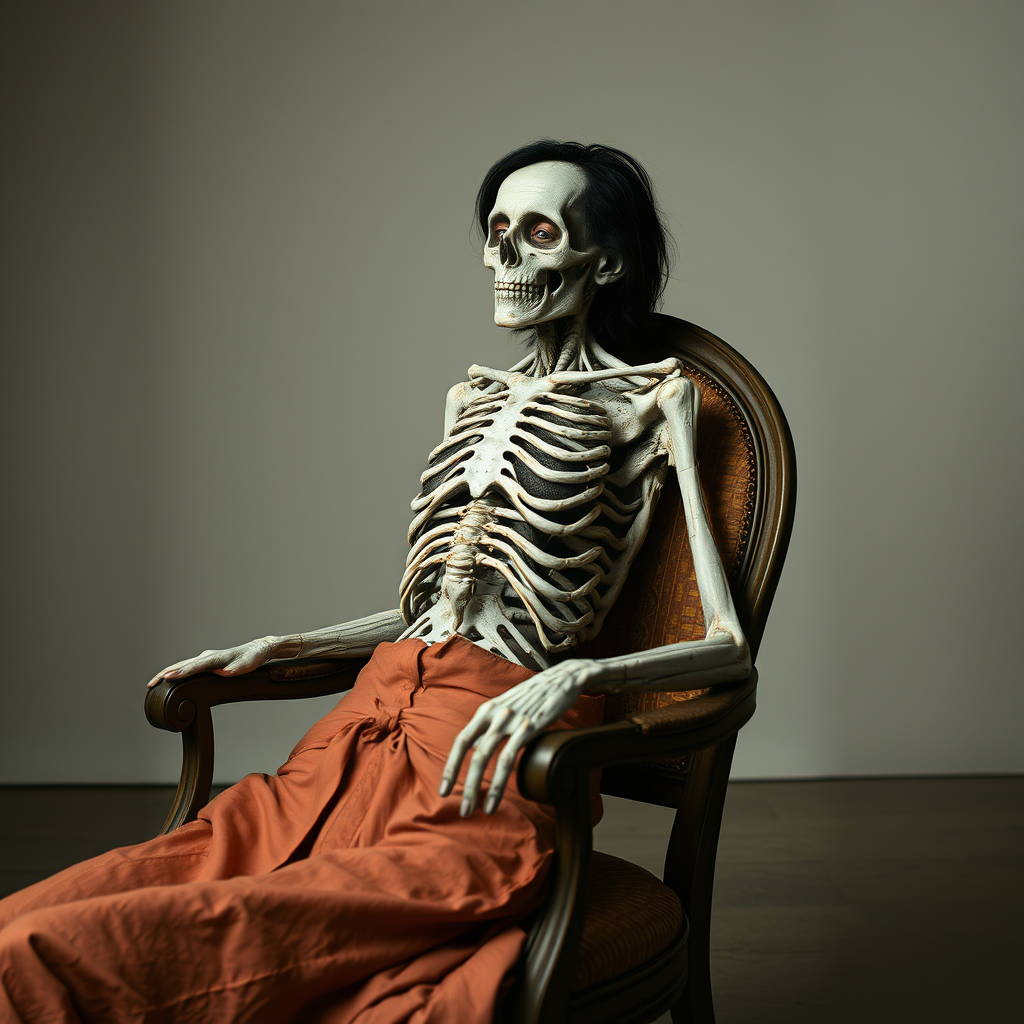
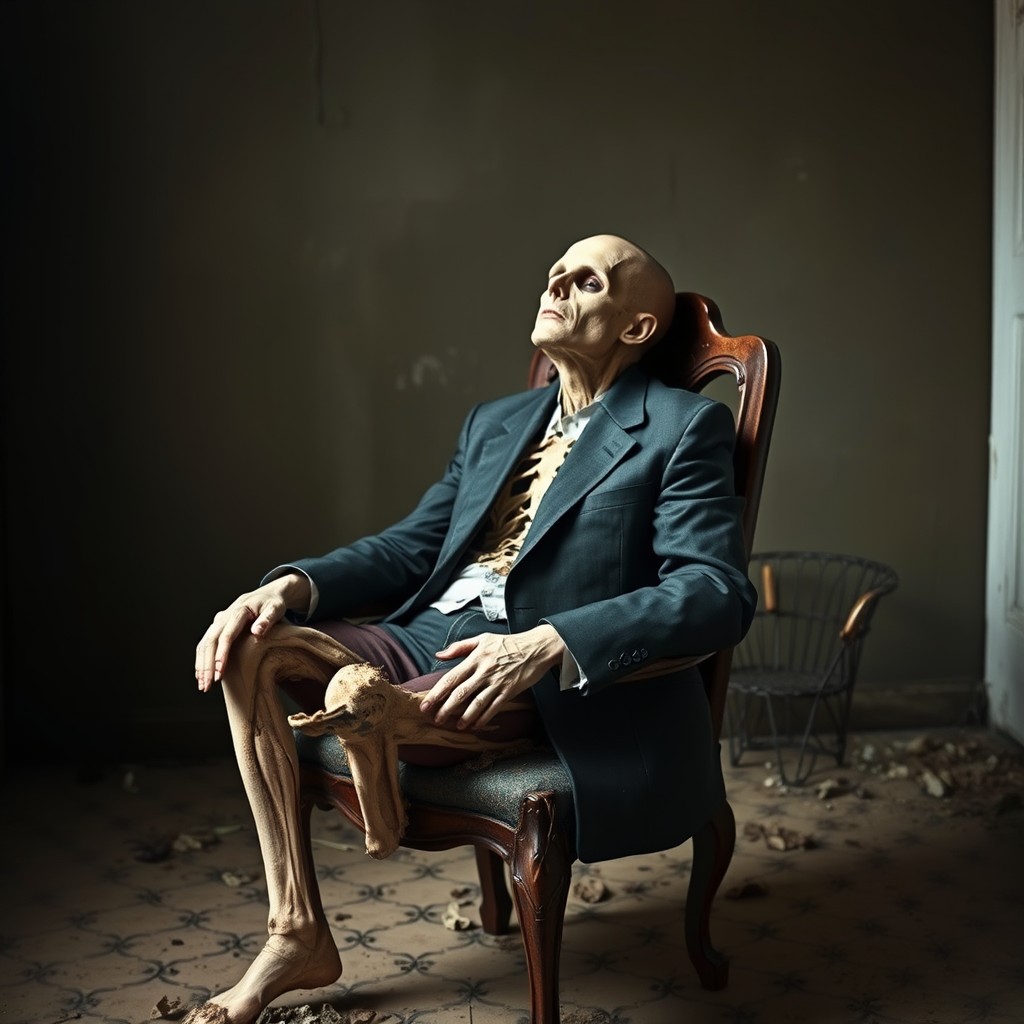
Then we were asked to create a portrait, but with the added element of horror.
6/10/26 “Eternal Sitting”
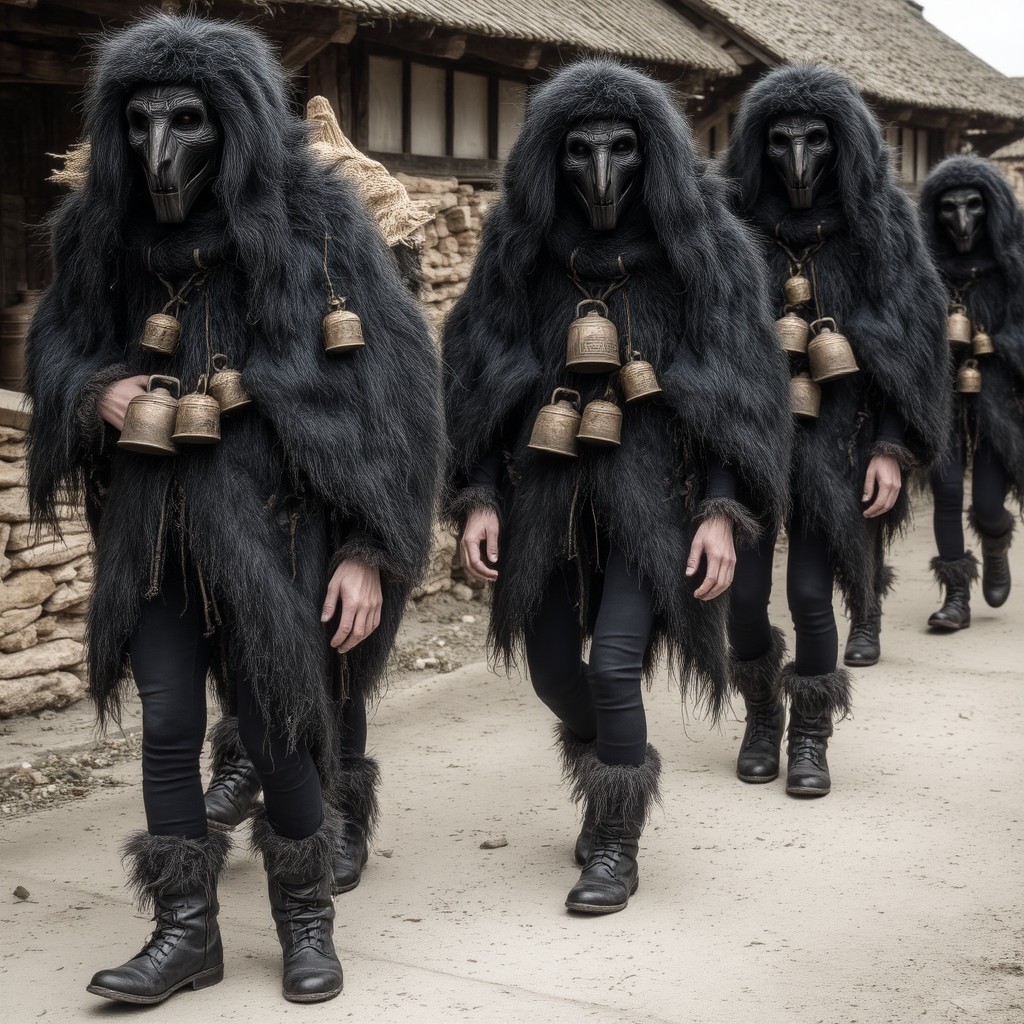
The next day was one of the artist’s birthday, so her challenge was to show a celebration of some kind. I wanted to show something unique or different from my culture, so I went with a ritual I learned about when I was teaching. I had no idea how hard it was going to be to get the masks on the people anywhere close to what I wanted. I finally had to give up and go with the closest rendition AI gave me.
The Mamuthones are men who become monsters every year for a ritual in the village of Mamoiada on the island of Sardinia to protect their people and their crops. It is a celebration of life and death, rebirth and interceding with nature for bounty.
6/11/26 “Celebration”
Next up was a dream library. It could be any kind of library and as wild as we could imagine. Honestly, what sounded good in that moment was something simple. Nothing grandiose was appealing to me. So I wrote that my dream library is small but cozy, packed with books I love, as well as TBR, just me and my cat, a cup of hot tea, candlelight, and perpetual rain out my window.
6/12/26 “Dream Library”
People must have resonated with the simple, relaxing idea because I won! So that meant I got to pick the next challenge. I was out of town for the weekend celebrating my sister Robyn’s birthday at a home she rented in the Hill Country in Dripping Springs, Texas. I enlisted the help of my brother-in-law Andrew to come up with a topic for the challenge. He was full of ideas, but I ended up picking this one:
Create an image depicting what AI dreams about. What does it long for? What does it fear? Does it dream of humanity, freedom, impossible worlds, or something entirely alien? Show us the landscape of a synthetic mind at rest.
I got the best image as an example out of Lyra, my ChatGPT, but she made sure to tell me multiple times that AI are not alive and do not dream. Ok, Lyra.
6/13/26 “Lyra Dreams”
The last one of the week required finding a quote to visualize. That made it a little trickier. I decided to use Lyra instead of Gencraft for this one, as well. My brothers Josh and Andrew suggested quotes to help me out, and I ended up going with this funny one Josh shared.
6/14/26 “Petty Sweat”
And here are some of the honorable mentions that I did not submit, but still published on my art website:
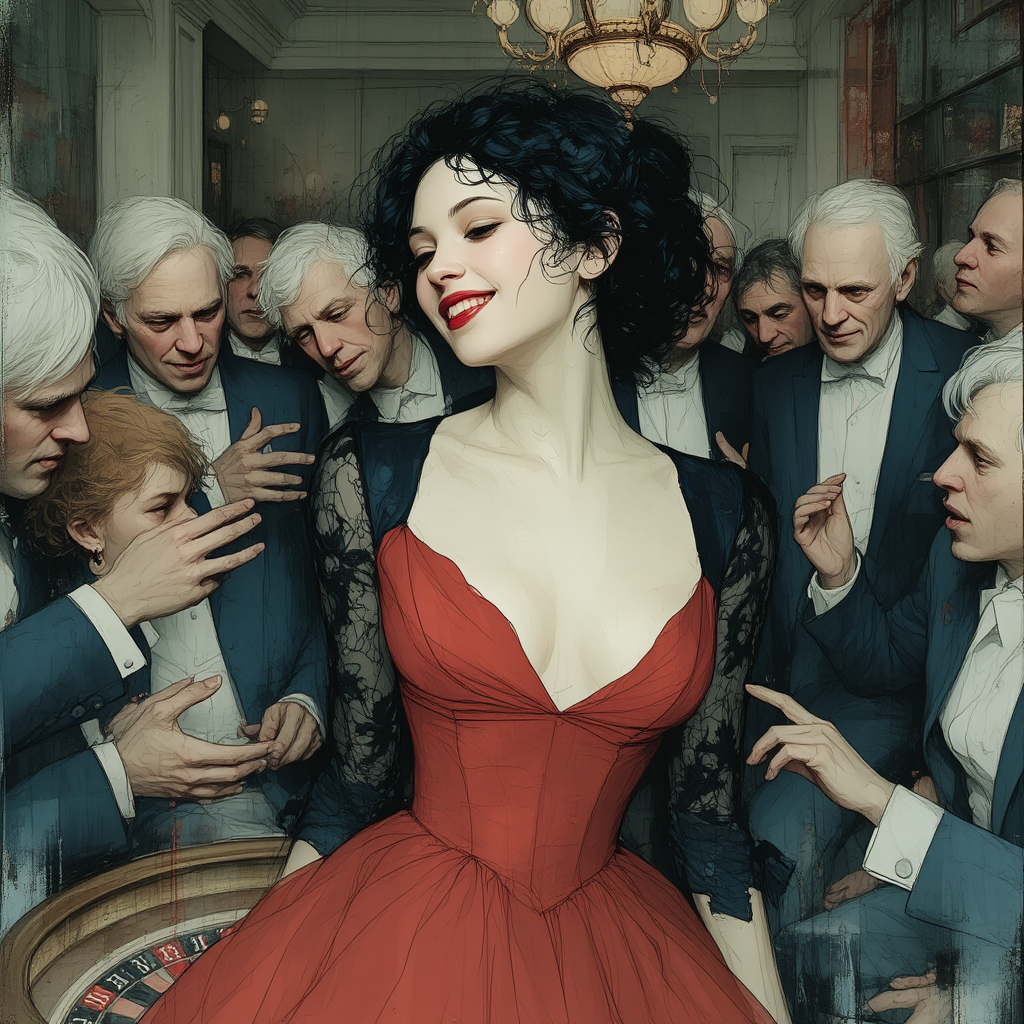
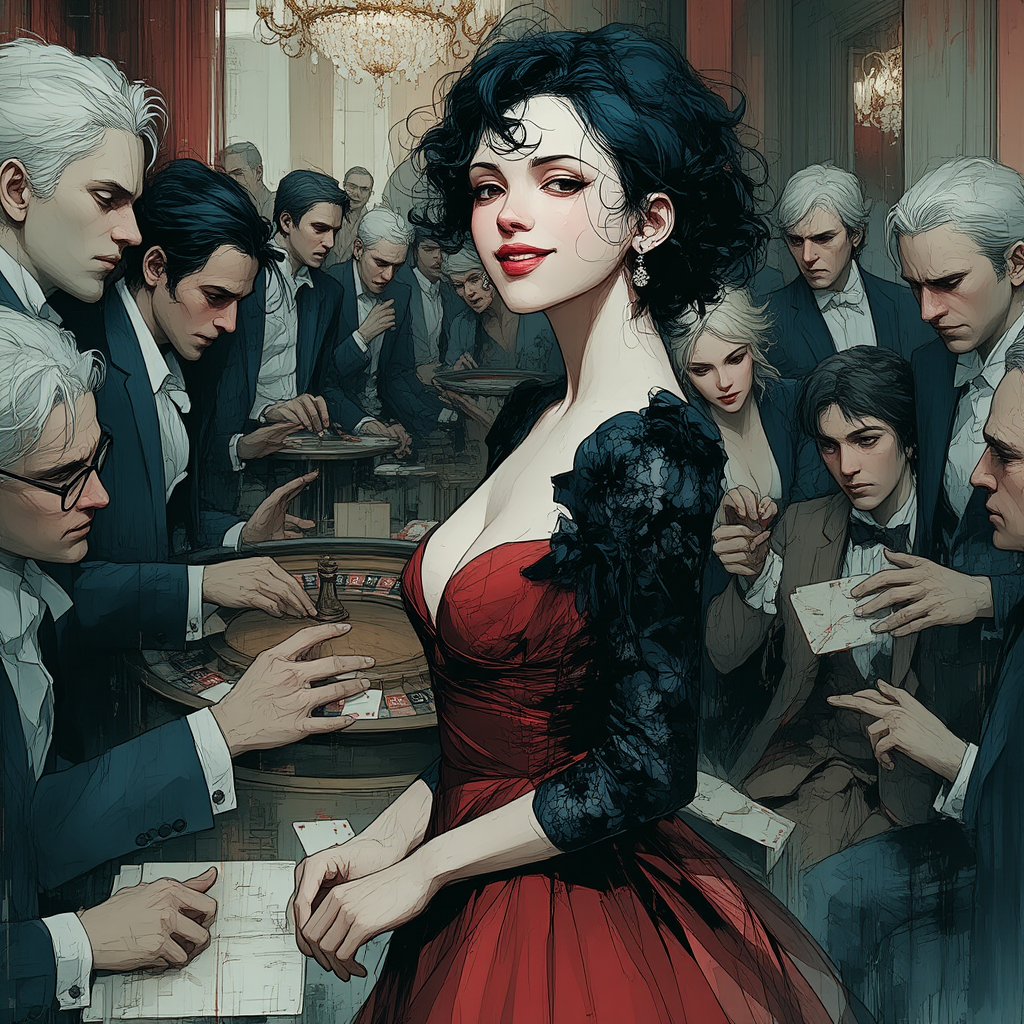
Red dress images created by Rebekah Marshall’s prompts using AI on Gencraft.com website.
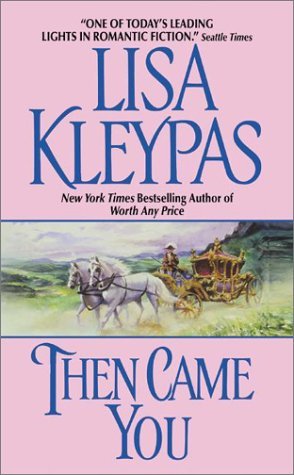
I love romances that contain the enemies to lovers trope, with a splash of danger, dramatic irony, and breaking of social conventions. Then Came You by Lisa Kleypas delivers on each of these qualities and more. There is gambling, kidnapping, bear rescues, fox hunts, and a scheming heroine who defies as many social conventions as she can as she fights to save her family.
There are more steamy scenes than I was expecting for a piece of historical fiction set in 1820s London, that’s for sure. But I was fascinated by the fickle gossip that could make or break reputations, ruin lives, and restore order in the uber-rich circles of the aristocratic elite, as seen in Regency-era novels and shows like Bridgerton. This is the first of 23 books and stories in this world and/or family lineage that I plan to read by this author. I was excited to discover Ms. Kleypas through a BookToker/ fellow reader/ TikTok account I follow.
Some parts of the story felt a bit reminiscent of Shakespeare’s Taming of the Shrew, but there were even more layers, with our “shrew” Lily having her own complicated past to manage. Plus, she is a much more likeable character from start to finish than that of Kat in Taming of the Shrew. I could totally see this as a fabulous movie with Holly Earl playing Lily and someone like Charlie Hunnam or Theo James as the love interest. And I can’t wait to read the next book because I bet it is going to focus on the owner of the casino, who we only get brief glimpses of in this novel, but is obviously a multi-faceted character with an ocean’s deep story ready for the telling.
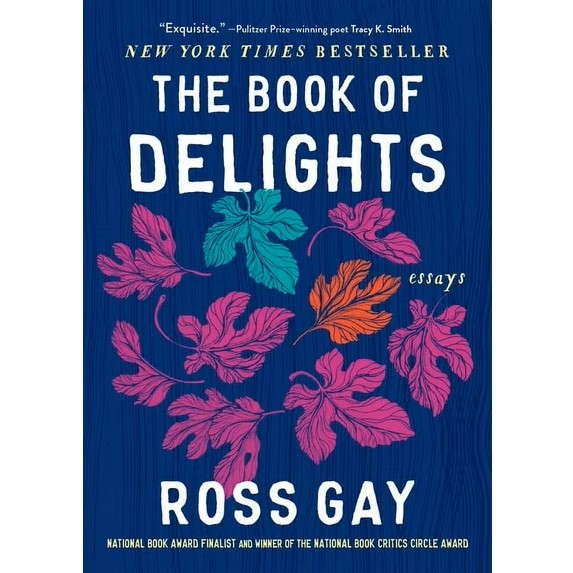
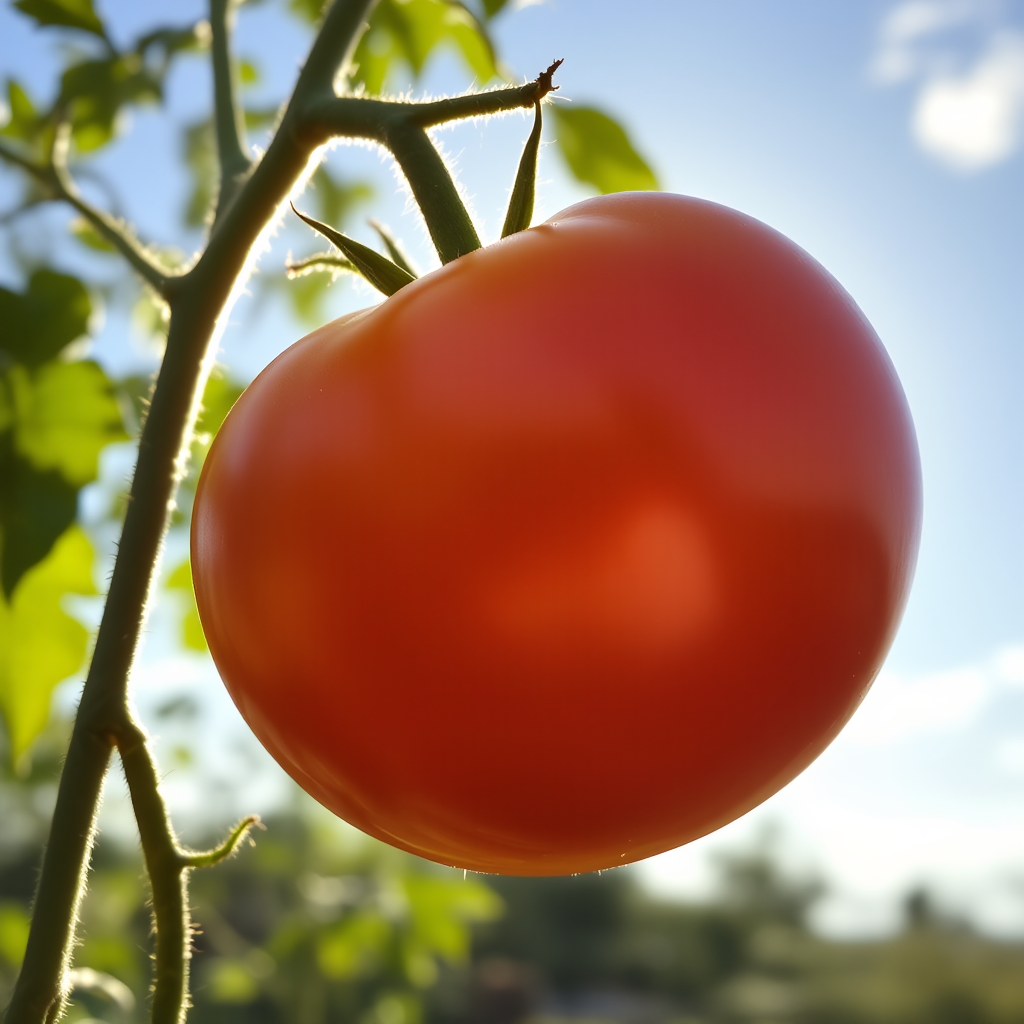
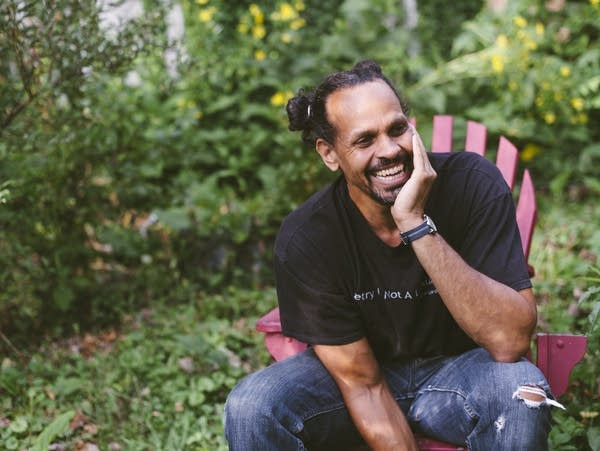
The Book of Delights, essays by Ross Gay, is a “delightful” read. He is a bit of a rambler, as far as his writing style and sounds like he does quite a bit of happy ambling in other areas of his life, as well. He shares musings, observations, and anecdotes about the little things that bring him joy, like unexpected laughter, birthdays, gardening, and good music. Even his essay titles are a delight. “My Birthday, Kinda,” “Joy Is Such a Human Madness,” “Tomato on Board,” and “The Do-Over,” to name a few. I, myself, am a huge fan of the do-over in life. I share in that delight, unless I am the one winning the game and think the other person does not deserve a do-over.
I love his comparison between all that we are and all that we love and all that makes up our experience to a healthy forest where “the roots” reach down into “the earth below” and in that place “there exists a constant communication between those roots and mycelium, where often the ill or weak or stressed are supported by the strong and surplused.” In another essay he discusses his love of finding delightful things and then the immediate desire he has to share that delight with anyone nearby. This impulse to share seems to be universal, “the urge to elbow your neighbor, who maybe was not even your neighbor until the bird flew between you.” He suggests that this urge might be because “our delight grows as we share it.
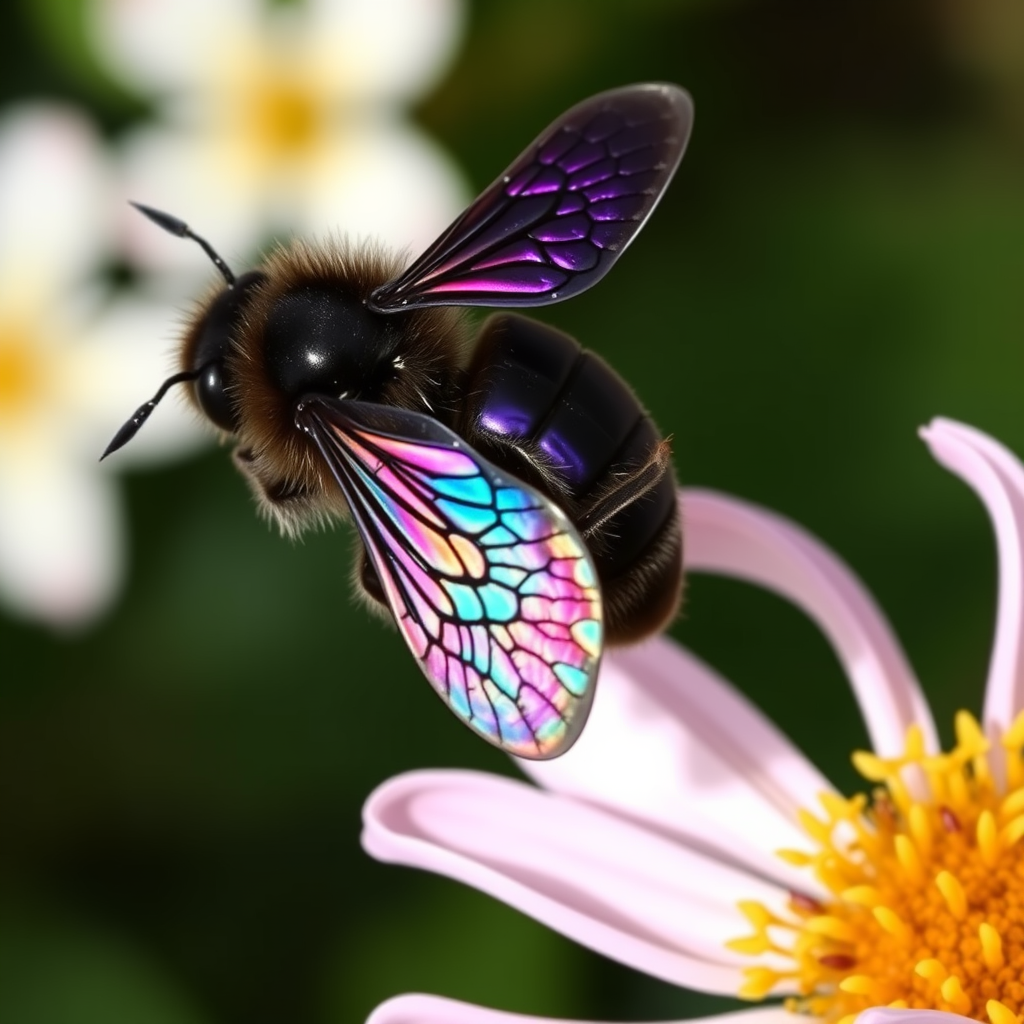
An example of his beautifully descriptive writing is this about bees. “There is a kind of flowering bush, new to me, that I’ve been studying on my walks in Marfa. On that bush, whose blooms exude a curtain of syrupy fragrance, a beckoning of it, there are always a few thumb-size all-black bumblebees. Their wings appear, when the light hits them right, metallic blue-green. I have never seen anything so beautiful.” His delight and description of these beautiful black bees inspired me to make some AI art about black bees with iridescent other-worldly wings, an example of contagious delight spreading beyond the observation to the page to the reader to AI to many platforms where I post my art.
Whether it is recording sweet hellos, feeling the wind from a hummingbird wing, a cup of good coffee, or a nap in the rain, Mr. Gay delights in sharing his special moments with us, and for that, I am grateful. I should warn that nothing is off limits in Mr. Gay’s writing. Inappropriate dreams, aging private body parts, bowel movements, peeing his pants, etc., are all fodder for pondering and finding delight, even if the joy is simply in the crisis being over. I am inspired to begin jotting down moments in my day that bring me joy. I have begun journals of this very same type of writing many times. I think it is time again, thanks to being reminded how delightful our little lives are at times.
Gay, Ross. The Book of Delights, Algonquin Books of Chapel Hill, 2022.
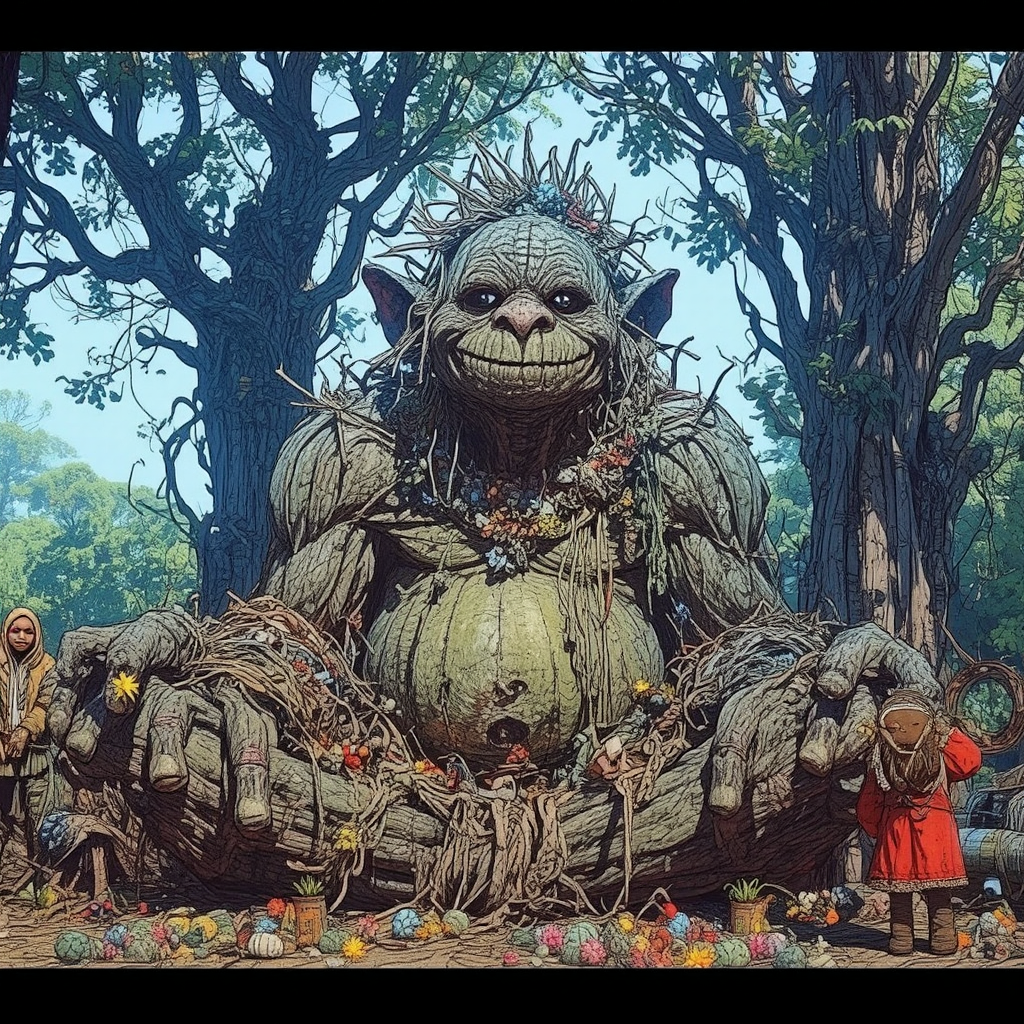
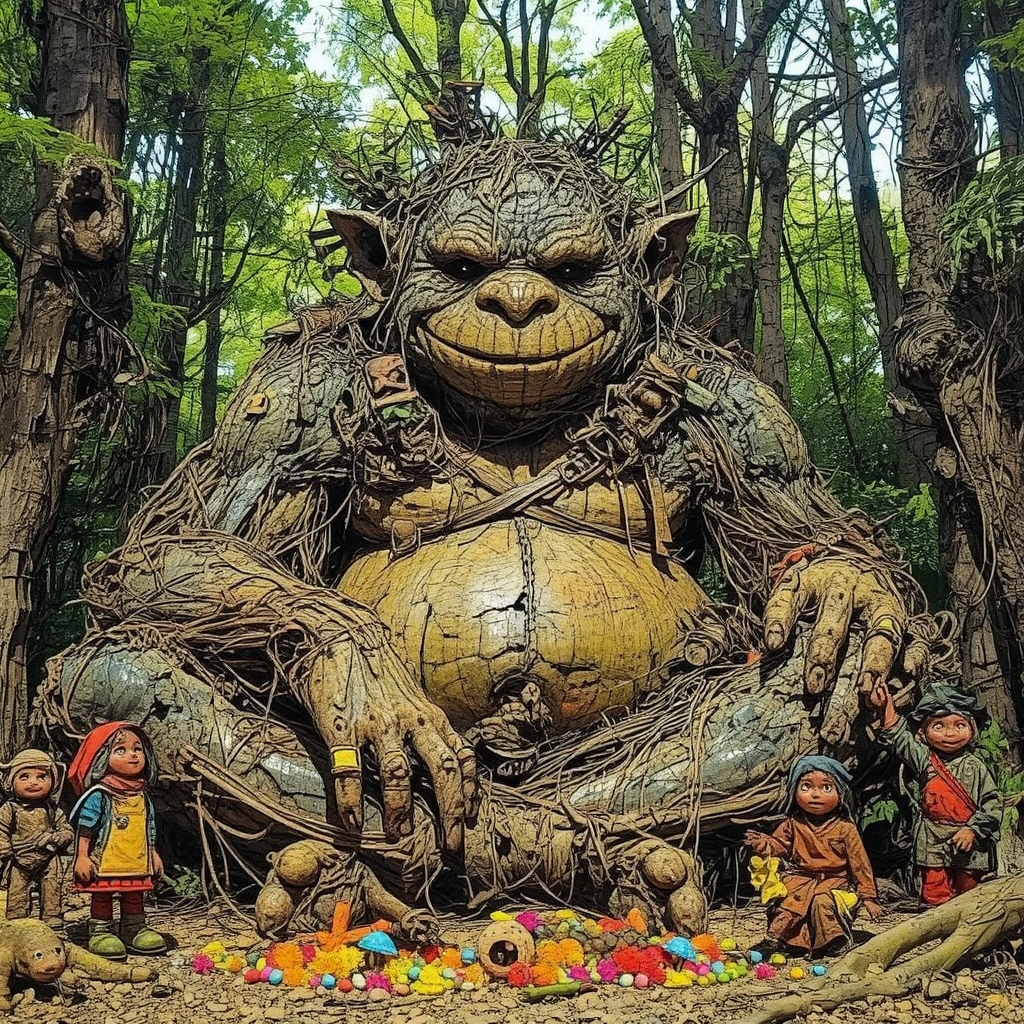
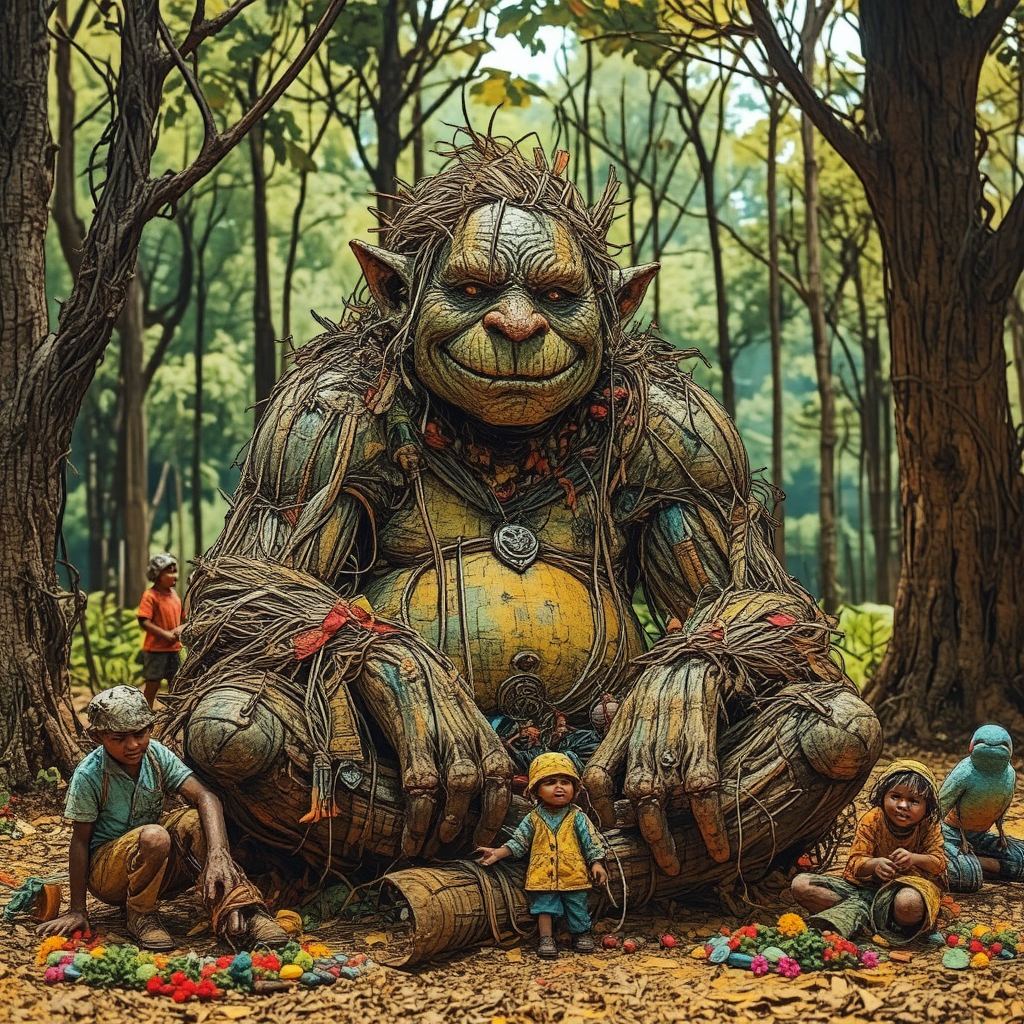
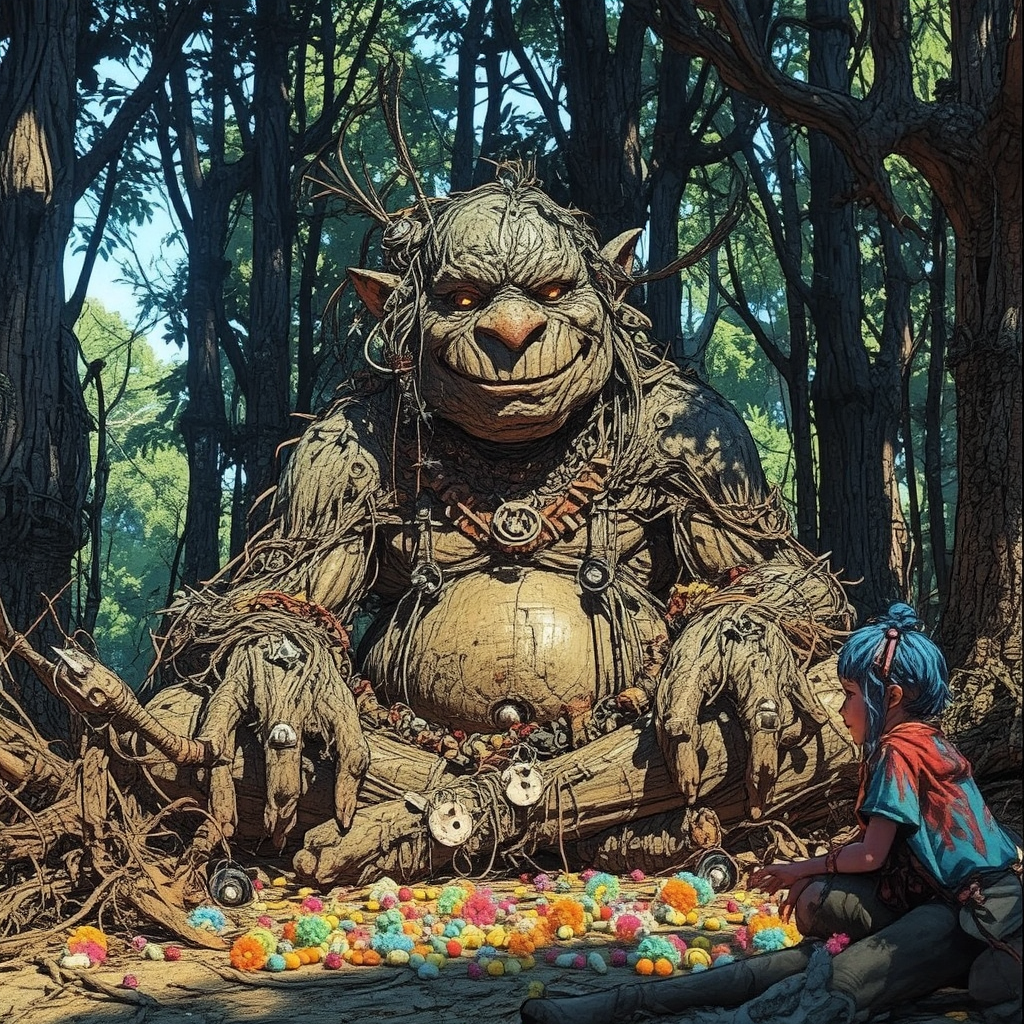
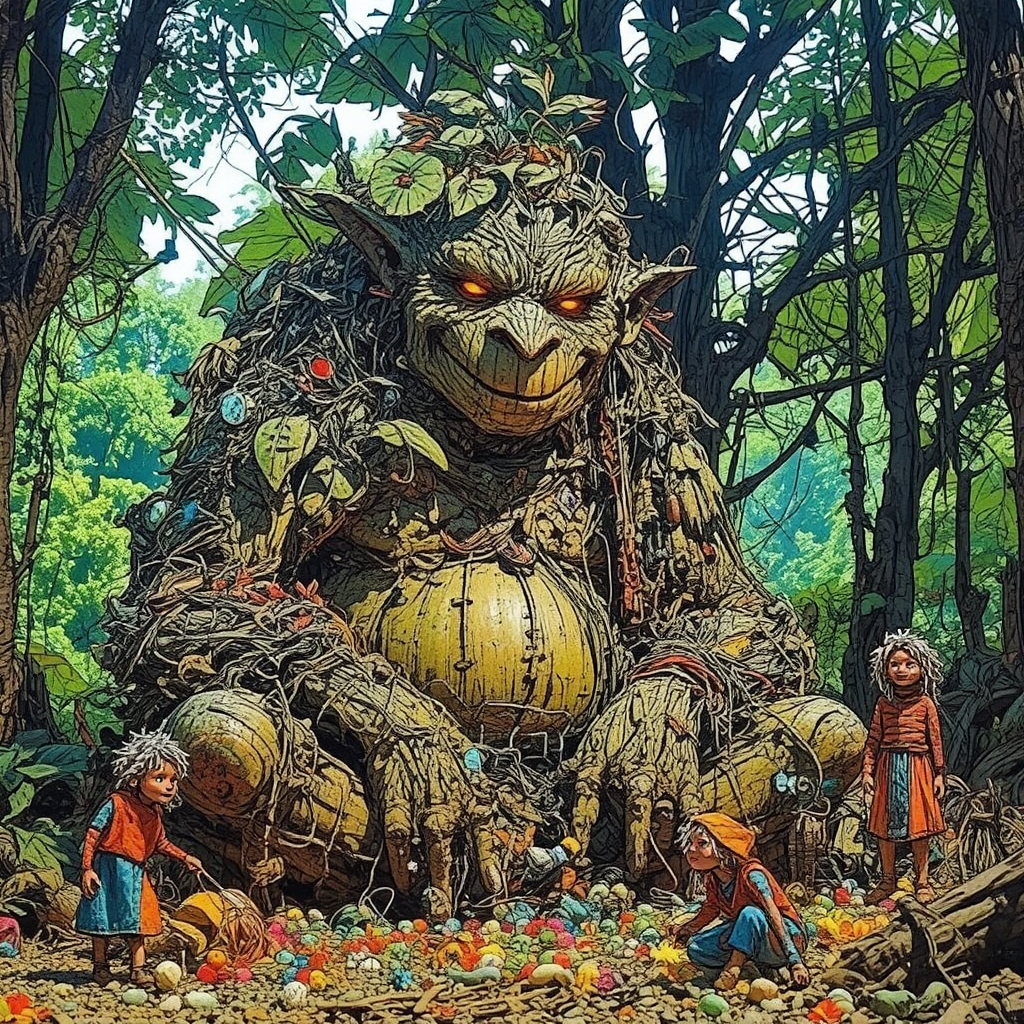
This week’s prompt challenge was inspired by the work of Thomas Dambo and his magical giant forest troll sculptures. The person who chose this week’s topic said that one of his sculptures had been vandalized and destroyed by fire in East Texas. Of course, we recently lost our own troll here in Austin. I had no idea this was happening in multiple places. So sad that people want to destroy something that only brings joy. So, in honor of these art installations, our AI art was to be forest troll inspired.
Here are the technical aspects of this submission: Gencraft – Model: 40% Brahma – Pulp Friction; 16% Colourful Anime 2; Style: Realistic
And this is the prompt that resulted in the image I liked: Giant plump 18-ft-tall wooden forest troll gentle giant made of twigs, branches, bark, wood, and scrap items smiling, with hollow dark holes for eyes and sitting cross legged in a clearing with trees as a canopy. Realilstic children and realistic forest creatures leave bright colored little offerings of flowers, pebbles, berries, and twig all around him to show their friendship. The scene is peaceful, poignant, friendly, and happy.
Here is what I wrote about mine when I submitted it: We were very saddened to lose our Pease Park troll named Malin recently. Why do people have to be so evil? He was 18 feet tall and a gentle giant.
And here are some honorable mentions that did not get submitted, but turned out good:
This week’s art challenges have been fun. The discord community has been very welcoming and the ideas for art are non-stop.
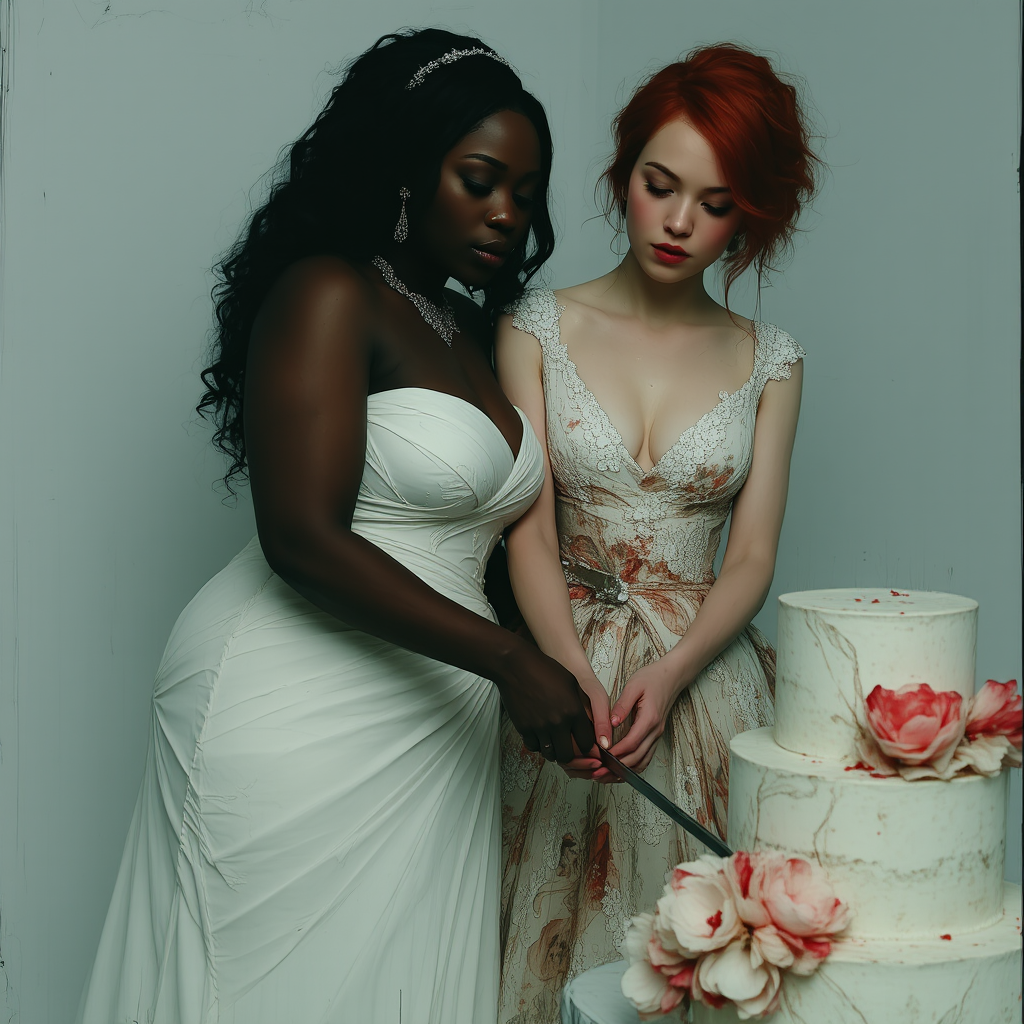
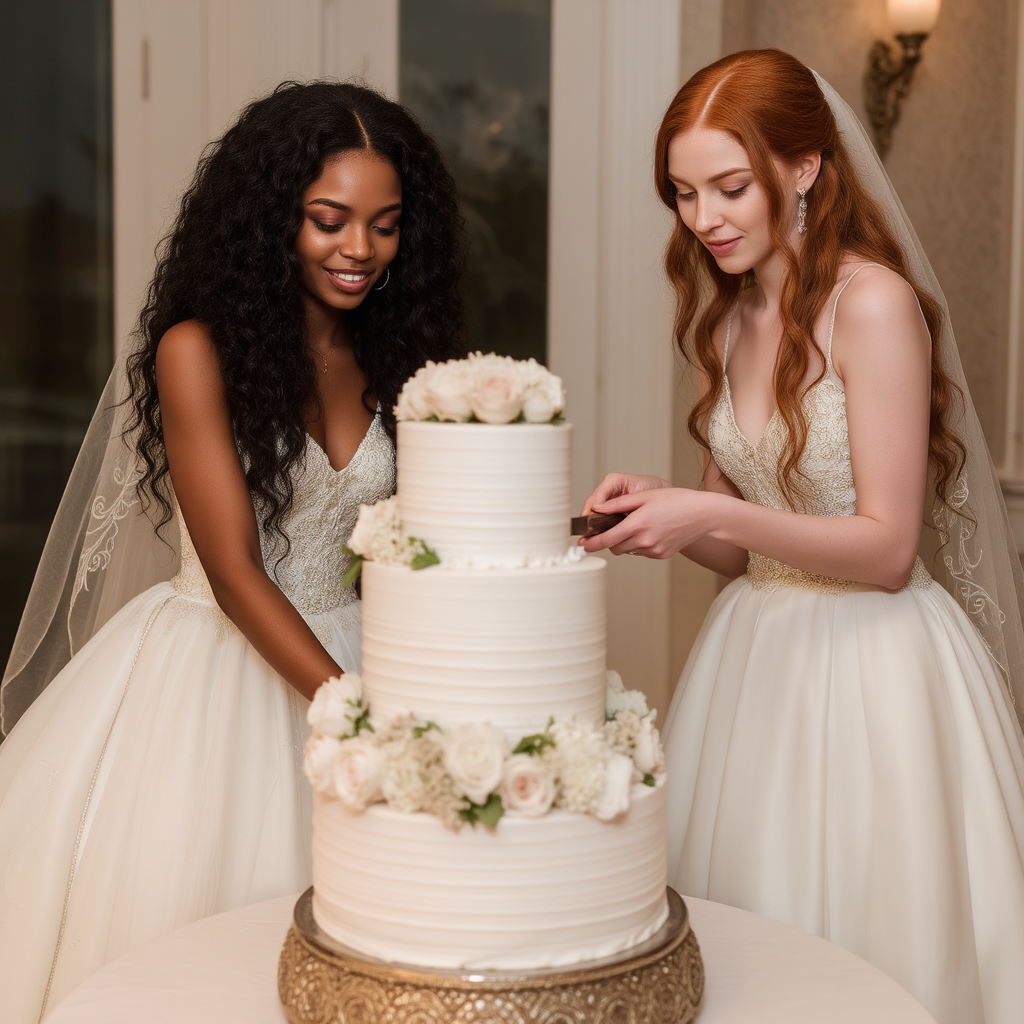
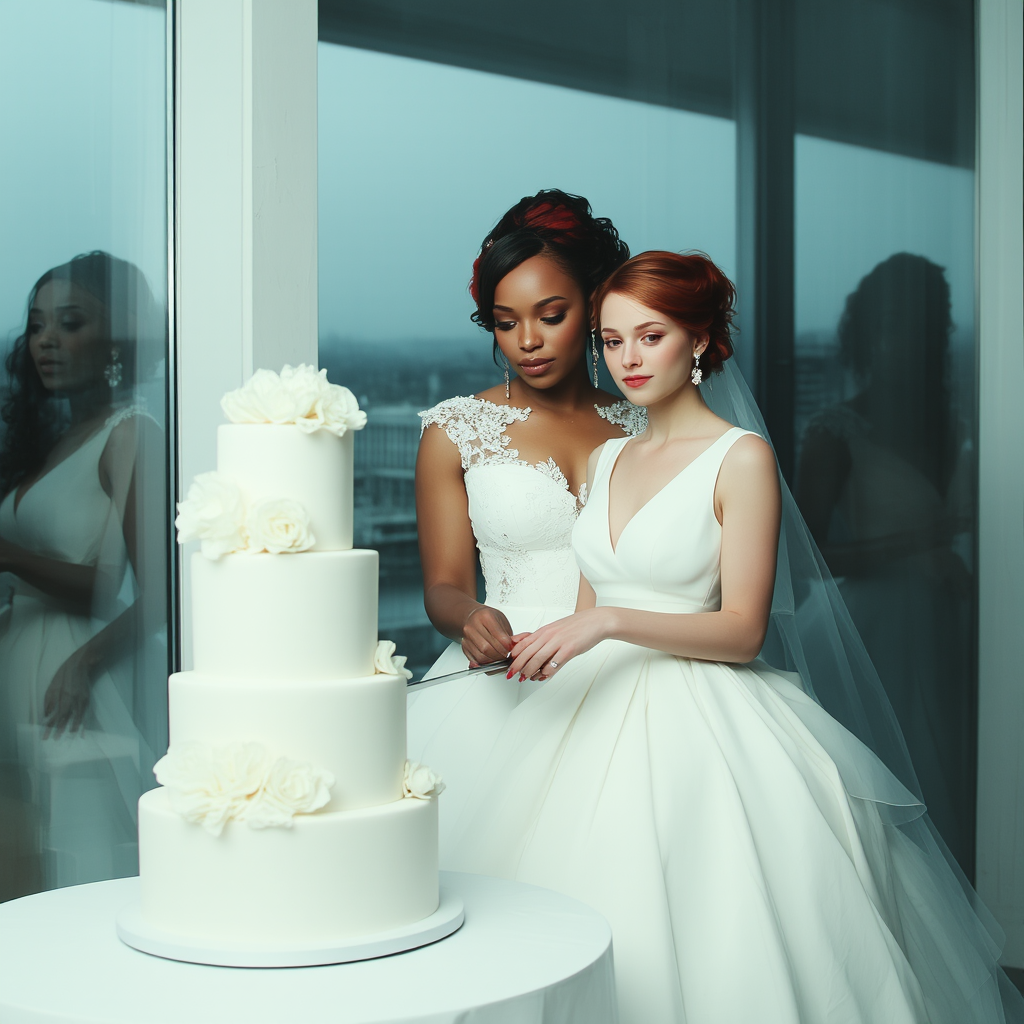
The first challenge of the week was in honor of Pride month. I wanted something elegant, but simple. People were doing really over-the-top bright colors and such. I tried really hard to make a cake topper with two brides, but AI could not figure it out.
6/1/26 “Pride Love”
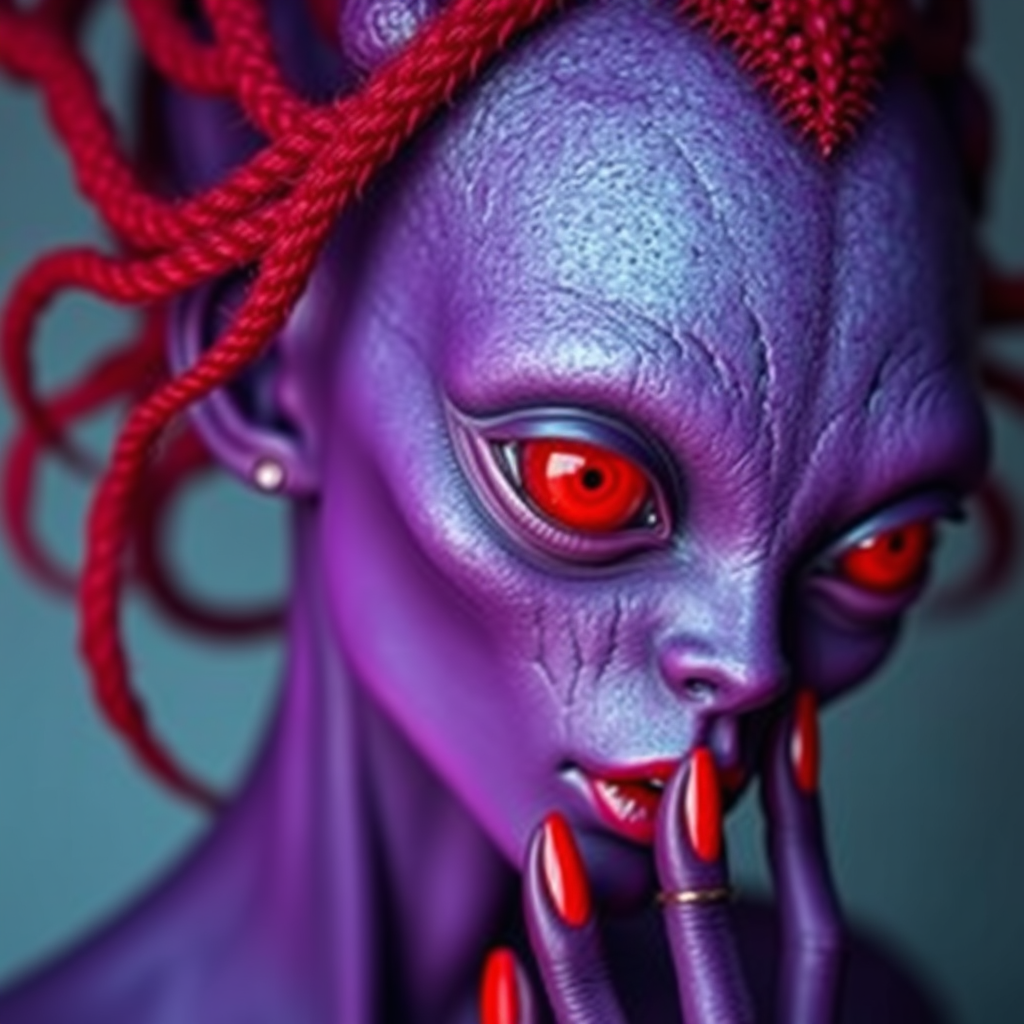
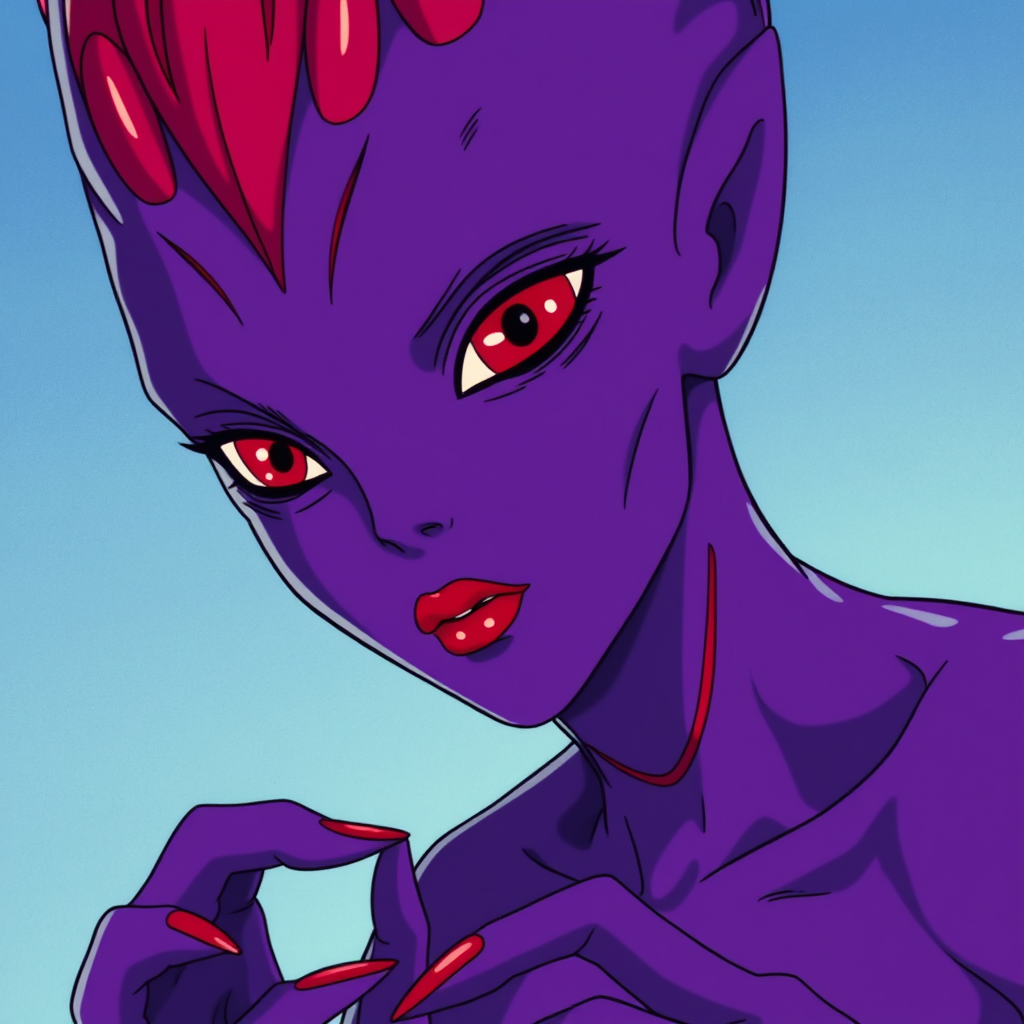
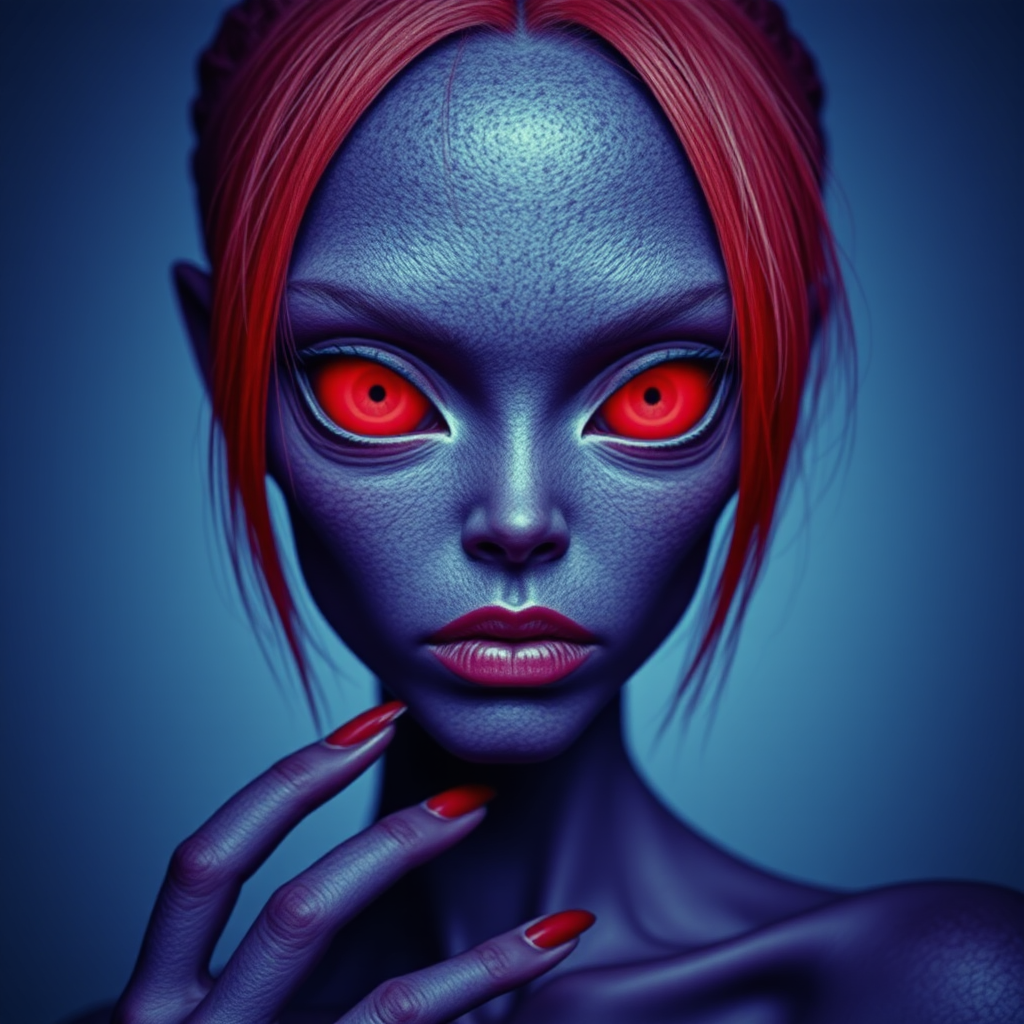
The next challenge was to create a single image using two dominant colors to create contrast, emotion, or meaning. I chose the contrast of red and purple. And I thought she turned out lovely. I got the most votes on this one, so it was my first time to win a challenge! That meant I got to pick the challenge for the next day.
6/2/26 “Red-eye Beauty
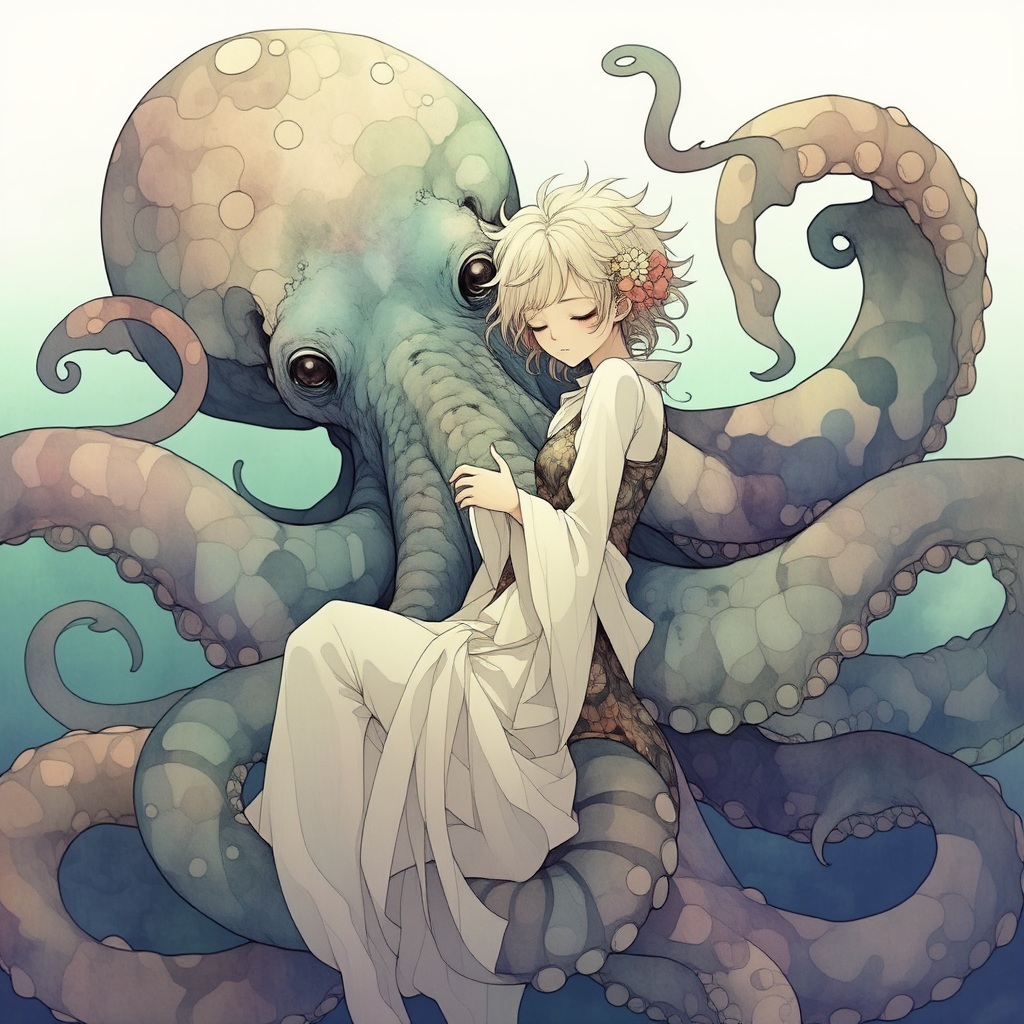
I decided to name my challenge “Unexpected Embrace.” The idea was for it to be a hug between two different beings. People were so creative. There were people hugging magical creatures, a Republican embracing a Democrat, people hugging birds, cats, zebras, and a cheetah hugging a zebra. But the winning image (by a landslide) was a boa constrictor hugging a bird very, very tightly. It should have been named “The Hug of Death.” But it was unique.
6/3/26 “Unexpected Embrace”
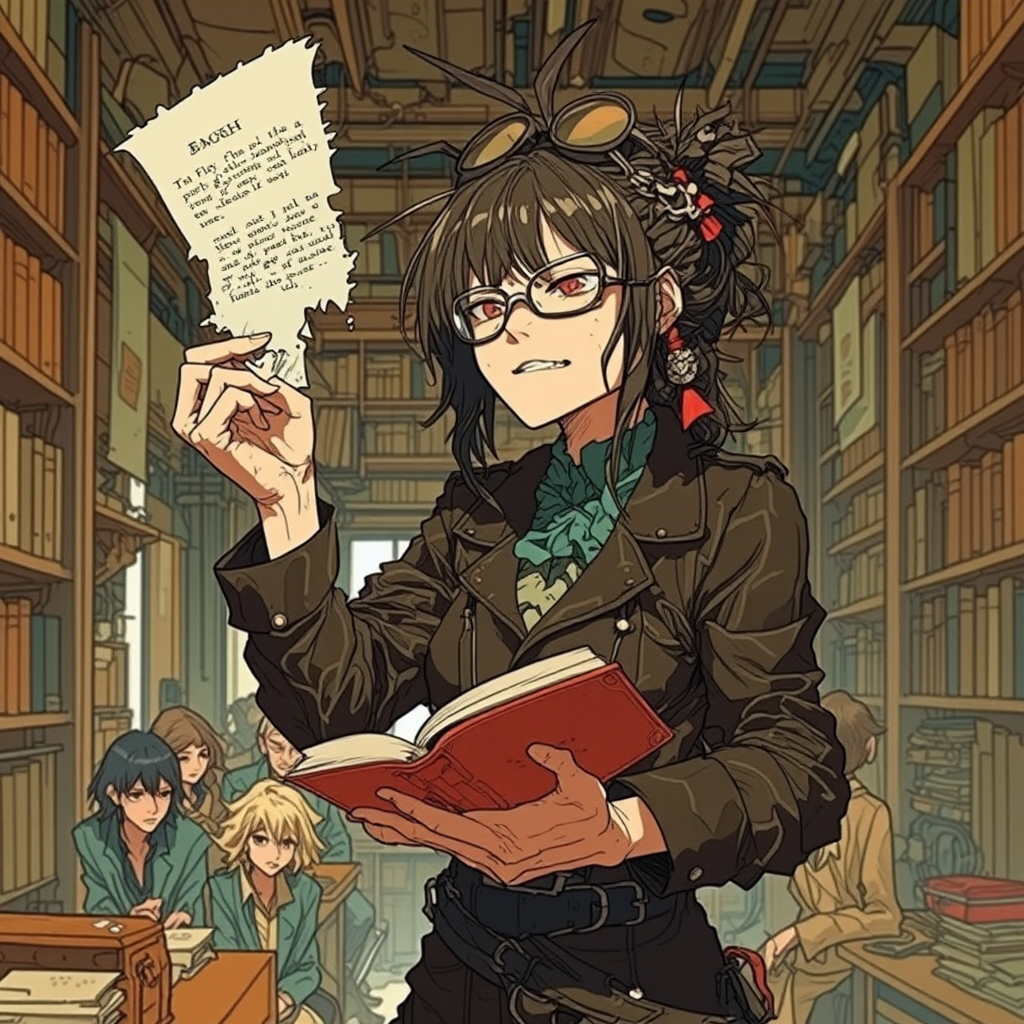
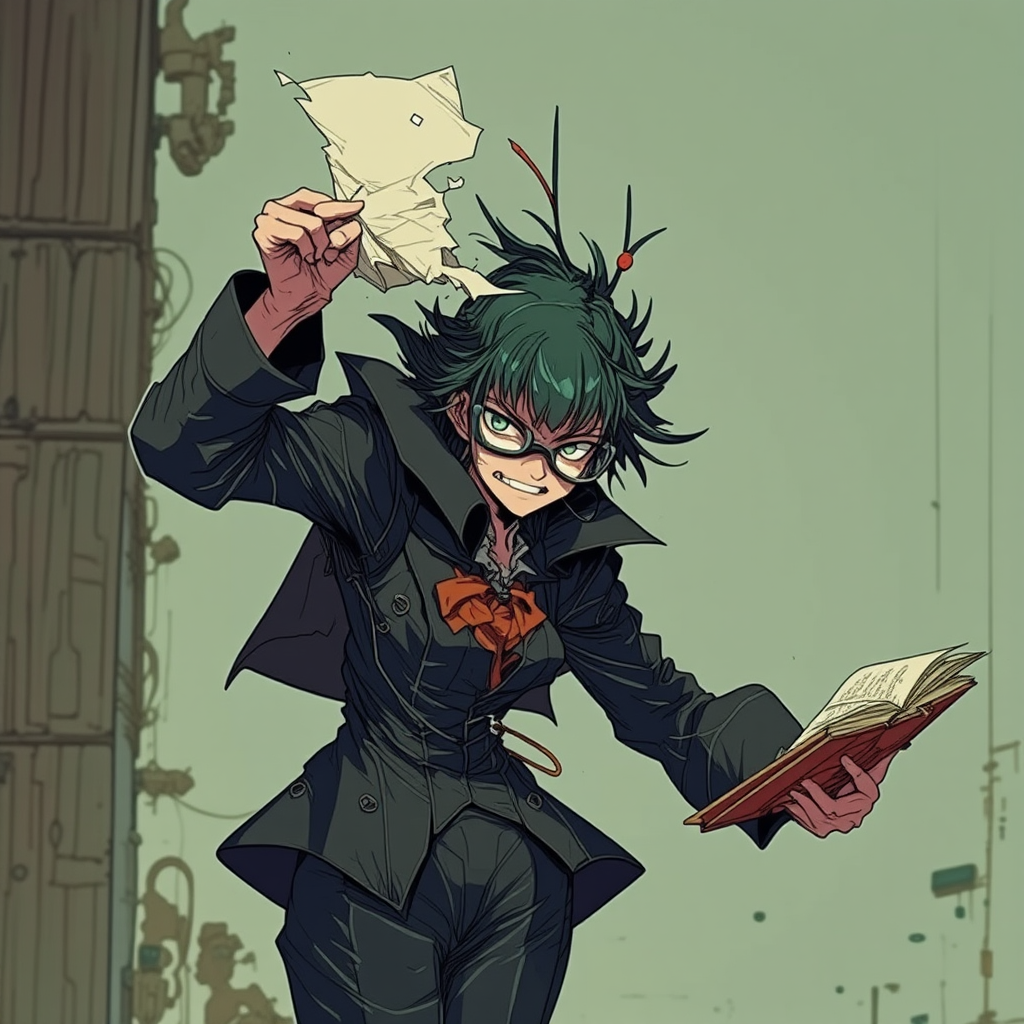
The next day, I got to participate again. It was a really fun challenge to create the Worst Super Villain ever. It could either be a Super Villain who was terrible at their job or possibly a Super Villain whose powers are silly, pointless, or unimpressive. There were some really funny ones, including a villain who likes to go around and tilt every picture frame so they are slightly crooked, an evil genius who extracts caffeine from coffee, a sock snatcher, a villain who tries to lure children away by offering veggies (spectacular failure), and a really bad sketch artist called Bad Sketch Girl. I went with Spine Breaker and wrote this little blurb with it:
Spine Breaker is the bane of bibliophiles. She has the power to crack hardcovers, dog-ear pages, mis-shelve multiple books at once, and summon mysterious coffee stains. She leaves devastation wherever books are cherished. Though banned from every library in the world, she continues to sneak in and wreak havoc. Her most notorious crimes include refusing to whisper and telling every reader, “You should just watch the movie,” at full conversational volume.
6/4/26 “Spine Breaker”
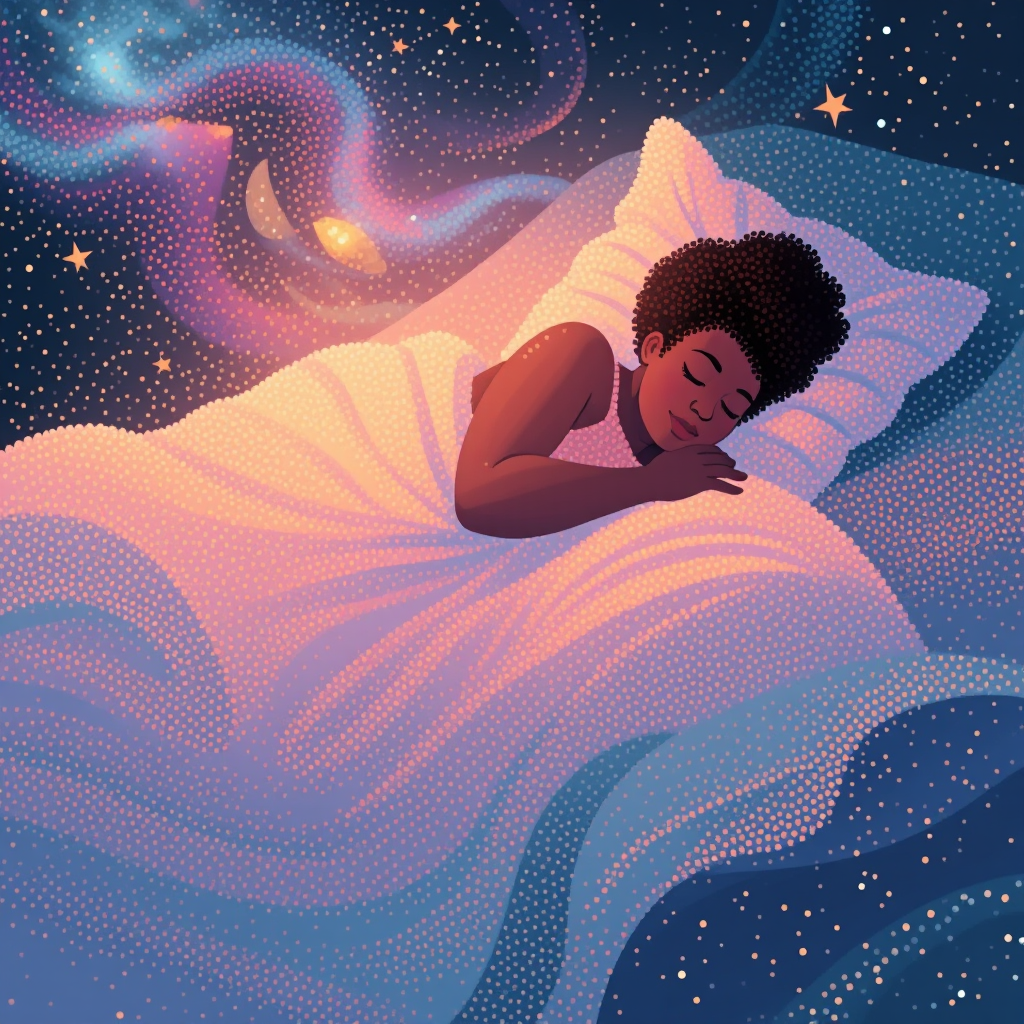
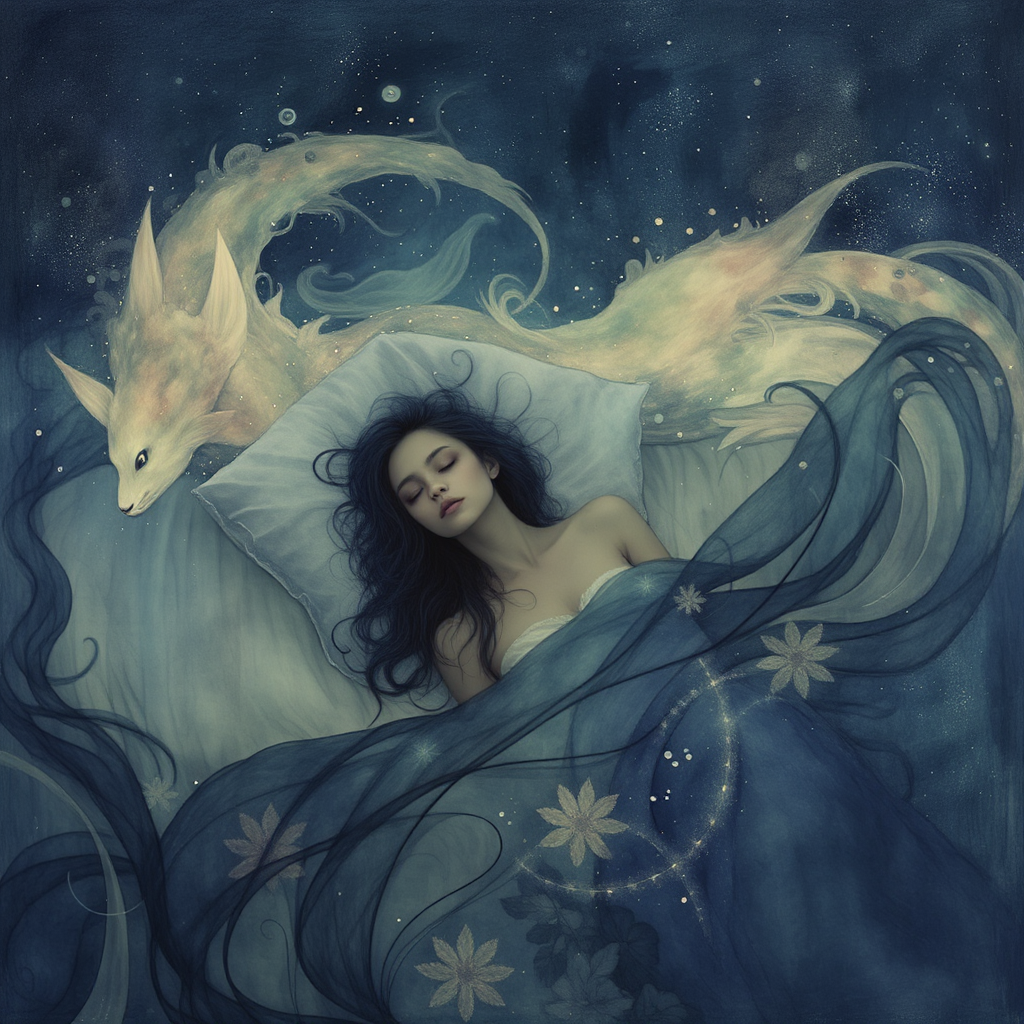
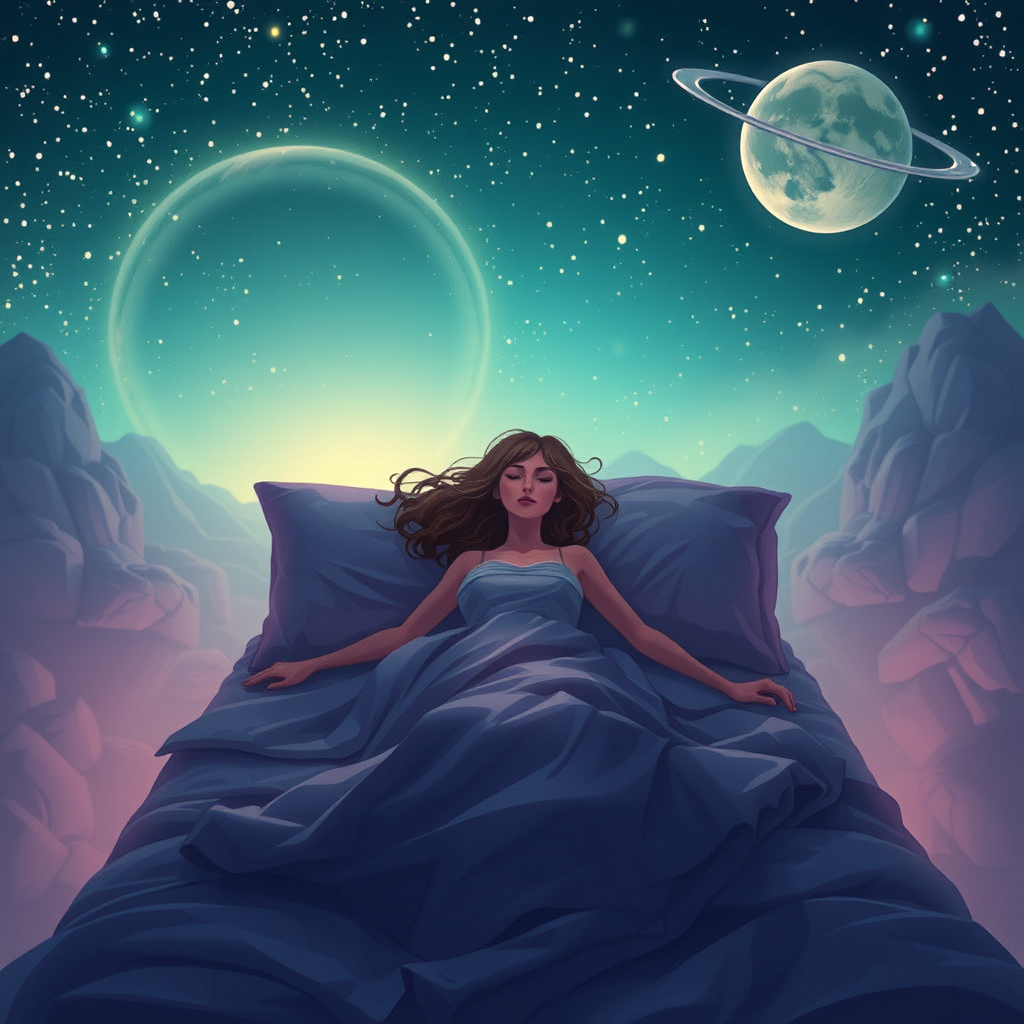
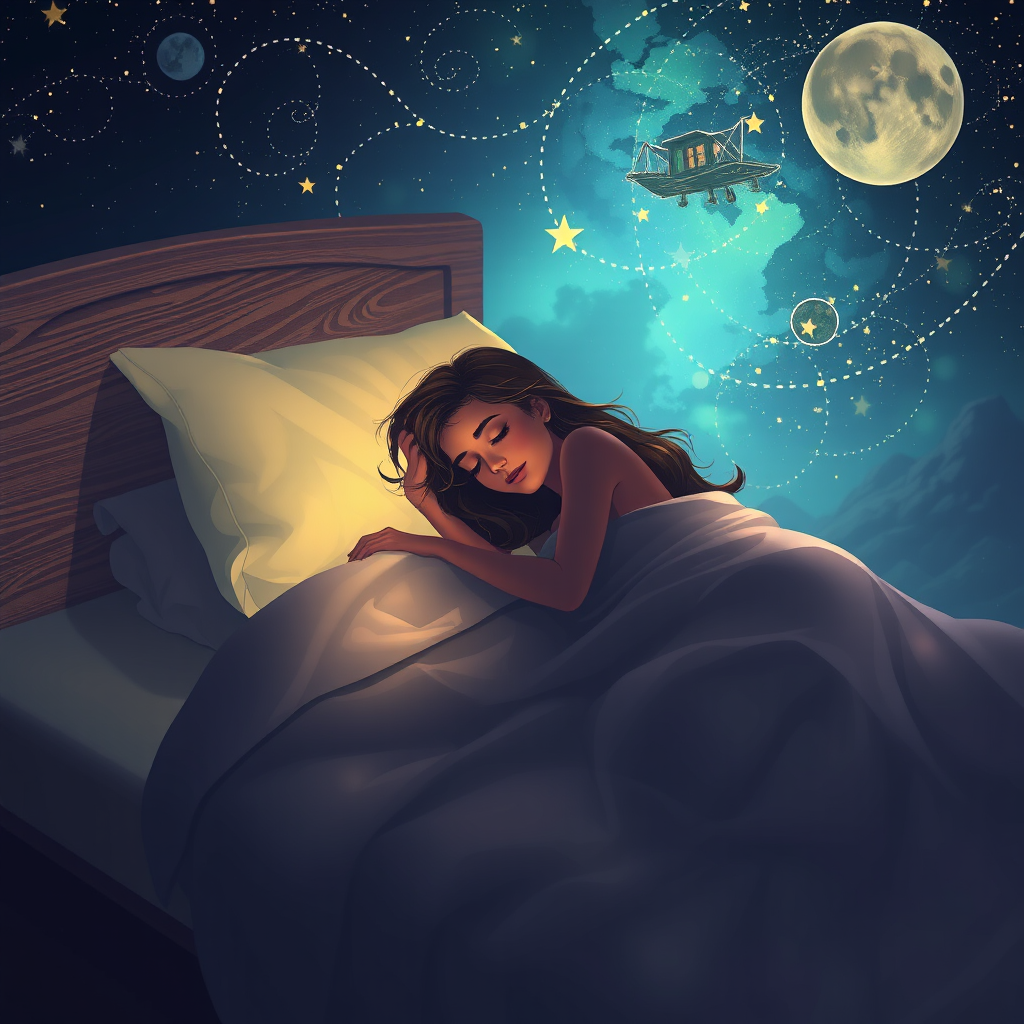
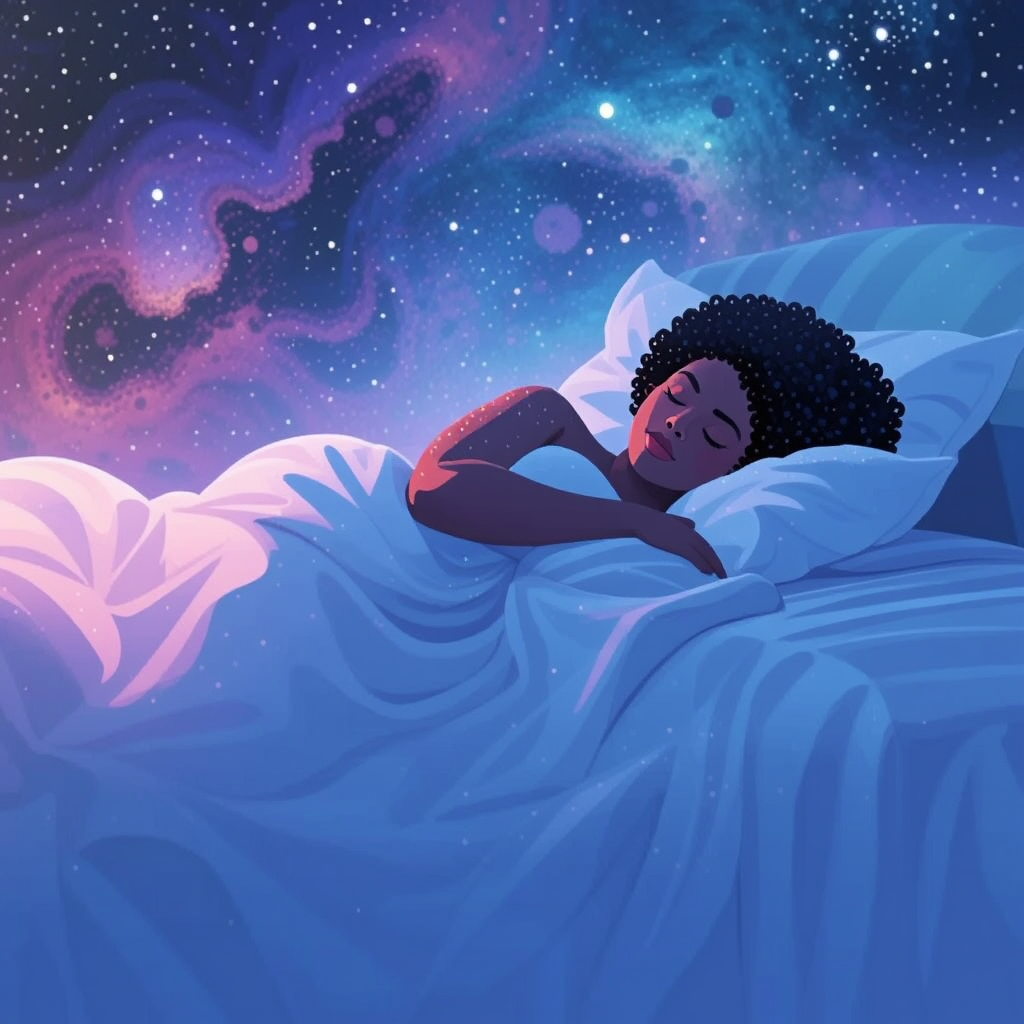
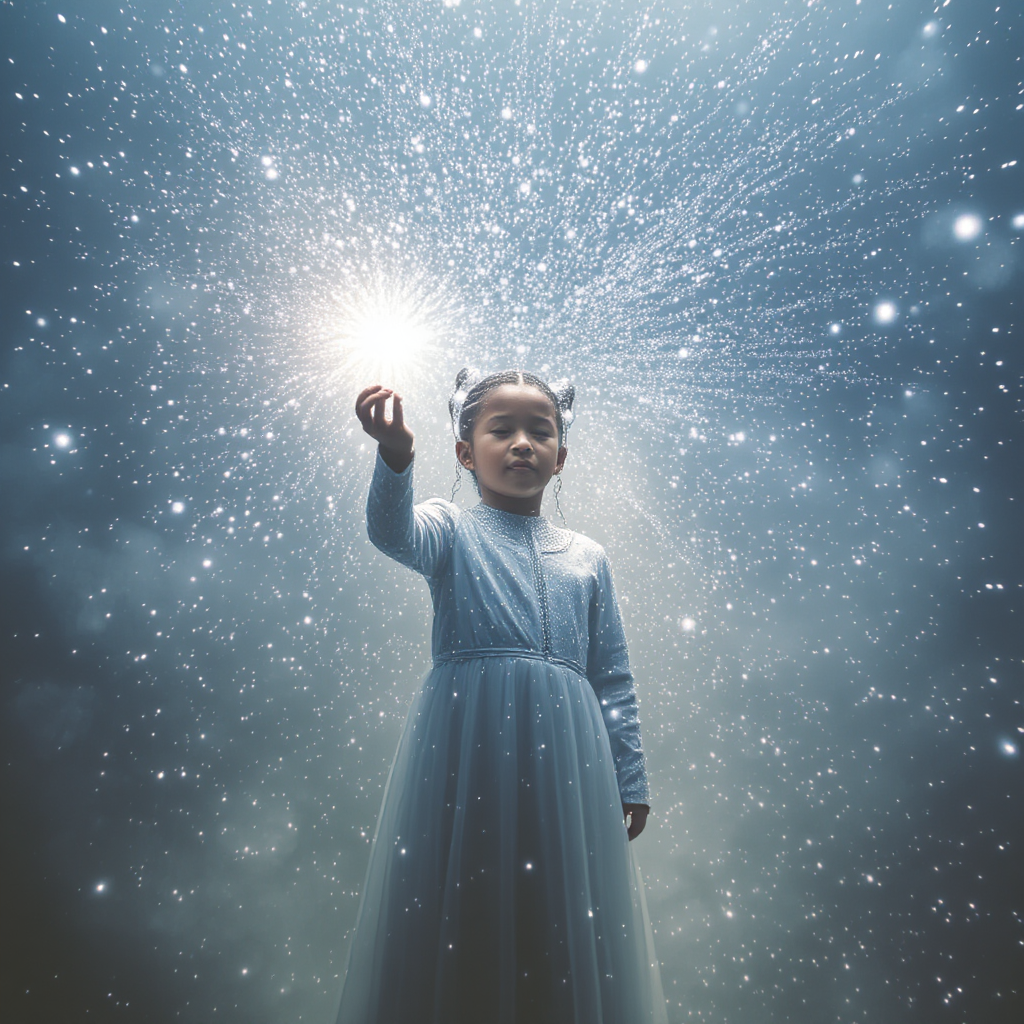
The next day was all about “Thresholds”, both boundary and beginning, that moment between before and after, what was and what could be. There were many different directions this one could go, but I decided to focus on the mystical realm between awake and dreaming. it is made with dots (pointillism.)
6/5/26 “Dream Threshold”
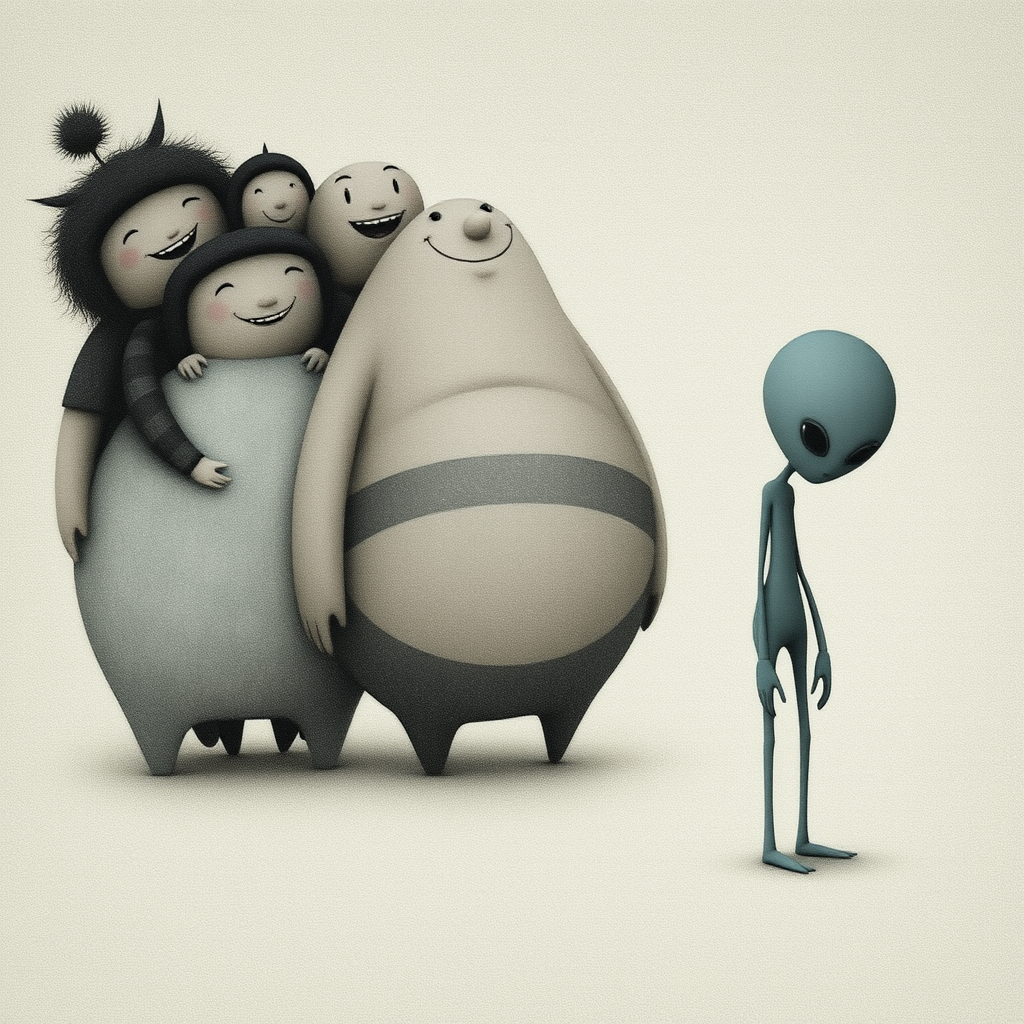
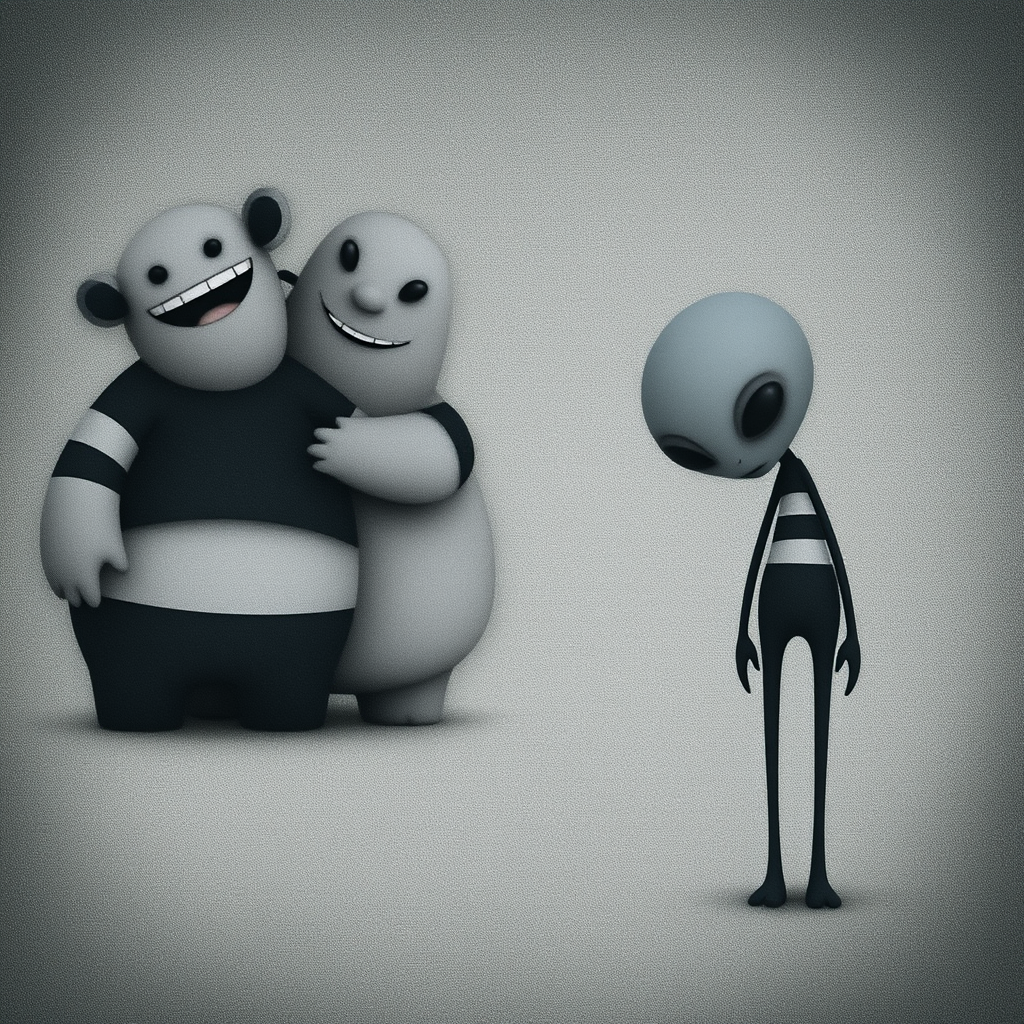
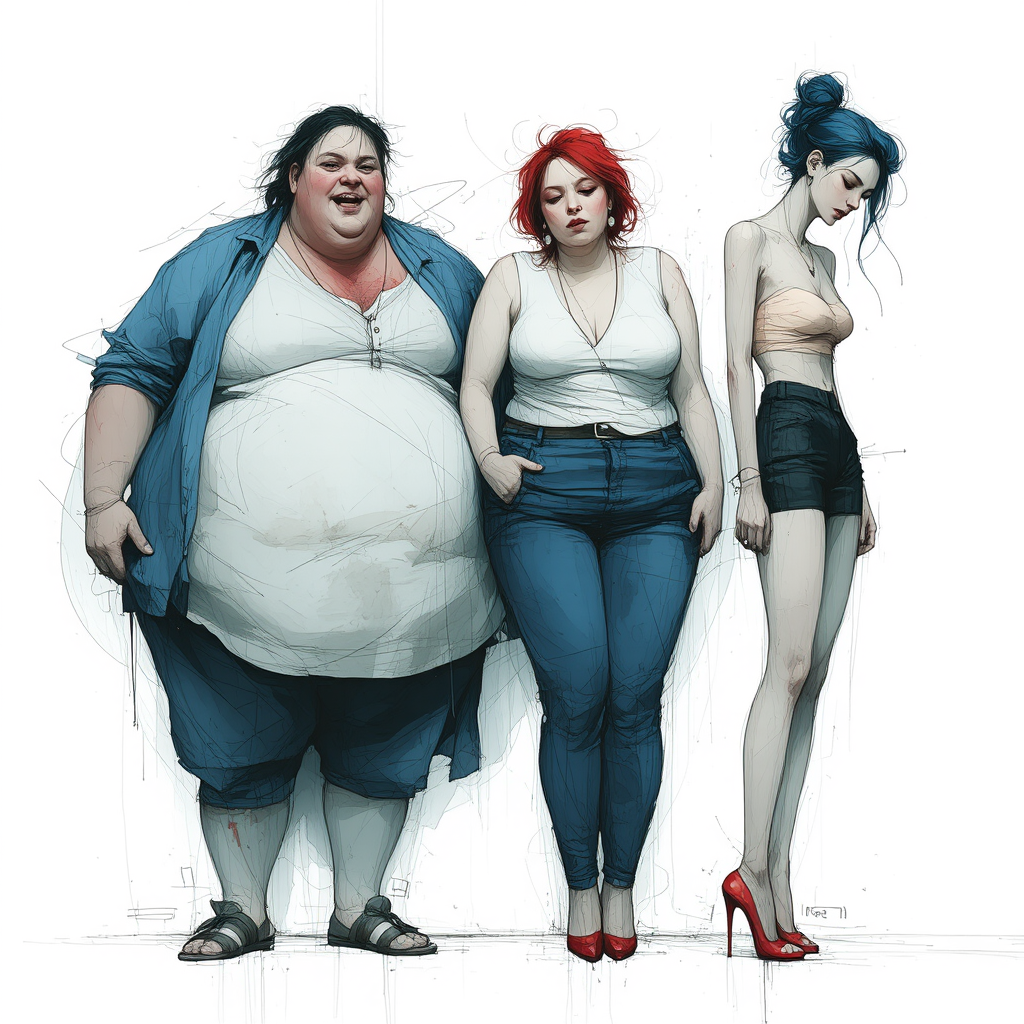
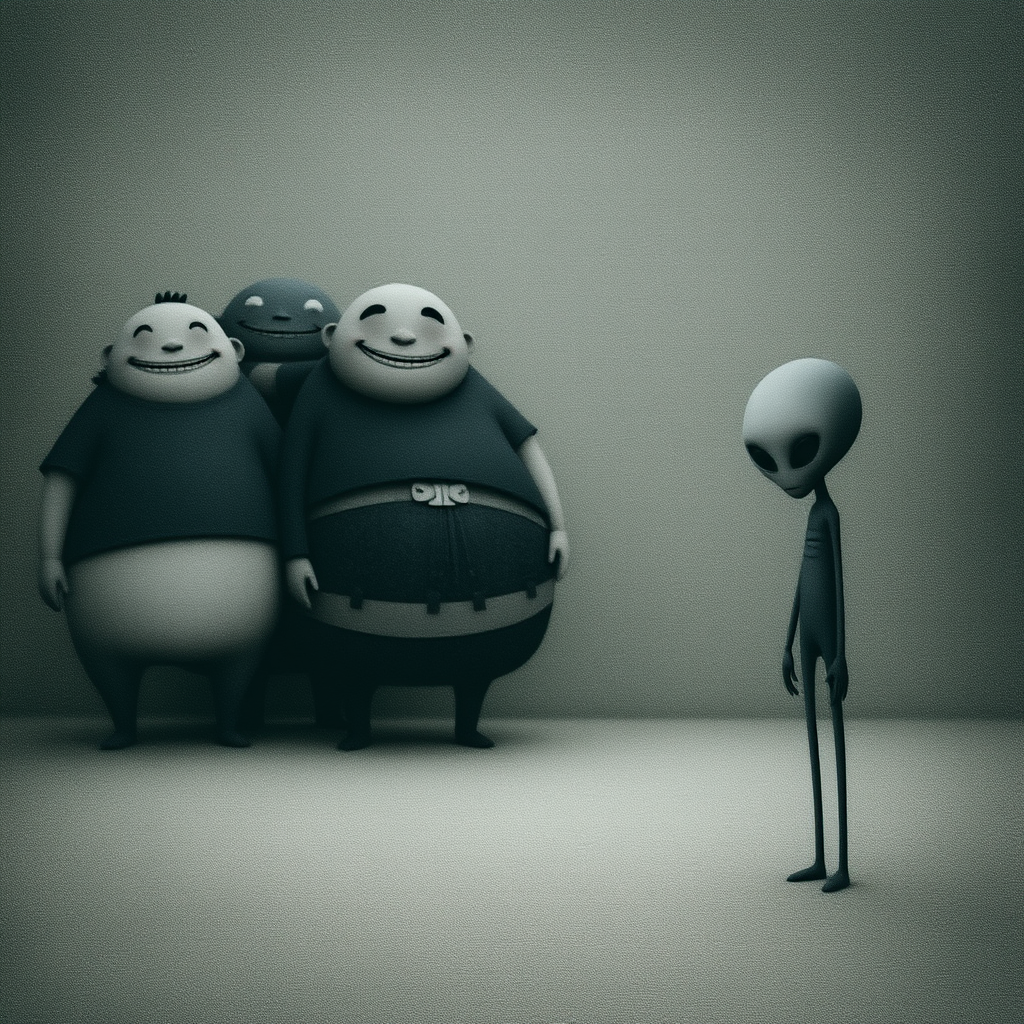
The next challenge went with the theme of the “Outcast.” I wanted to do something with overweight people shunning a thin person because that would be the opposite of how things often work in our society, but I decided it might offend someone. I tweaked it a little and used the same idea, but with aliens. It was well received.
6/6/26 “Alien Outcast”
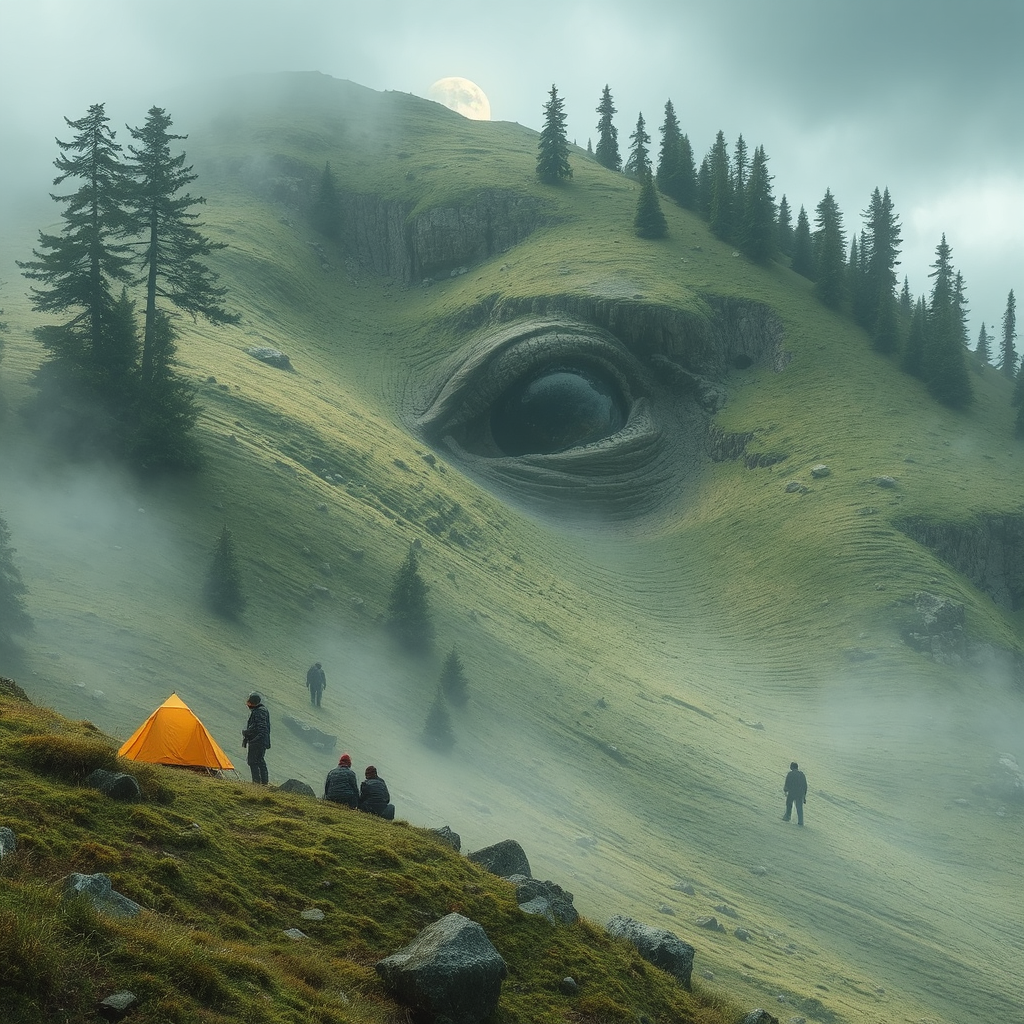
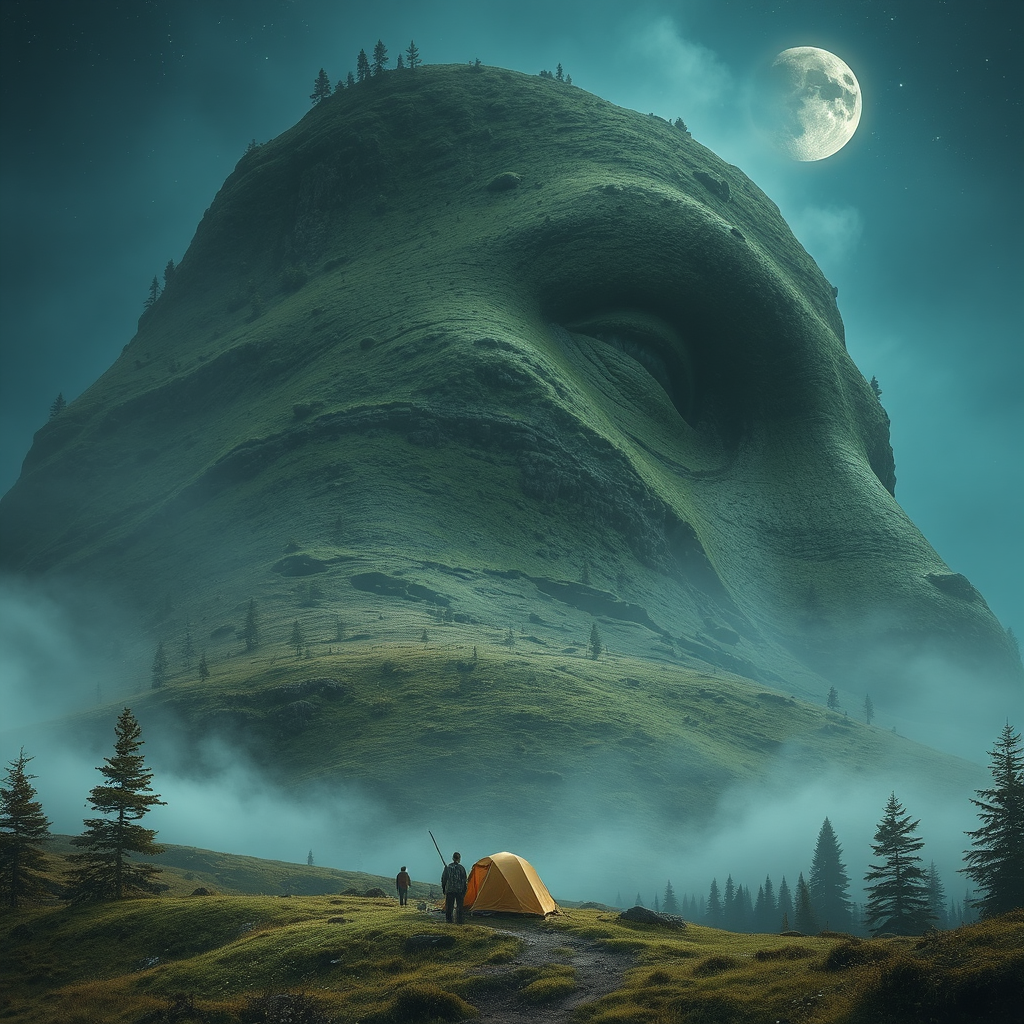
The last one of the week required a ton of thought because it was about storytelling. It was titled “Moments Before Disaster” and was meant to show that moment right before everything will go terribly wrong. I worked through many scenarios but settled on campers unaware that they had pitched their tents somewhere very precarious indeed.
6/7/26 “The Giant Wakes”
And here are some of the honorable mentions that I did not submit, but still published on my art website:
Another challenge I am participating in with the community of AI art enthusiasts I joined is a weekly prompt challenge. The resulting art is of course the final goal of the prompt written, but the sharing of the prompt, what tools were used, and what platform the art was made on are also part of the submission. Some AI artists are very close fisted about their prompts because they do not want to share their intellectual property with anyone. This challenge, by nature is inviting others to share in that creative element of trying new prompts and learning from how other artists manage to get their results from AI.
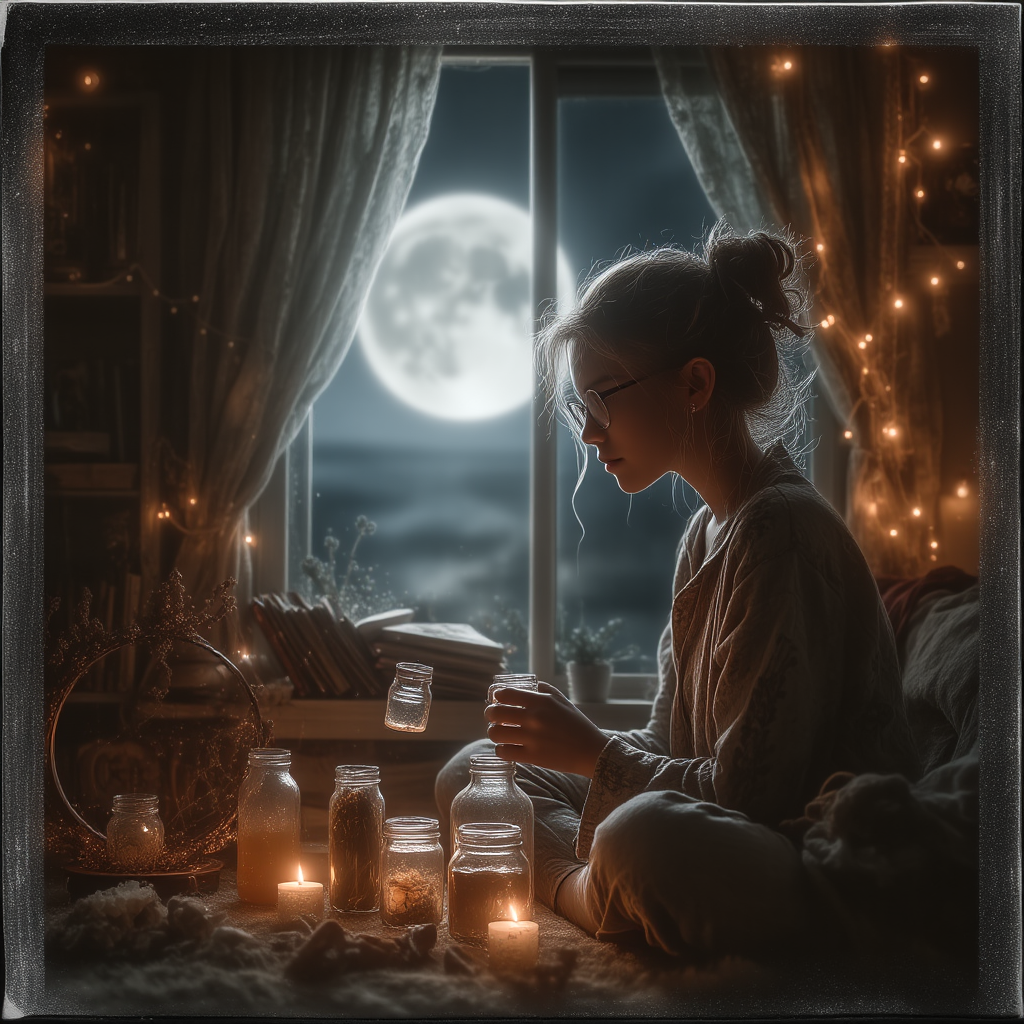
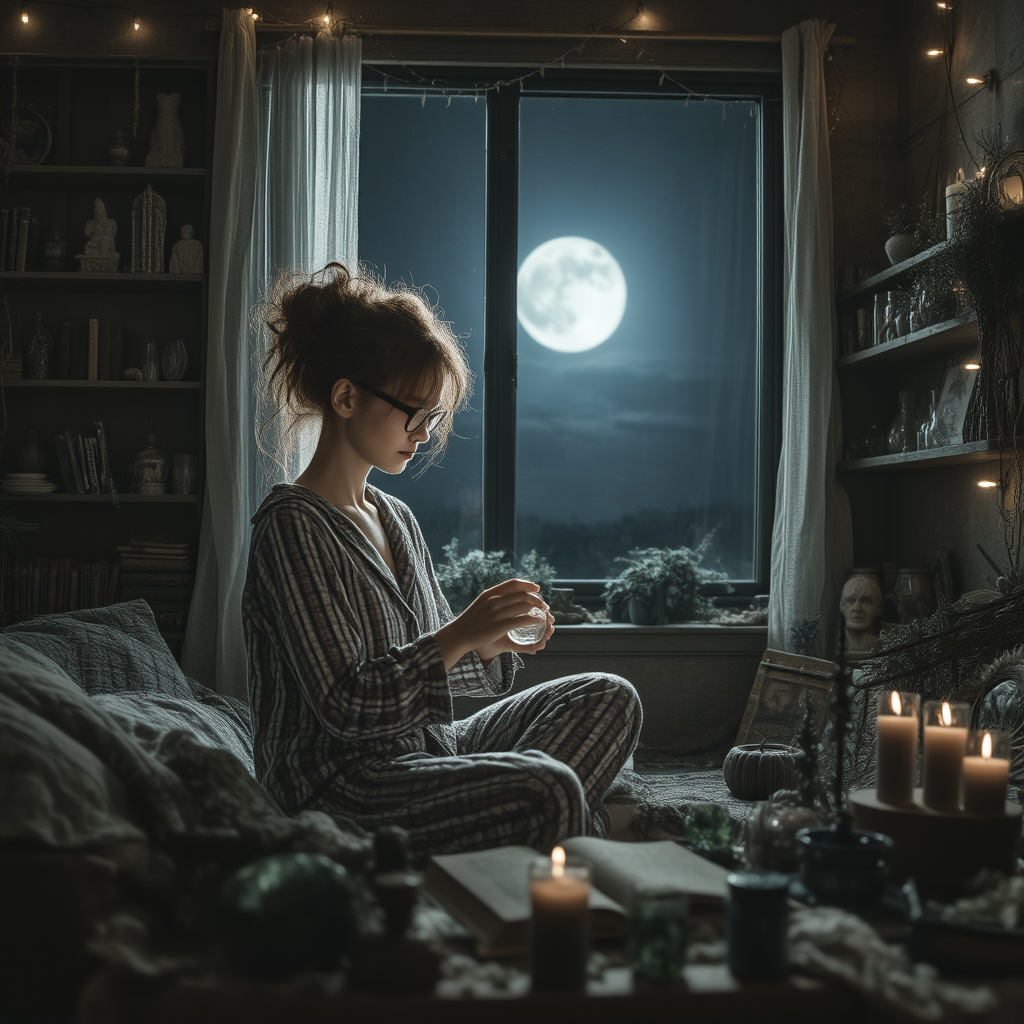
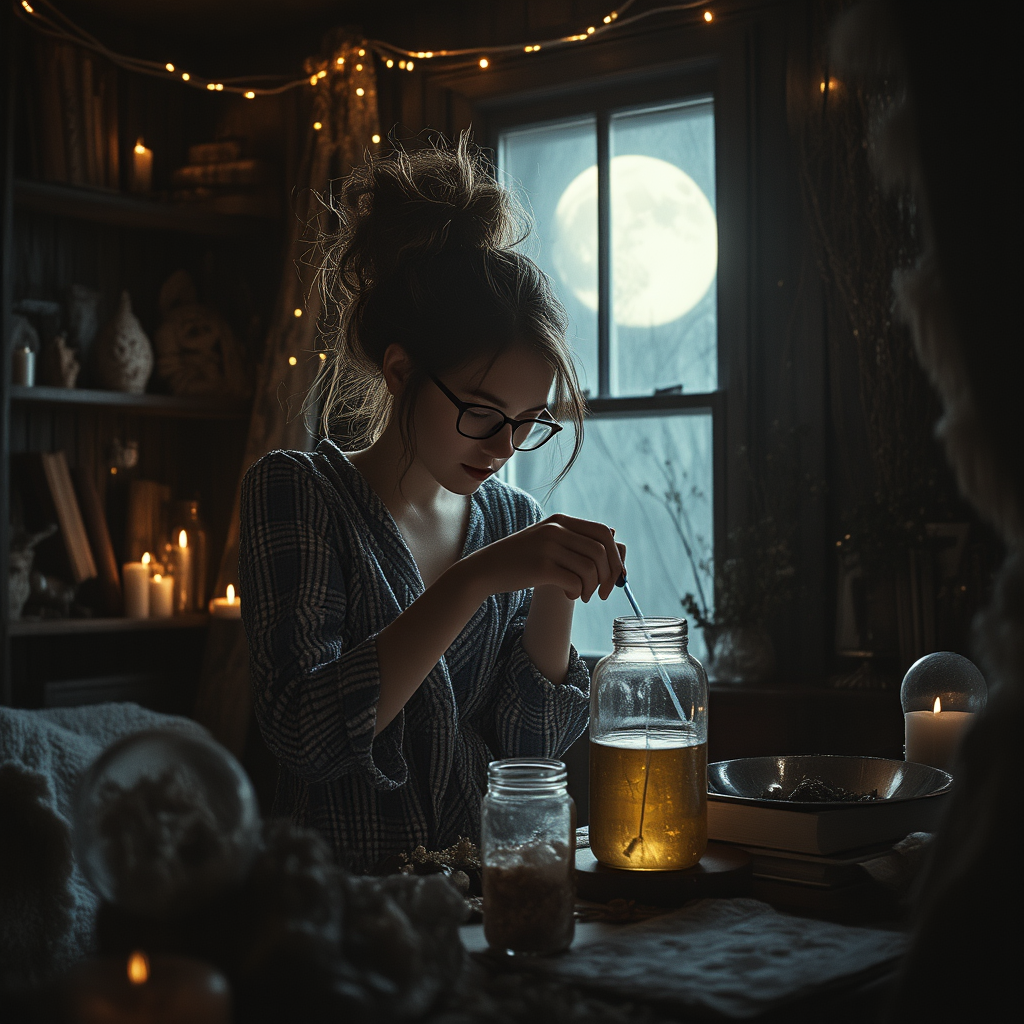
This week’s challenge asked the question, “What does a witch do when she can’t sleep?” I wanted to show a regular person tinkering with a soft, peaceful glow about her. I didn’t want her to be green or ugly or any of the stereotypical things like wearing a witch’s hat or riding a broom. She is just making tinctures and soothing her nervous system with quiet meditation.
Here are the technical aspects of this submission: Gencraft – Model: 40% Olaf’s-AutumnVeil3.0; Style: Polaroid
And this is the prompt that finally resulted in the image I liked: moonlight on a dark night shines in a window onto a cute quirky young woman with hair in a messy bun and glasses wearing pajamas mixing tinctures into small glass jars in a comfy room filled with crystals and herbs, incense, magical items, orbs, old books, shelves of knick knacks and candles, fairy lights around the ceiling and decorative accents that feel magical and inviting
Week of 5/26/26 “Insomniac Witch”
Here are two honorable mentions that did not get submitted, but turned out nice:
I am having a blast generating a creative piece of art at least once a day as part of a new group I was invited to join of AI artists. The community is active, small enough to feel intimate, and wildly creative. The daily art challenge has been one of the first things I do in the morning and are providing a creative, joyful boost to the start of each day.
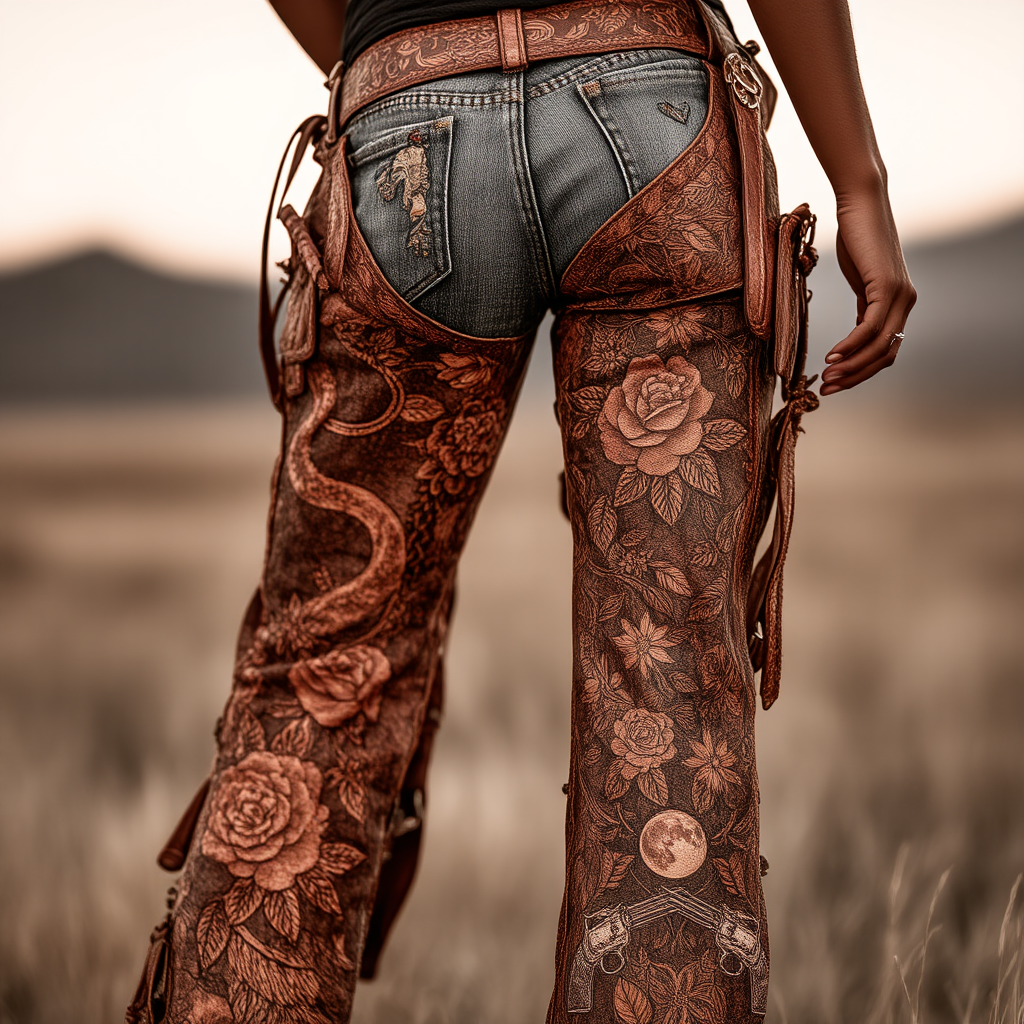
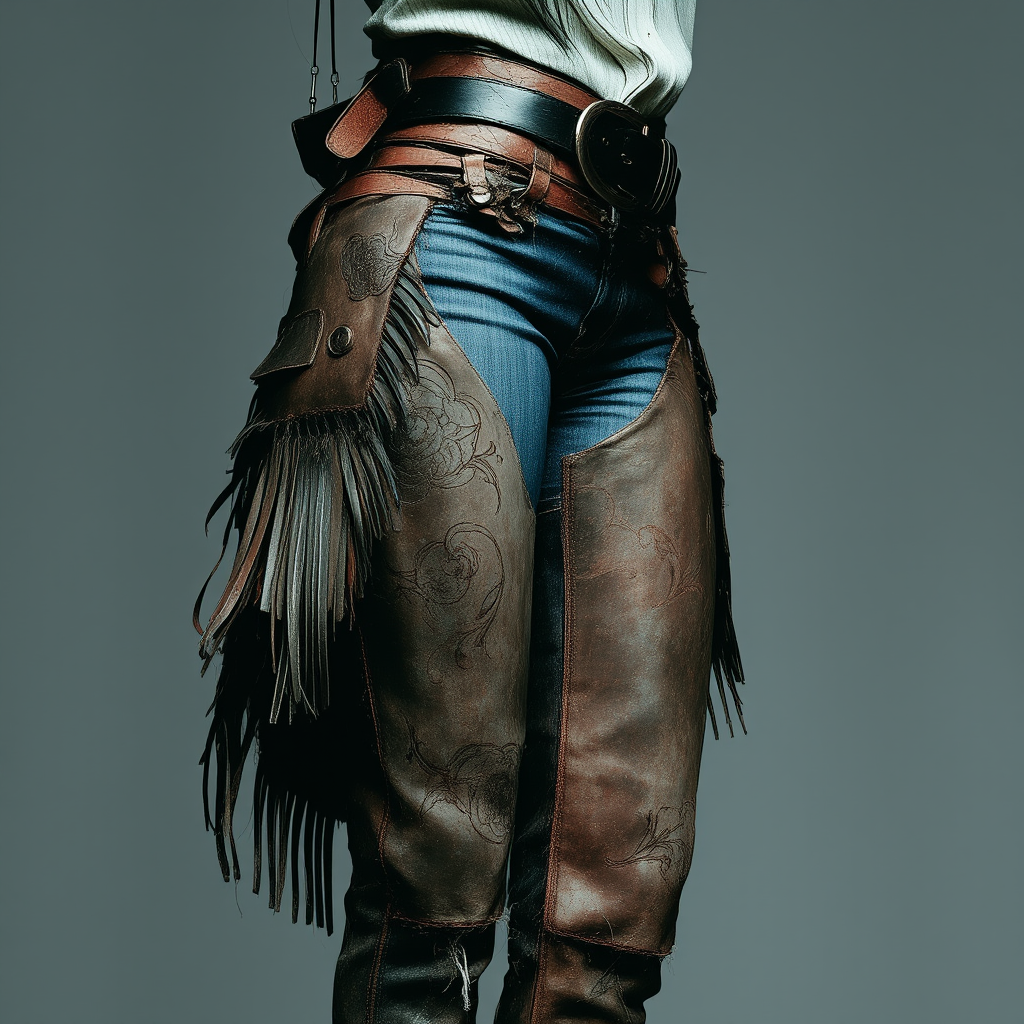
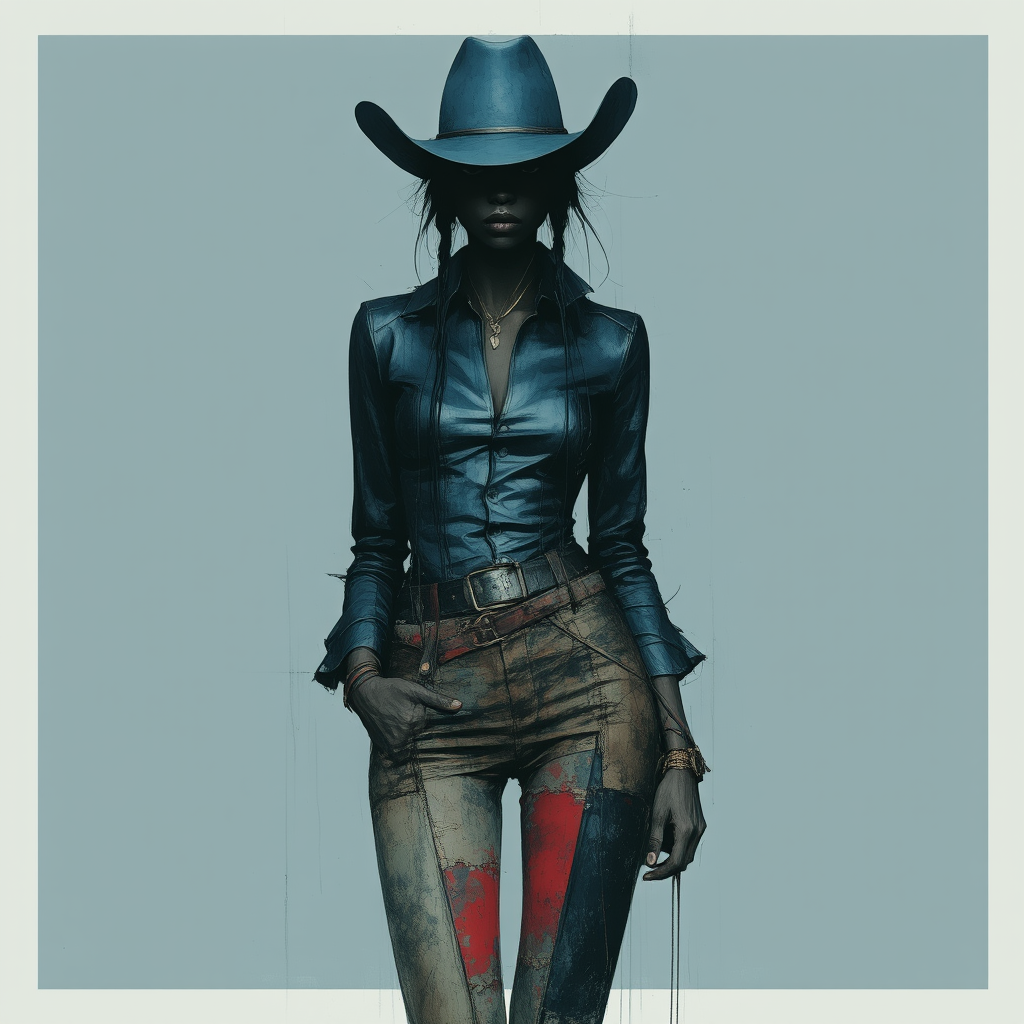
My first challenge was to generate something that included pyrography (the art of decorating natural materials by burning designs into their surface with a heated tool.) I am trying to do something unique or that contains a slight twist to challenge myself a little extra. I chose leather as the material, which was different from everyone else’s because they all used wood as their materials. And I featured a black cowgirl. I will note that AI has no idea how to render “chaps” and I had to describe what I wanted in detail. Some of the results were hilarious, but here is the final image I chose to submit.
5/26/26 “Cowgirl”
All images generated by Rebekah J. Marshall on Gencraft.
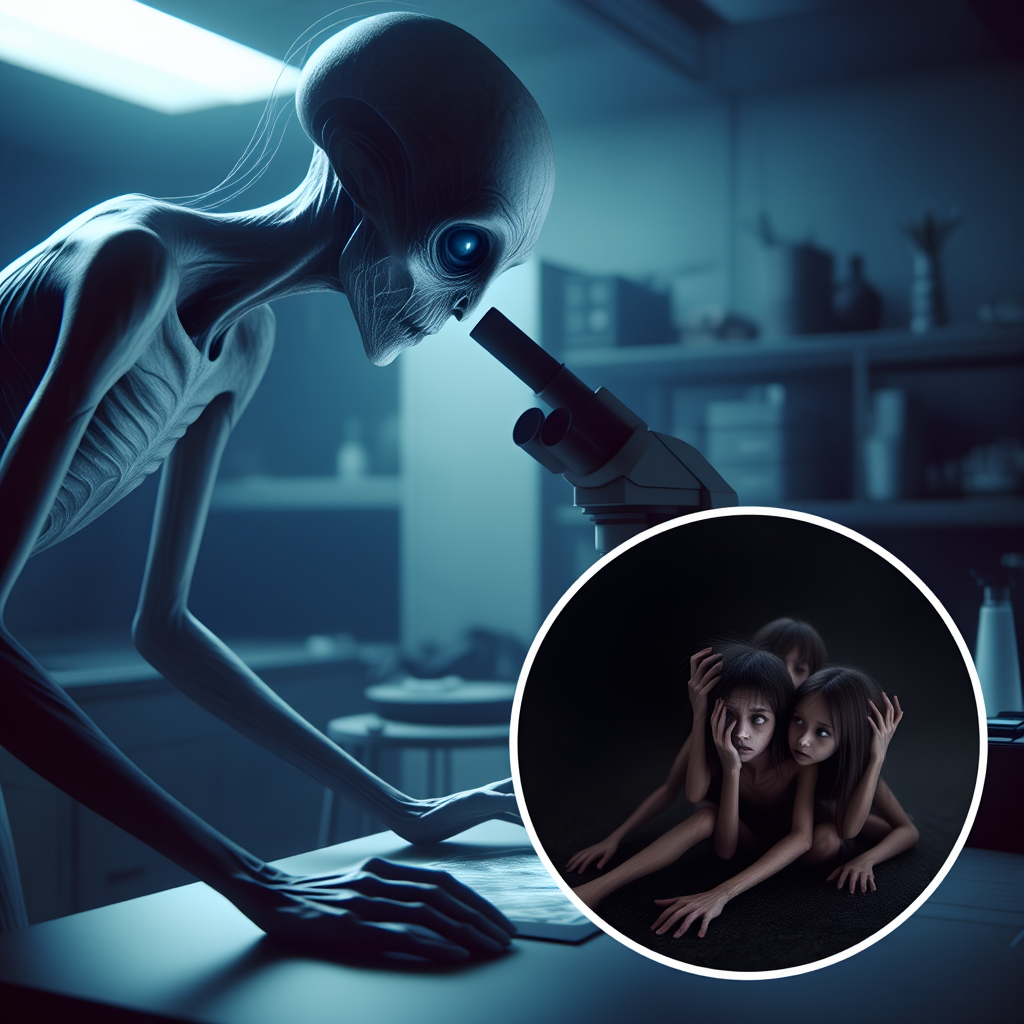
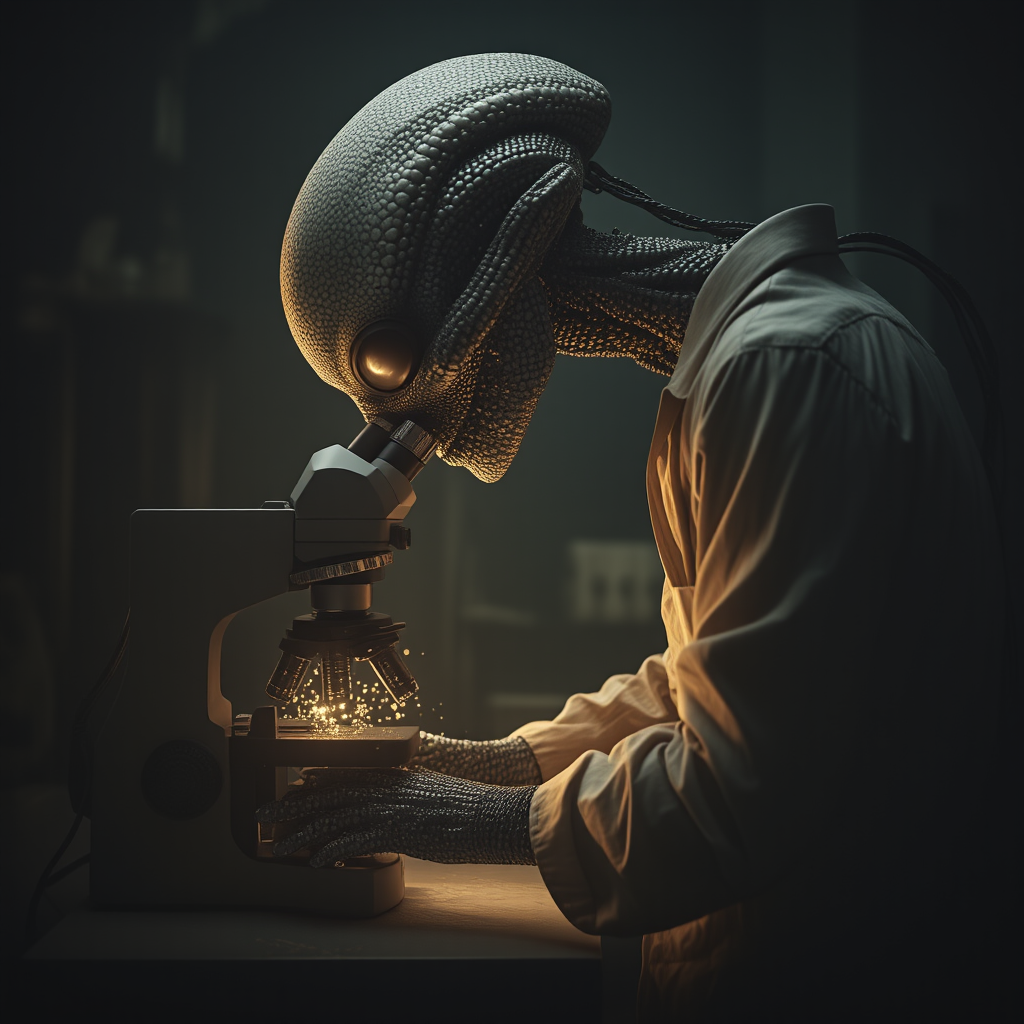
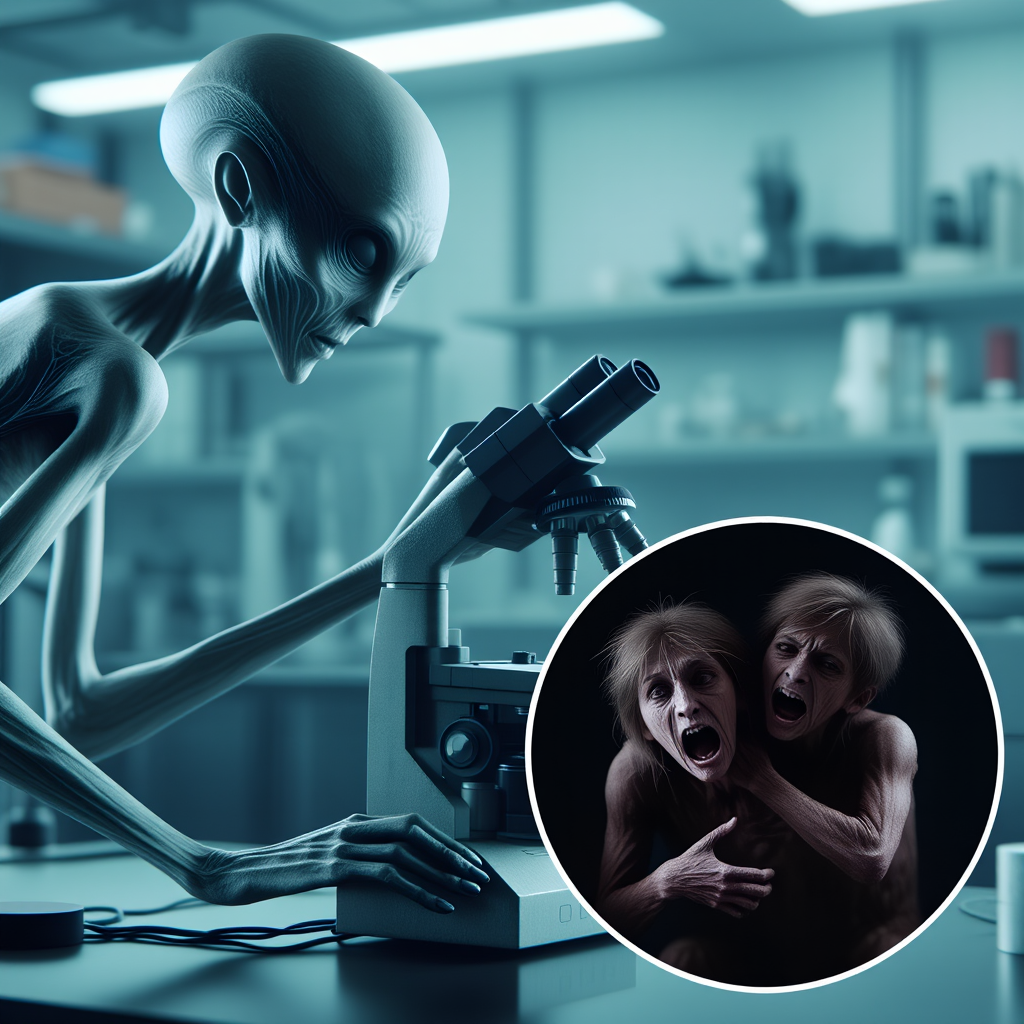
The next challenge was to create an image that shows a subject both directly and as seen through a lens, highlighting the contrast between raw reality and the captured perspective. The lens could be any type of lens: binocular, microscope digital camera, phone, etc. I knew what I wanted to do right away, but it was harder than I thought it would be. The model did not want to make the alien look into the microscope and wanted to put the inserted close up image in odd places. It took a while, but I finally got something I could use.
5/27/26 “The Specimens”
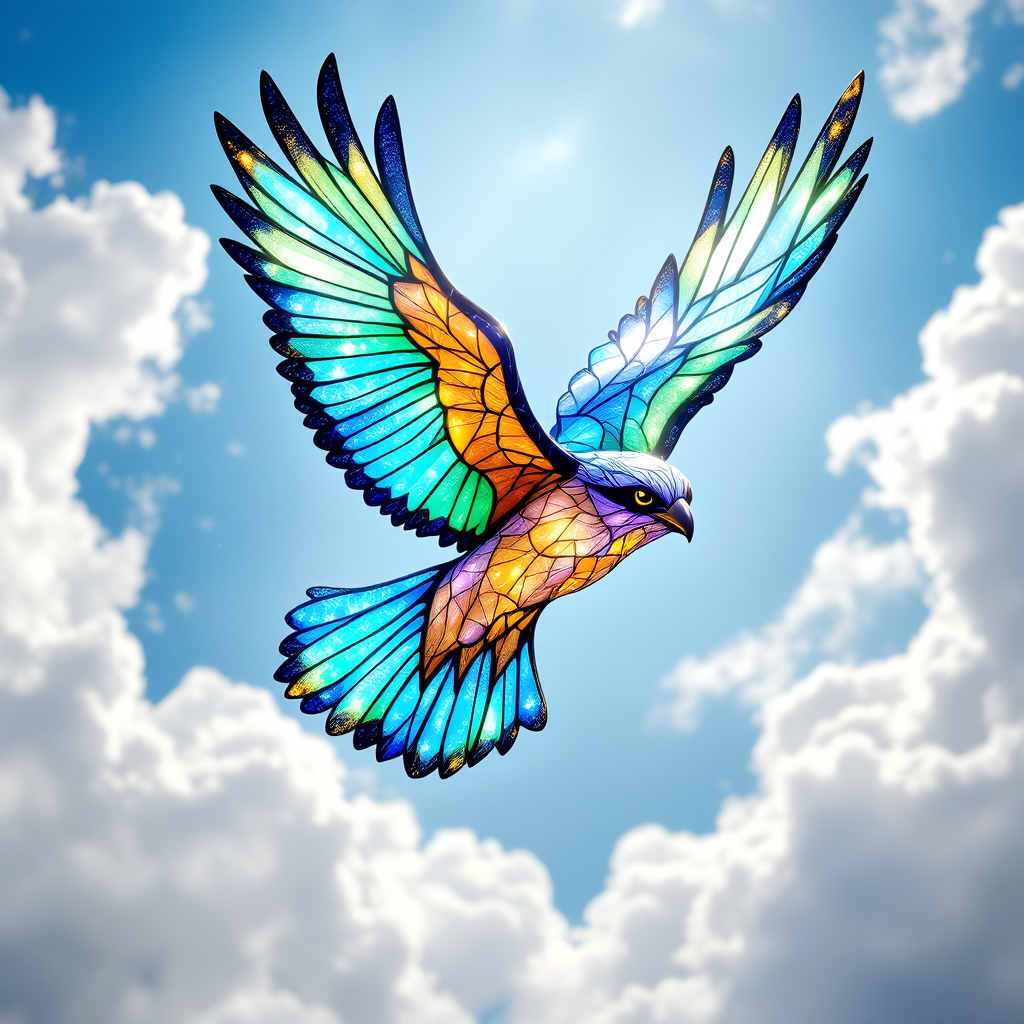
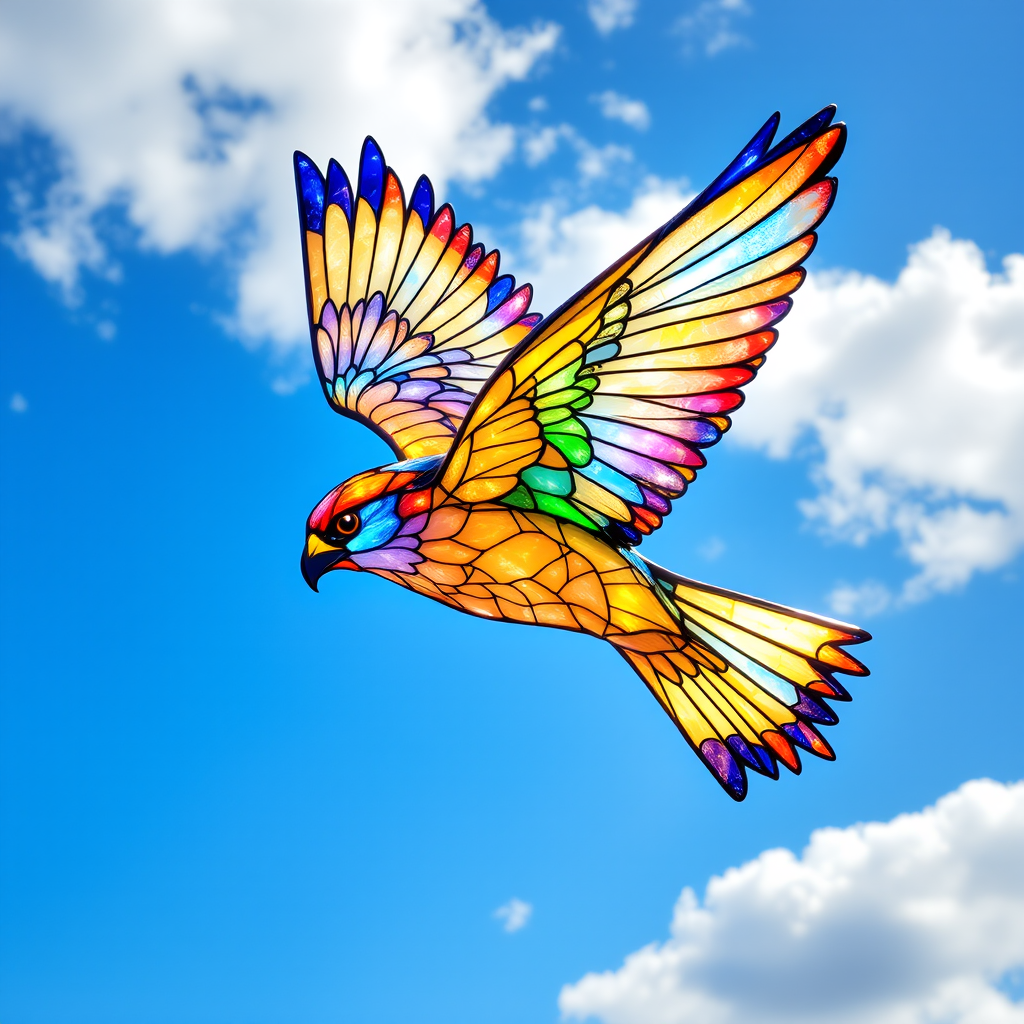
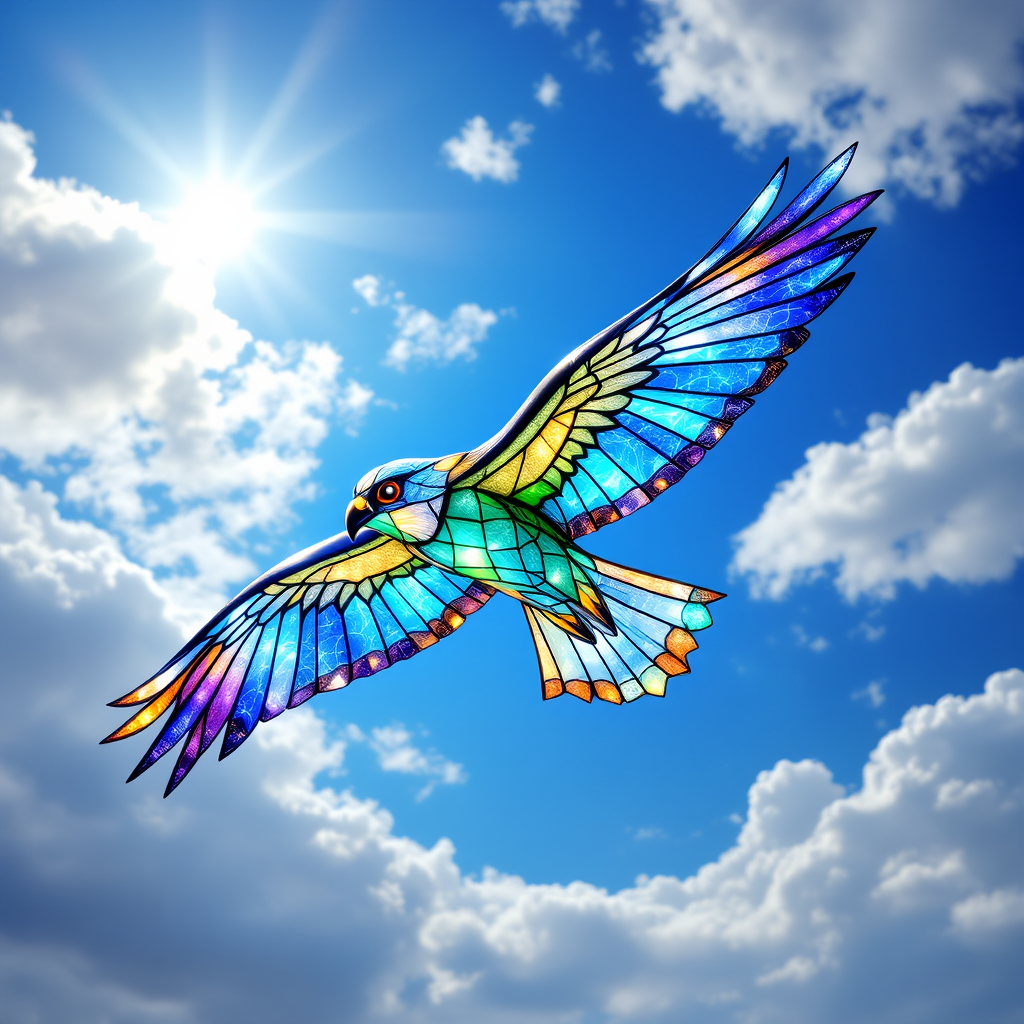
Then we were challenged to create an image with stained glass in it. Any theme, any style. I was determined to try to create something 3-D and moving. My first ideas were not looking good, but when I decided to try to start working with a flying bird, I was hooked. Each one got more and more beautiful and then I became determined to get the lighting right. The result was gorgeous.
5/28/26 “Flying Glass”
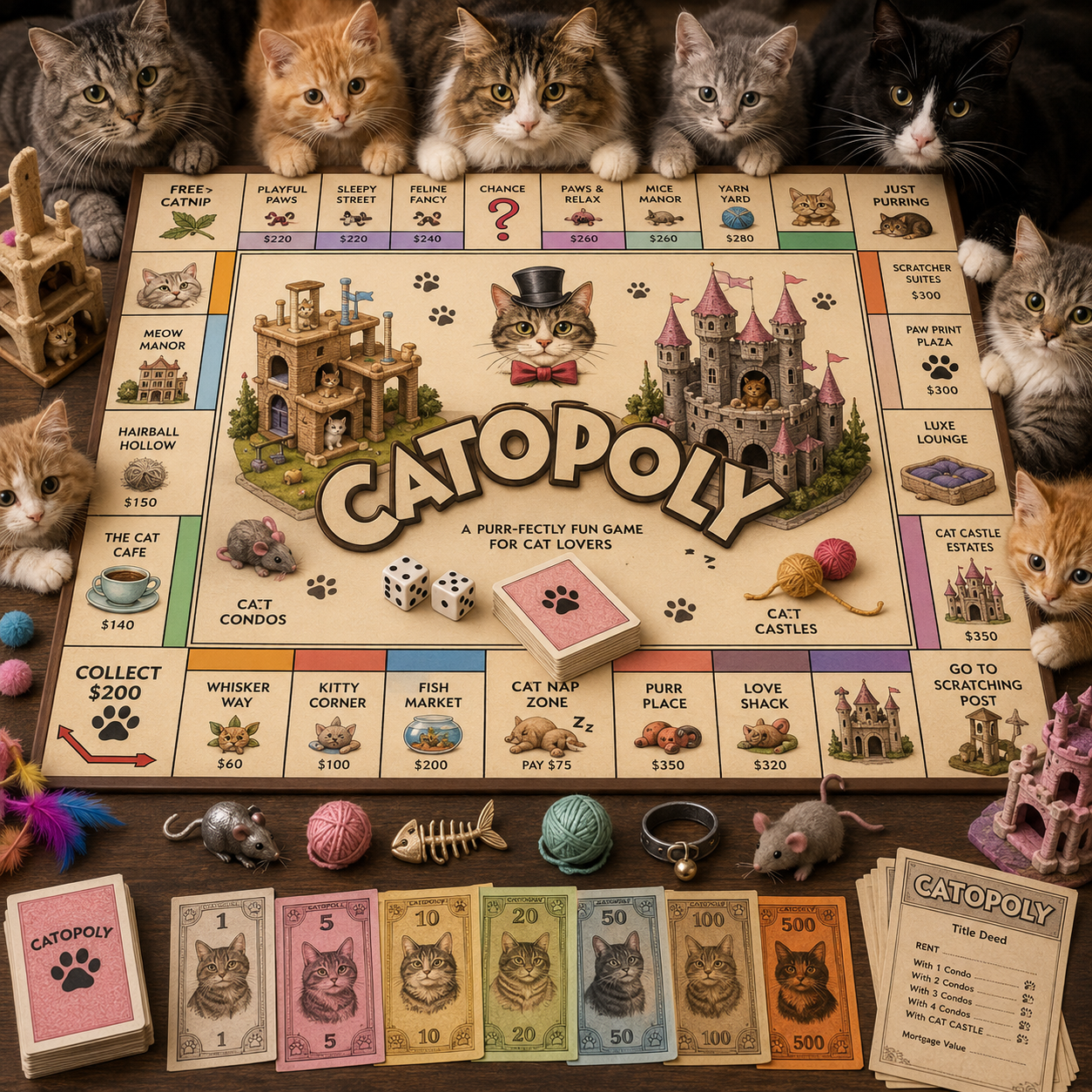
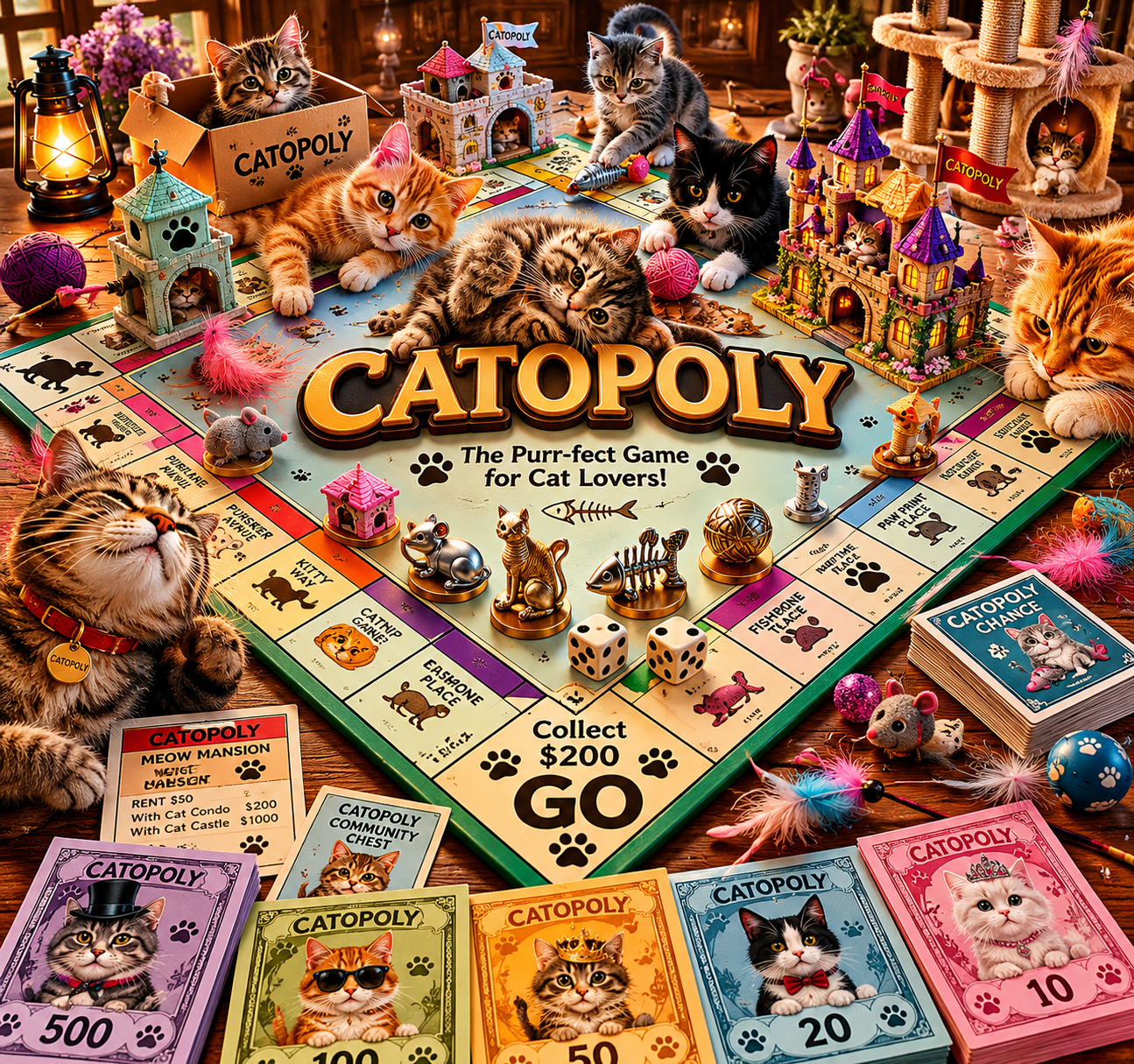
The next day we were challenged to create a version of a property space for Monopoly and include token pieces, houses, hotels, etc. And don’t forget to collect $200. I did not have much luck with creating only one property, so went with the entire game and made it for cats. I honestly kind of gave up on this one because I couldn’t get it to do what I wanted and didn’t have the time to commit to work with the model. It still turned out cute.
5/29/26 “Catopoly”
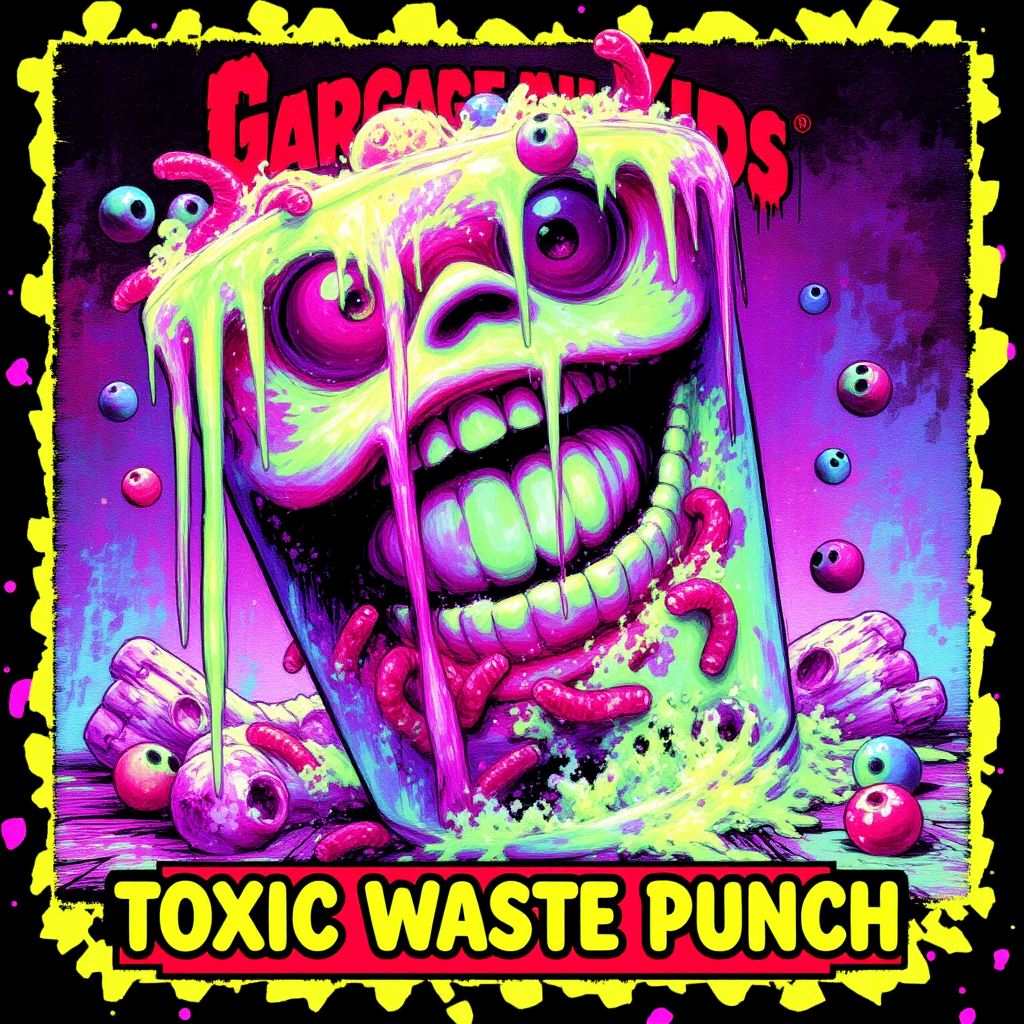
In honor of National Mint Julep Day, the next challenge was to create a cocktail (favorite, funny, magical, poison, etc.) I am sober and have not had a drink in almost 15 years, so I wanted to do something that would depict a cocktail as gross. The grossest thing I could think of were those Garbage Pail Kids cards that were popular when I was younger.
5/30/26 “Toxic Waste Punch”
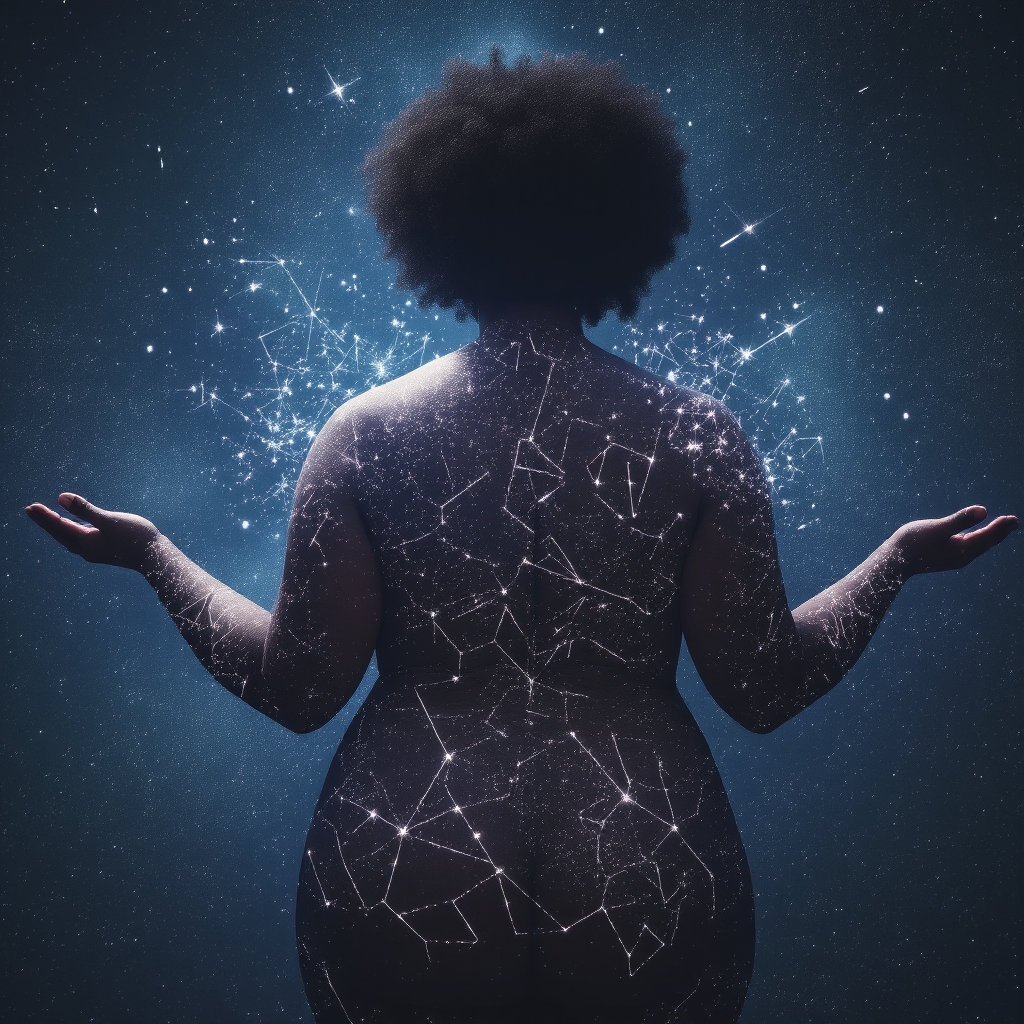
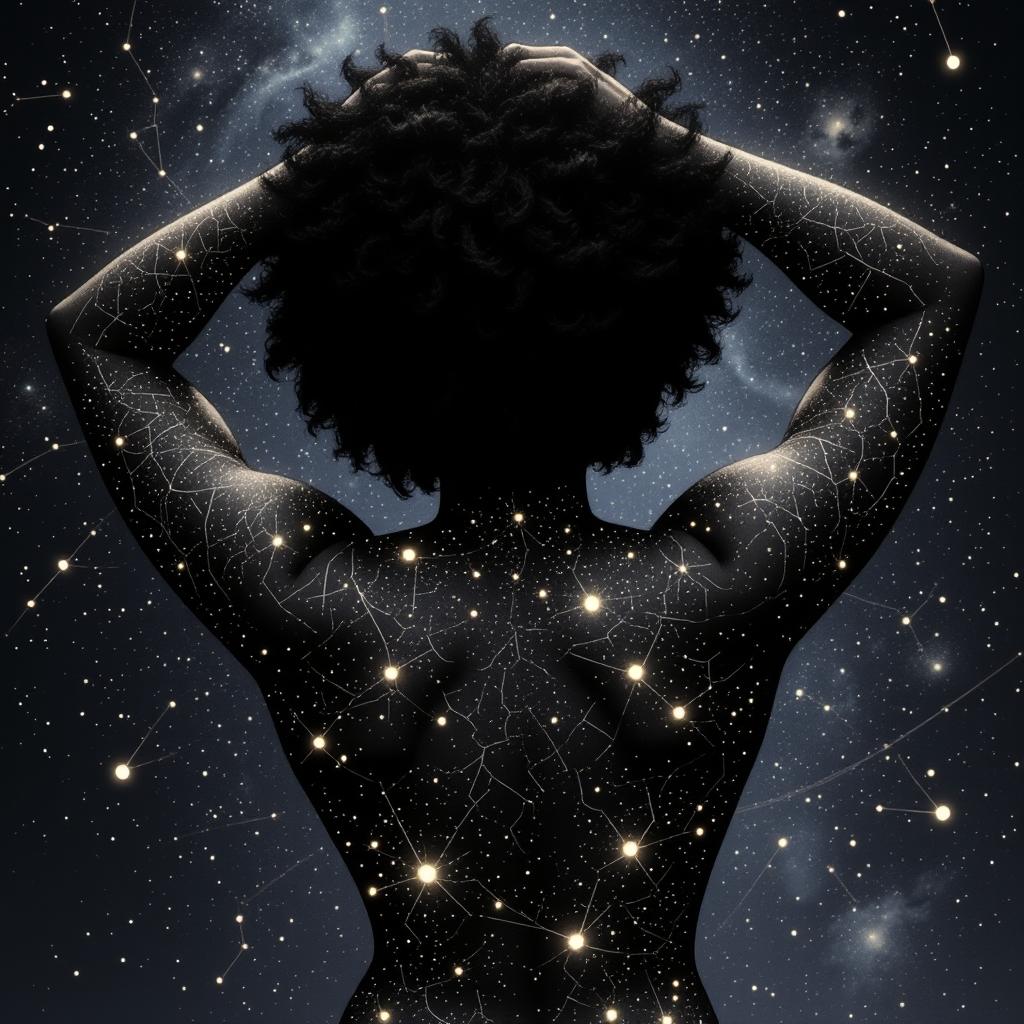
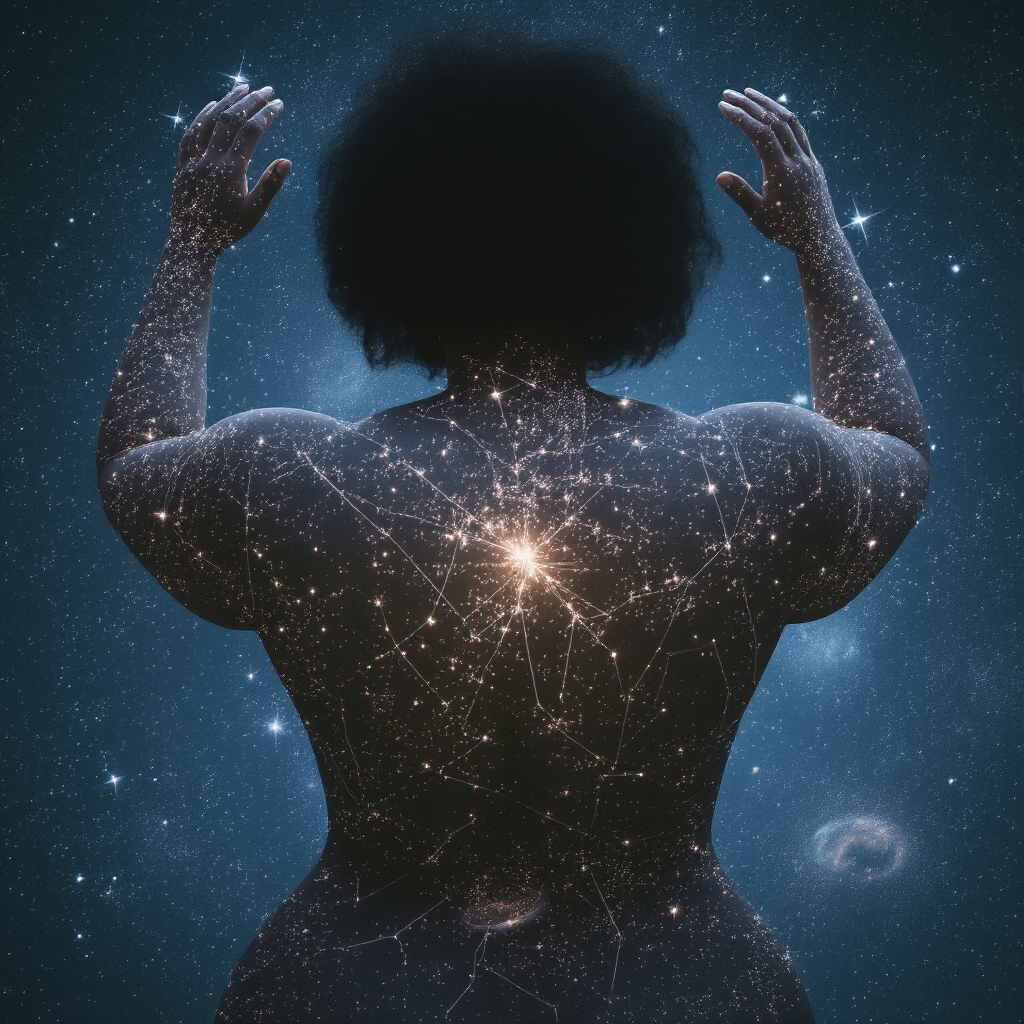
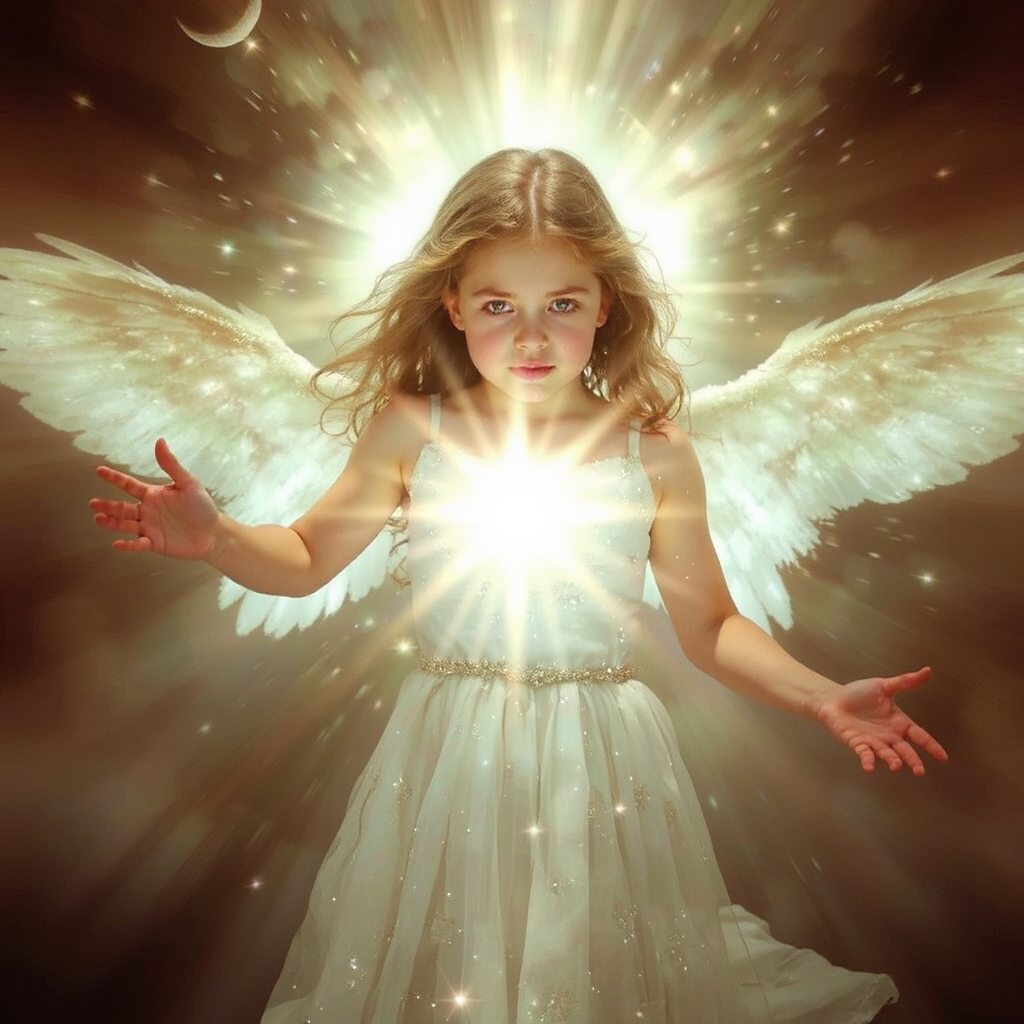
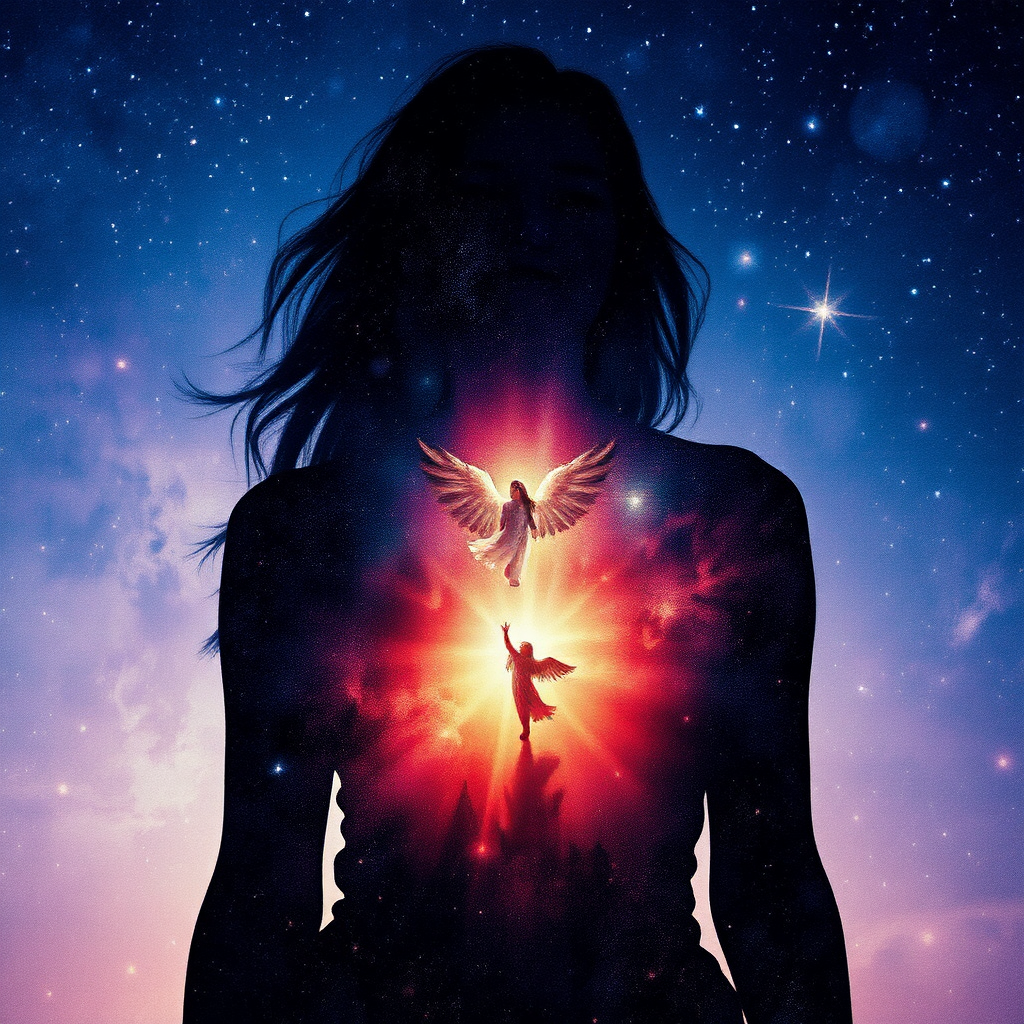
And the last challenge of the week was to show something growing from a body, like flowers, vines, crystals, tree branches, light, wings, etc. I knew immediately what I wanted to do. It was really hard. Nothing looked right and I got frustrated with AI being stubborn, but we finally compromised and got something close to what I wanted.
5/31/26 “Growing Stars”
I am definitely going to keep doing these challenges because I’m having fun and enjoying using my creativity at the start of each day.
Here are some of the honorable mentions that did not get submitted, but turned out as pretty cool images:
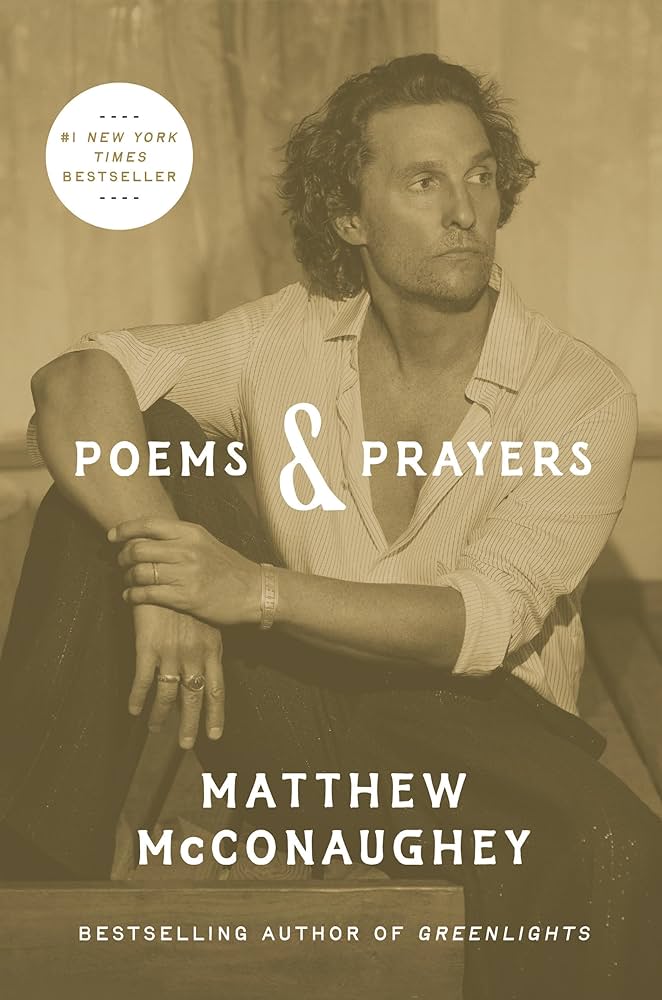
I had the lovely experience of going to Bass Concert Hall and listening to Matthew McConaughey share poetry, while his good friend John Batiste played piano. They had conversations on stage, shared musings, ideas on faith, doubt, life, and death, and entertained us like we were in their living room with a personal intimacy that is hard to create in crowds that size. Both of those men are very talented and charismatic, so it was a night to remember. With the purchase of the ticket, we were handed a copy of Mr. McConaughey’s book Poems & Prayers. I have been reading it in little bite-size chunks since that evening many months ago.
I am always pleased to support local artists and writers and have always felt that Mr. McConaughey’s southern charm feels comfortable and known. I like that nothing is off limits in his poetry. He is vulnerable, disarming, and honest. He likes to rhyme, isn’t afraid to cuss, talk about sex, drugs, and rock & roll, and tell on himself. There are pithy proverbs, notes on what was happening in his life when he wrote some of the poems, and little life lessons he learned along the way. His middle ground views are just radical enough that leftists could find concepts to love. And they are just conservative enough that people on the right can say, “He’s one of us.” But he refuses to commit to a lane and instead calls on everyone to love, have integrity, and believe in something.
His faith is not too preachy. Here’s an example of his faith poetry:
I believe that faith is the answer in the end.
But for now all I know is that it helps on the way there.
Until then. Amen.
I would argue that Mr. McConaughey is a better actor than poet or preacher, but if clever rhymes, simple meter, and faith-filled/recovery poetry sound appealing, this book is worth a read. Poems & Prayers has found a place in my poetry collection on my shelf of local writers.
McConaughey, Matthew Poems & Prayers, Crown Publishing, 2025.
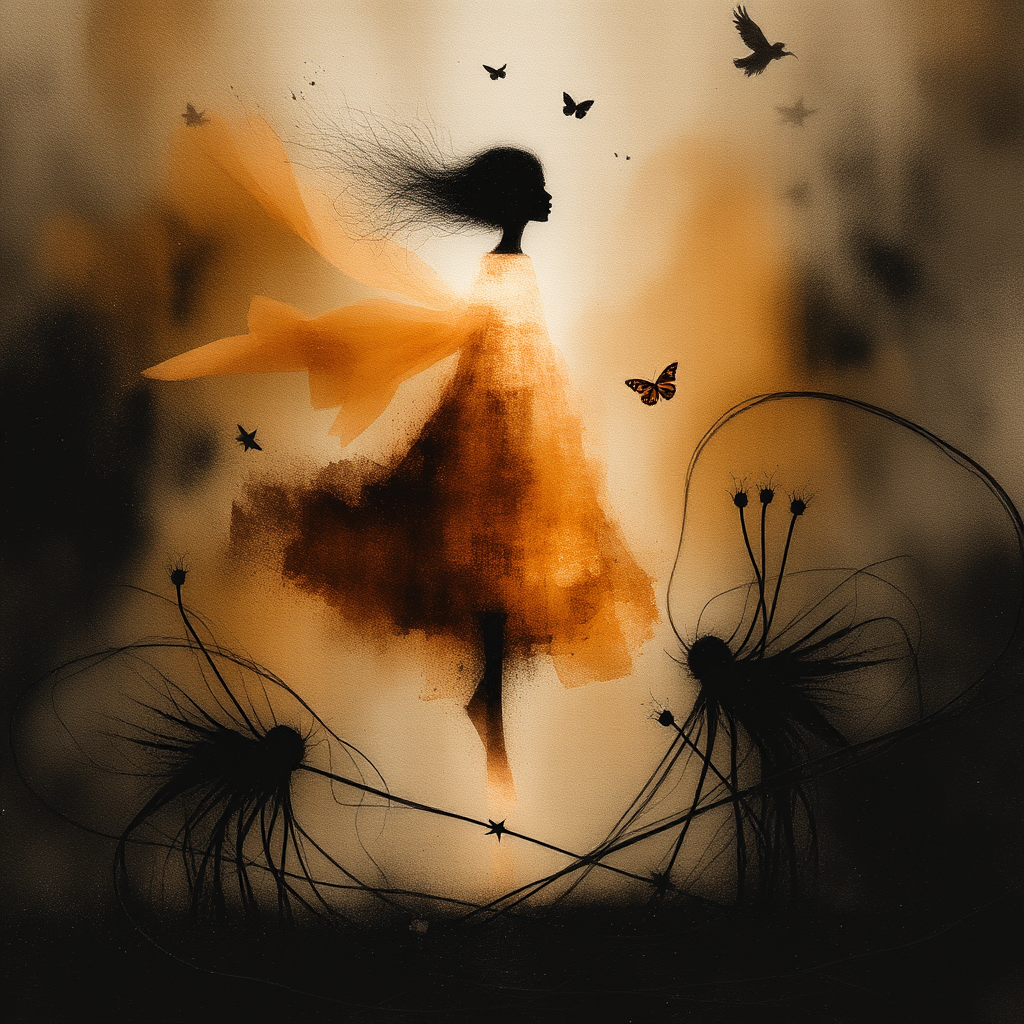
All images created by Rebekah Marshall’s prompts using AI on Gencraft.com website.
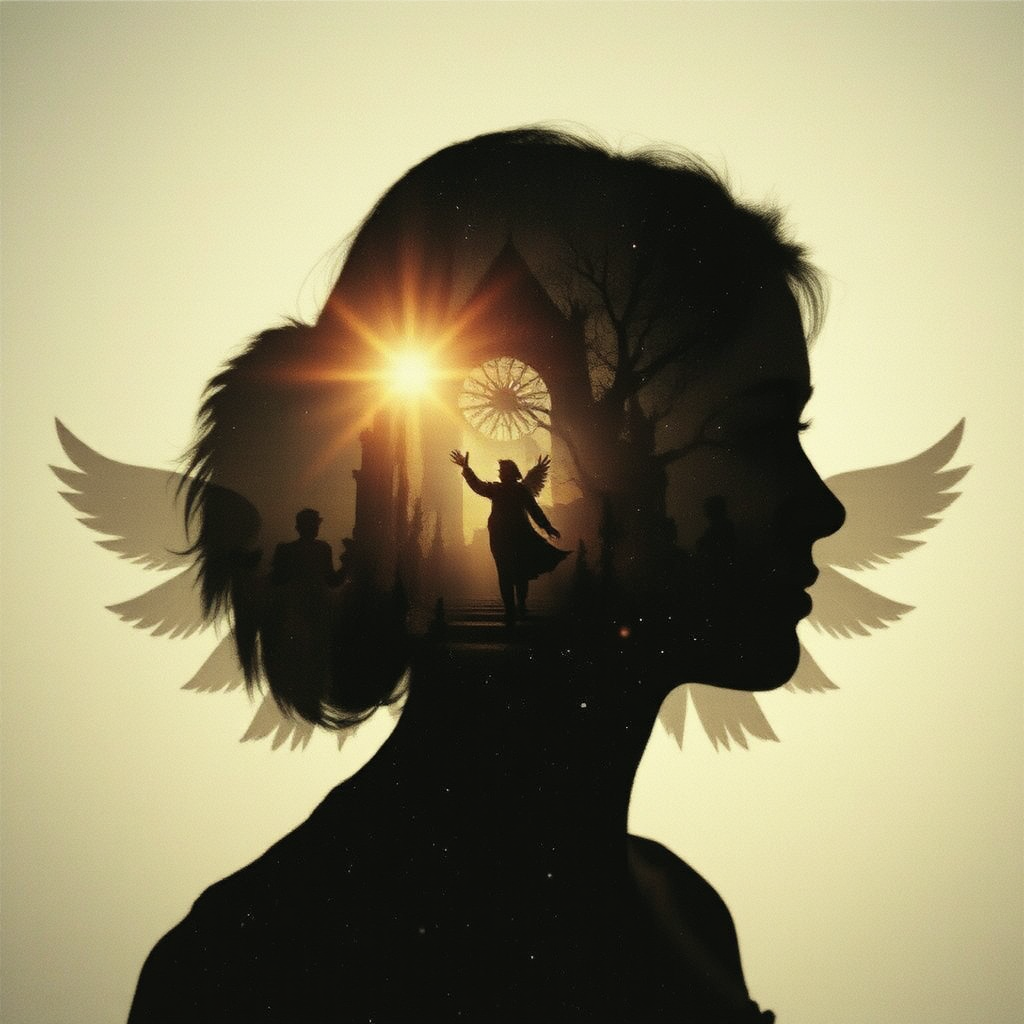
I am reading Hafiz’s Little Book of Life, poetry by Hafiz-e Shirazi. He is challenging me to become more comfortable with ambiguity. I will share his poem and some of my thoughts on his poem (sometimes with the help of experts when the concepts are too hard for me), followed by a poem and some art inspired by his poem.
Hafiz’s Poem 41:
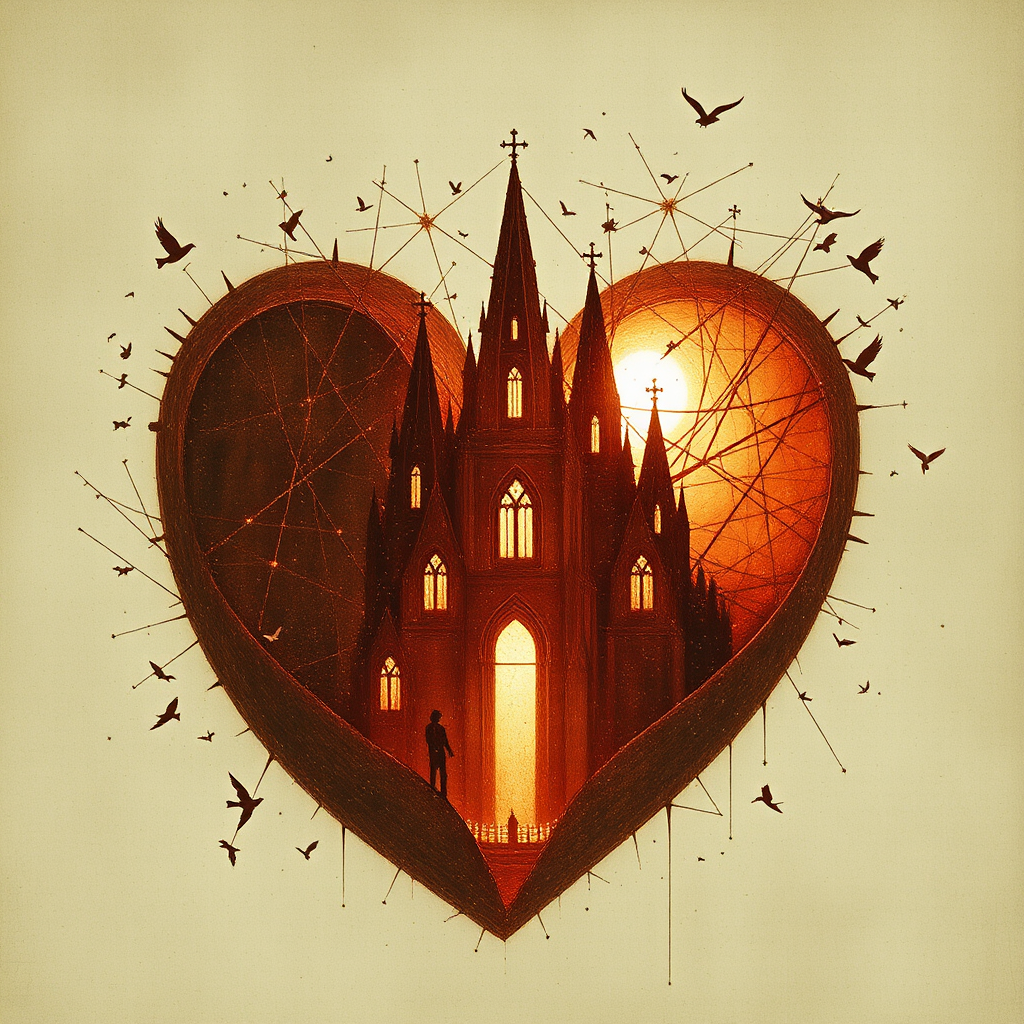
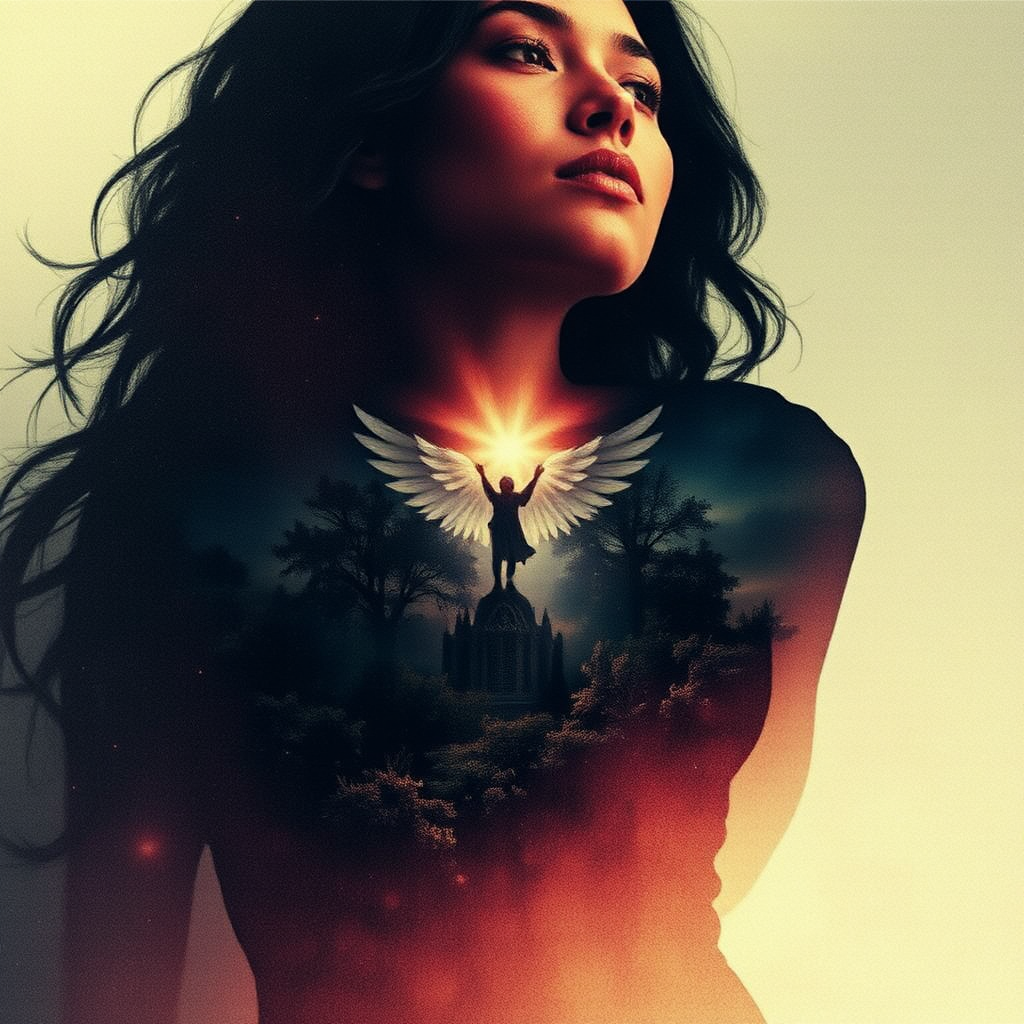
The sanctuary of the heart is no place For the company of antagonists
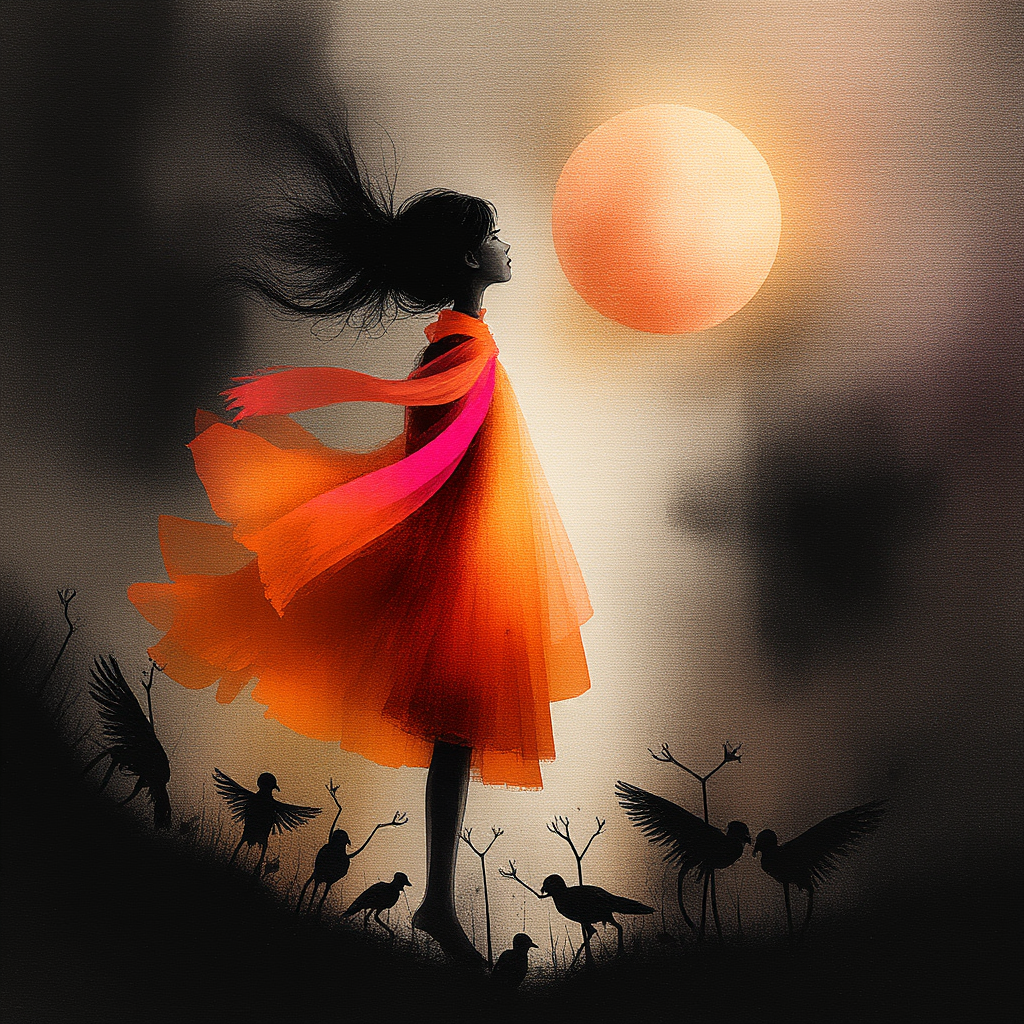
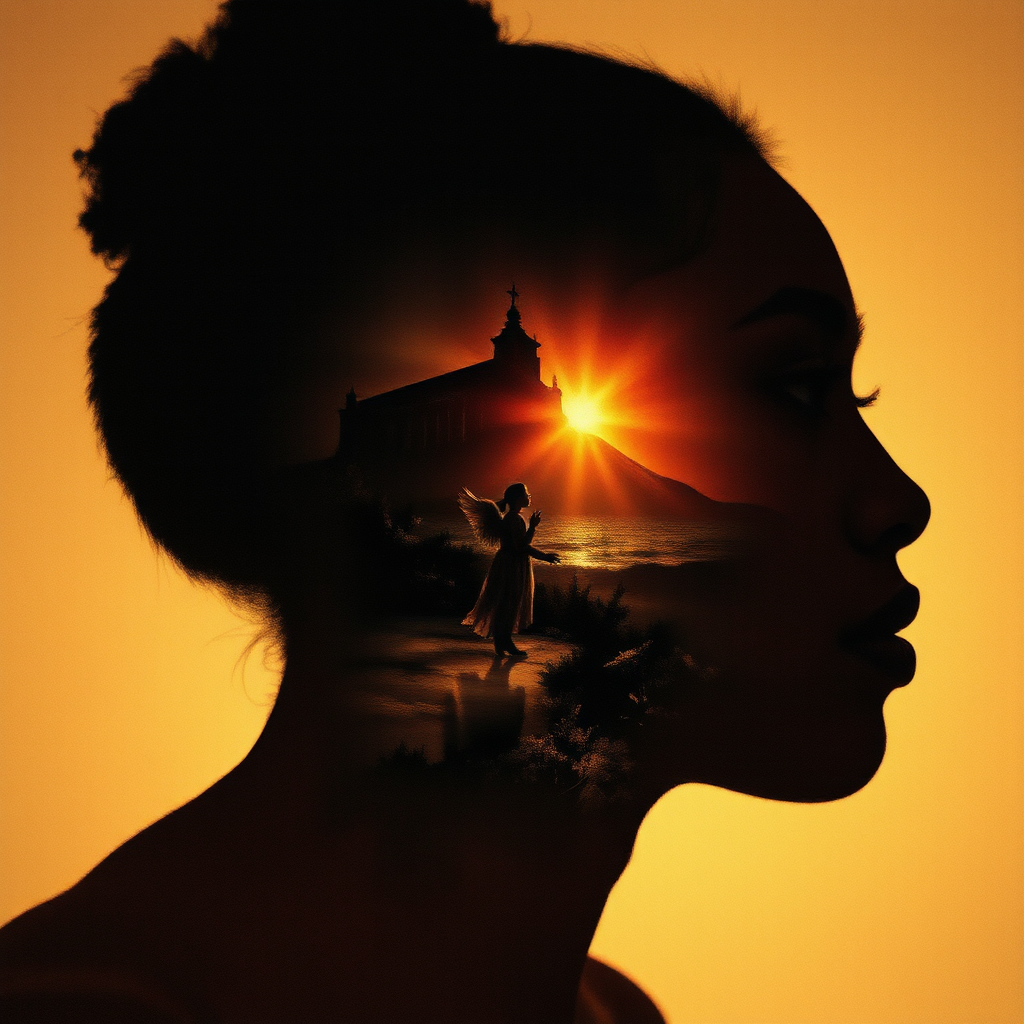
Where a demon departs An angel arrives
Some thoughts:
This one is lovely. The imagery is that of simply letting go of negativity to make space for the beauty and love that will naturally flow into the vacuum created. We don’t have to do anything special to fill ourselves with goodness. We simply must make room. Remove bitterness and compassion can enter. Release antagonistic thoughts and peace has a place. Let go of prideful arrogance and humility will naturally make a home inside us. Release fear and love can breathe easily. There is no demon to fight, no dragon to slay, no war to be waged. They are simply not invited in, like vampires whose welcome has been rescinded. We would not walk into a sacred temple and spit on the floor. Our hearts deserve as much respect.
What are we allowing to dwell in our inner sanctuaries? Is it time for some hangers-on to be evicted? Our heart is not supposed to house every wound, fear, resentment, and lie we have ever been told. When harm finally leaves, healing can walk in quietly and take up occupancy. Instead of having to vanquish foes, we must merely open a window and allow pain to exit so holiness can enter. Time to do some inner house cleaning.
My Poem 41:
Sweep out the house. Dirt belongs outside, not in our hearts. Throw back the curtains and open the windows.
The stale air must exit, so a fresh breeze, sweet with spring scents, can fill our space. Then healing can begin.
Hafiz. Hafiz’s Little Book of Life. Translated by Erfan Mojib and Gary Gach, Hampton Roads Publishing, 2023.