Tag Archives: book review

Jewish American Identity in Saul Bellow’s Dangling Man and Philip Roth’s Goodbye, Columbus

TRIGGER WARNING: This essay analyzes Jewish American identity in mid-20th-century literature and includes discussion of antisemitism, cultural and gender stereotypes, prejudice, and historical references to World War II. These topics are discussed in a literary and analytical context.
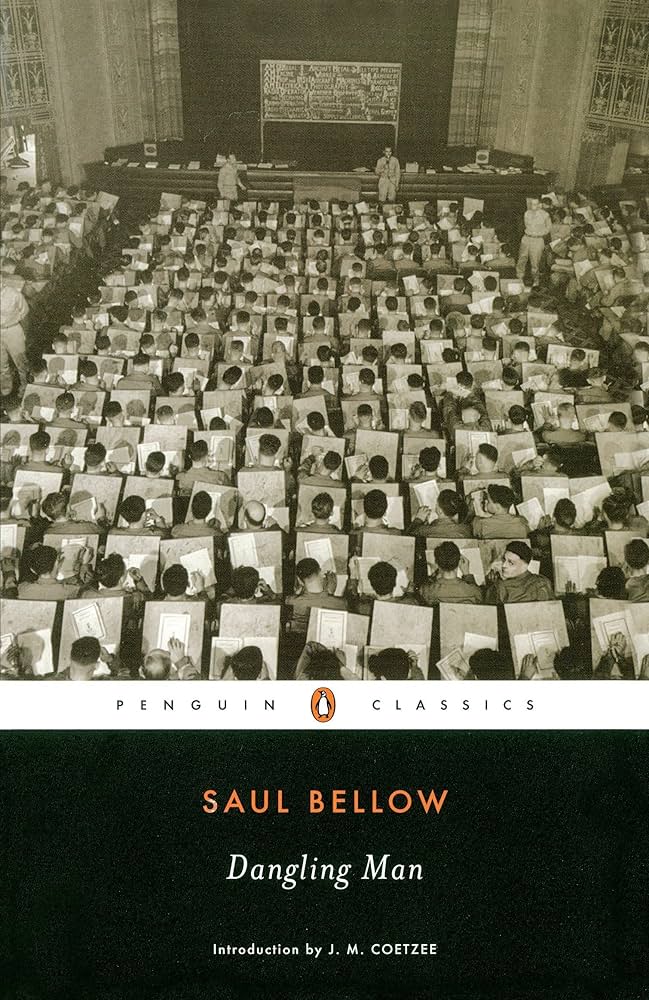

The main characters in Saul Bellow’s Dangling Man and Philip Roth’s Goodbye, Columbus react to Jewish stereotypes by challenging some and confirming others. The writers allow the characters to explore their Jewish identity within the context of the larger American culture of which they are a product.

Joseph in Dangling Man lives in early 1940’s Chicago. Antisemitism was prevalent in American culture. Jews were often characterized as greedy and dishonest. Vandalization of synagogues and Jewish cemeteries were a common occurrence. Literature spouting antisemitic rhetoric and symbols like swastikas were the norm (Freeman). Joseph does not mention any of this, but it is the reality in which he resides. He is not always honest with his wife and has an affair. His hot-headed temper gets him into trouble off and on. And his judgmental views of others reveal hypocrisy. In these ways, he upholds some stereotypes that others may have had concerning Jews. However, his pondering journal entries debate such concepts as materialism, honor, integrity, and truth, inner wrestling that defies the stereotypes of the time while he waits to be drafted to fight in WWII.

In one case he struggles with how to view the world and find his own place in it. “Joseph suffers a feeling of strangeness, of not quite belonging to the world…” (Bellow 17). He mentions the complicated nature of the world with both good and malevolence present to contend with and it bothers him when people try to simplify life to either good or bad. Yet, he has his own standards that he struggles to uphold. He endeavors to be honest with himself. He battles against his brother who wants to give him a handout. He is judgmental of his brother’s family and their materialism, viewing their desire for more than four rationed pairs of shoes per year as vanity. (Bellow 42). And he is disappointed that his wife Iva does not want to improve herself and her way of thinking to become a more enlightened person like him.

Neil in Goodbye, Columbus lives in late 1950’s Boston and is a secular Jew unsure of his position within his culture. He has definite opinions regarding what good Jews should do, like not get nose jobs to hide their Jewishness. He lived in a time “when antisemitism was at an all-time low” compared to the 1940s. However, non-Jews reported worrying about the materialism, excessive amounts of freedom, and lack of values that Jewish youth were perceived as possessing (Prell). Neil verifies that these stereotypes may have been founded concerning some of the more well-to-do Jewish families as he describes Brenda’s family’s wealth. He is amazed and seems critical of their “sporting goods trees”, housekeeper, giant home with guest bedrooms, multiple well-stocked refrigerators, and extra rooms full of outdated furniture (Roth).

This was also the time period when the Jewish American Princess began to be talked about. Brenda is the perfect example of this stereotype, the spoiled, bratty, argumentative Jewish girl who gets her way by manipulating her father. There is also a stereotype of the critical Jewish mother who is difficult to endure. Mrs. Patimkin certainly fits this description quite well. It is as though Neil is painting his experience with Brenda’s family as a lesson in all of the stereotypes Americans believed during the 1950s. Though he does not fit most of these, he is very aware of their presence and is looking in like a non-Jewish outsider observing this family as a case study.  

By the end of the book, Neil returns to his world that is not connected to the Patimkins (Roth 135). Despite being the first day of Jewish New Year, he goes to work and resumes his life as the kind of Jew that does not fit into most of the stereotypes he has encountered during his previous summer romance. He may not have it all figured out, but his experience with Brenda’s family has at least provided him with an example of what he doesn’t want in his life.

Works Cited

Bellow, Saul. Dangling Man. Penguin Group, 1944.

Freeman, Lauren. “The US and the Holocaust Project Group: Antisemitism.” Dec 2003, updated H. Marcuse March 26, 2012, marcuse.faculty.history.ucsb.edu/classes/33d/projects/ usholo/LaurenAntisemPage.htm

Prell, Riv-Ellen. “Stereotypes in the United States.” Jewish Women’s Archive – Encyclopedia. jwa.org/encyclopedia/article/stereotypes-in-united-states

Roth, Philip. Goodbye, Columbus. Vintage International Edition, September, 1993.

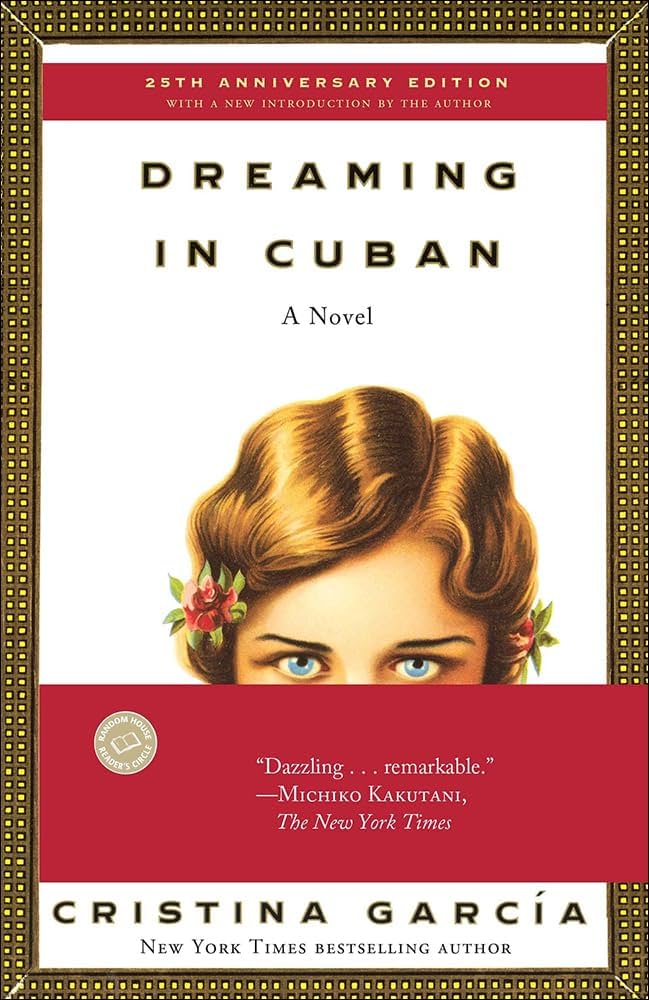
Reflections on Cristina Garcia’s Dreaming in Cuban

Cristina Garcia’s novel Dreaming in Cuban paints a portrait of two different Cuban American women and the way exile has helped to shape their identities as American citizens. Lourdes is a wife and mother at the time she flees to America to escape Fidel Castro’s Cuba. She leaves behind her parents and siblings to build her new life with her husband and daughter. Her American ideal is the stuff of movies and 50’s sitcoms. She has no patience for non-believers in the American dream and goes about creating her new identity from scratch. Pilar is a toddler when she leaves Cuba and it is not by choice. She is ripped from the arms of her grandmother and must accompany her parents to the U.S. She is torn between Cuba and America throughout her childhood due to her memories of her grandmother and a yearning to be reconnected with her. She resents the patriotism and blind faith her mother Lourdes places in the American dream and rebels against her mother’s ideals.

Lourdes owns a chain of Yankee Doodle Bakeries and is proud of the business she is building. She is a volunteer for the police force who patrols the neighborhood and believes it to be her “civic duty” (Garcia 136). She does things she believes to be distinctly American like she makes “Jello-O molds with miniature marshmallows” and “barbecues anything she can get her hands on” (Garcia 137). She attends the Thanksgiving Day parade on Fifth Avenue and watches the Rose Parade for New Year’s on television. For the American bicentennial, she plans to sell “tricolor cupcakes and Uncle Sam marzipan” (Garcia 136). She openly opposes anything that hints of communism or Cuban patriotism. “She’s convinced she can fight Communism from behind her bakery counter” (Garcia 136). Her daughter thinks she dreams of sponsoring her own float someday, “maybe a huge burning effigy of El Lider” (Garcia 137).

She only begrudgingly returns for a visit to Cuba in 1980 at the request of her daughter and is miserable the entire time arguing with the locals, complaining about the poor accommodations, criticizing the economy, etc. Garcia shows the contrast of Lourdes’s praise and pride in America with her disdain for Cuba. When she comes within killing distance of El Lider, Lourdes fantasizes about assassinating him, and her final act on the island is helping her nephew escape. She becomes a patriotic American whose love for her new country is partially a reaction to her escape and hatred of her old country. Her exile is her salvation and she is proud of her choice.

In contrast, Pilar struggles to figure out her identity. She takes for granted the country she grows up in because she did not have negative experiences in Cuba. She longs for a return to the island to see her grandmother and views those who bar her way as obstinate for no good reason. Pilar is a product of American society. She is drawn to the rebellious punk culture and uses her art to protest societal norms. She says she likes to “confront people” and that her art says, “Hey, we’re here too and what we think matters!” (Garcia 135). It is not until she returns to Cuba for a visit to her grandmother that she is confronted with the reality of the social, political, and economic unrest of her birthplace. Though she loves Cuba, she belongs in New York. “I know now it’s where I belong – not instead of here, but more than here” (Garcia 236). Her exile becomes real to her and that is when Pilar truly chooses America as her own, ready to claim it as part of her identity.

Works Cited

Garcia, Cristina. Dreaming in Cuban. New York, Ballantine Books, 1992.

A Court of Wings and Ruin (ACOTAR Book Review 3)

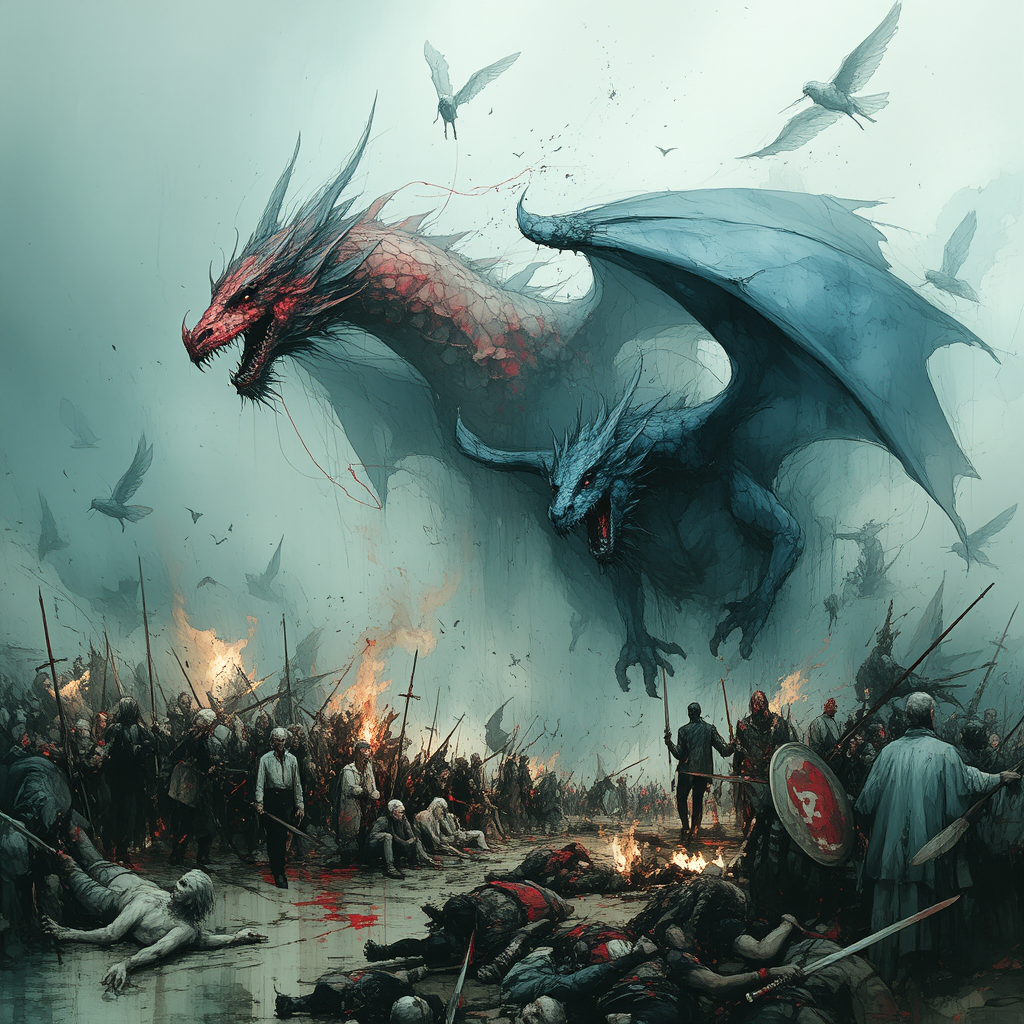
All images created by Rebekah Marshall’s prompts using AI on Gencraft.com website.

WARNING – SPOILERS

A Court of Wings & Ruin, the 3rd book in the ACOTAR series, held its own in the cannon. It was not my favorite of the books but was a necessary middle step to Feyre righting her life and fully coming into her own. She must make more heartbreaking decisions to save herself, save those she loves, and end things once and for all with her past relationships that keep weighing her down.

I like that the book is messy, things don’t go as planned quite often, pivots must be made, and even immortal beings must repeatedly circle back to try to fix things over and over again. It feels very human, very relatable to not have everything be an easy win as these magnificent beings battle their way to try to save the world. There are gigantic beasts, ulterior motives, dark ancient magic, impossible choices, and unlikely alliances.

Elaine (Feyer’s sister) begins to come into her own as she wrestles with her powerful gifts in this book. And her lack of interest in the being to whom fate has declared her a mate is a fascinating twist. Nesta must figure out how to live in this world she hates, and grapple with why she is strangely drawn to Cassian. I love that her character is super cantankerous. She is not very likeable, and that makes her interesting. She doesn’t seem to care about being liked. Feyre and her mate keep our hearts pounding with their love. And Mor’s secrets about her love life are a perfectly revealing piece of the puzzle.

I must say that the deaths in this book had me sobbing. I will say no more about that, so I don’t ruin anything too grievous for anyone. I will simply say that the toll of war is well-depicted and heartbreakingly devastating.

Maas, Sarah J. A Court of Wings and Ruin. Bloomsbury Publishing, 2017.

Your Subconscious Brain Can Change Your Life (Book Review)   

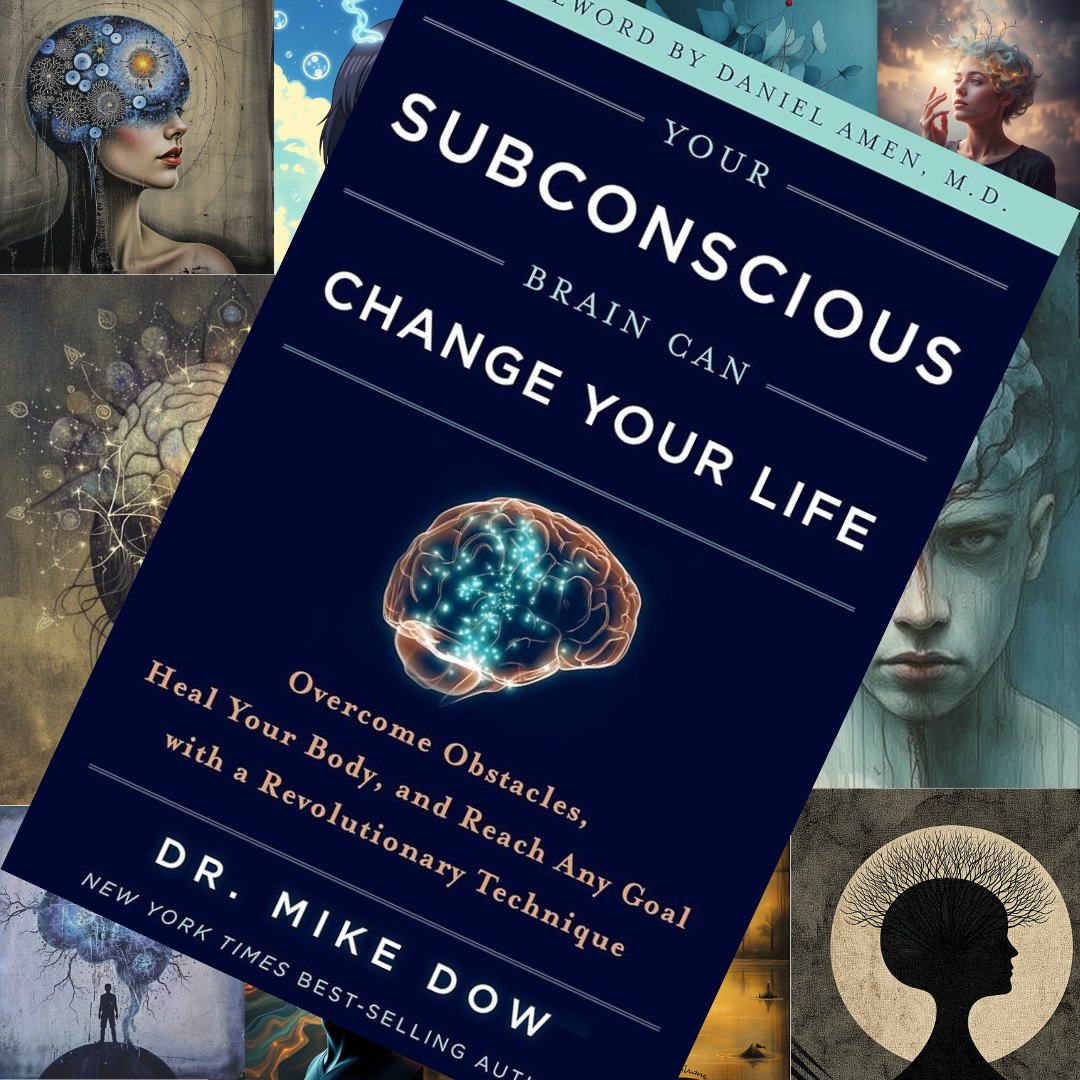
All images created by Rebekah Marshall’s prompts using AI on Gencraft.com website.

I struggled to finish Your Subconscious Brain Can Change Your Life by Dr. Mike Dow. Though the information is fabulous, and the techniques seem like valuable hypnotherapeutic practices, it felt like a medical textbook. That said, in the back of the book is a link to recorded resources for retraining the subconscious by listening to scripts. I have only just begun listening to them, but think I might have stumbled across some really helpful tools this way. Perhaps I should have listened to this book as an audio book, rather than reading it.

The practice is called Subconscious Visualization Technique and is recommended to be paired with other more traditional methods like medication, Cognitive Behavioral Therapy, etc. The author shows in study after study that SVT, when paired with other strategies, boosts recovery, decreases pain, and increases positive desired effects beyond traditional strategies only. And in some cases, SVT alone outpaces the traditional treatments.

The mind can be a very powerful ally if we learn to partner with it, train it, and set it to work on the systems that run these complex machines we live in. Though I cannot recommend the book as an enjoyable read, it is certainly an excellent resource and provides access to hypnotherapeutic recordings via links in the back that could prove invaluable. I have only listened to one so far, so the jury is still out, but I plan to continue listening to them and seeing how they help with reducing pain and inflammation, and increasing joy and contentment in my life.

Dow, Dr, Mike, Your Subconscious Brain Can Change Your Life, Hay House, Inc., 2019.

A Court of Mist and Fury (ACOTAR Book 2 Review)

Starfall on the balcony – Feyre & Rhysand. All images created by Rebekah Marshall’s prompts using AI on Gencraft.com website.

WARNING – SPOILERS

A Court of Mist & Fury, the 2nd book in the ACOTAR series, far surpasses the first book in emotional depth, relationship dynamics, and character development. I was sucked in from page 1 and devoured the 600+ tome.

After the crippling life and death decisions Feyre was forced to make at the end of Book 1, she must grapple with the fall-out of those choices. Not only is she tormented by inner turmoil and grief, but her relationship with Tamlin is troubled. His controlling behaviors and unwillingness to see Feyre as an equal, spell the crumbling of their bond.

When she returns to the Winter Court to recover and rediscover her autonomy, the awakenings of power, self, and abilities are a welcome adventure. Rhysand is equal parts challenge, equal parts friend, and most of all, gives her the space she needs to find herself again. The budding friendships, fierce battles, growing romance, and discovery of abilities make for a fabulously rich world Sarah J. Maas creates in this 2nd book.

The most pleasant surprise for me (stop reading right here if you don’t want a spoiler) is Feyre’s sisters coming back into her life. I hoped there could be more to their story, potential growth or reconciliation, anything. That is still to be seen, but at least the opportunity for healing exists. The most shocking surprise for me are the betrayals at the end. I can’t bear the thought of Feyre existing in the world she has chosen, once again, out of self-sacrifice. But I must read on.

Maas, Sarah J. A Court of Mist and Fury. Bloomsbury Publishing, 2016.

Book Review – The Big Leap

AI Generated image prompted on Gencraft.com by Rebekah Marshall.

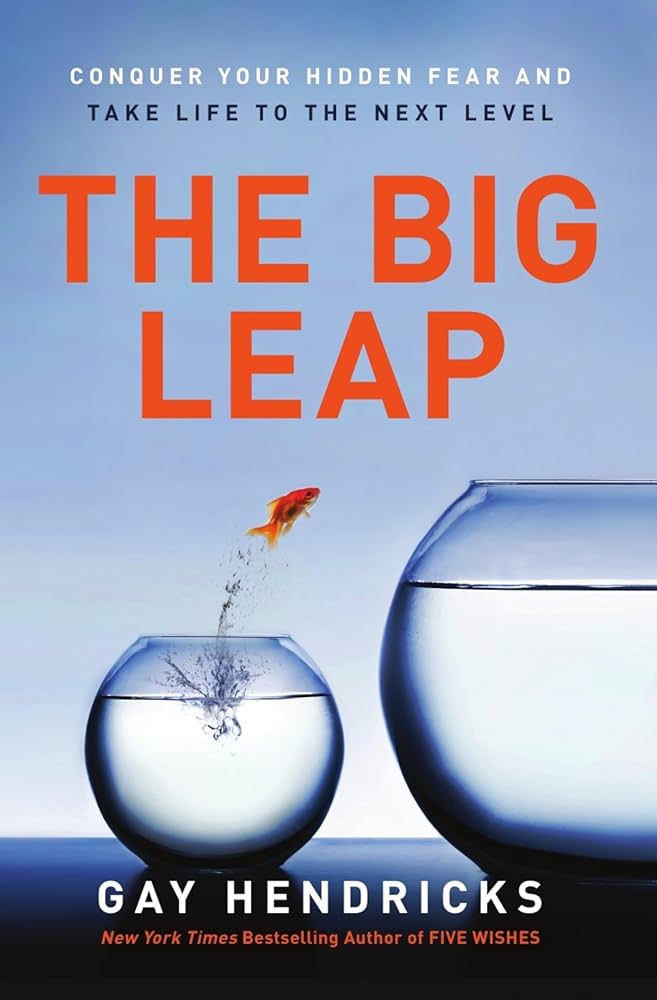
According to Gay Hendricks, PH.D., the only problem we need to solve is the Upper Limit Problem. He believes all avenues of discontent in life flow from the ways in which we limit ourselves or allow ourselves to be limited without breaking into our Zones of Genius. He posits that a universal human trait is the tendency to sabotage ourselves and others when artificial upper limits are exceeded.

The barriers we and society put in place are often unconsciously constructed by our upbringing, religion, politics, and education, but we buy into them and keep the scaffolding exactly where it’s always been. Phrases like, “She’s getting above her raising,” “He thinks he’s better than us,” “They aim too high,” “She’s greedy to want more,” “He needs to be brought down a peg,” “They didn’t do anything to earn that position,” etc. These aren’t phrases from his book, but common enough phrases in society that his hypothesis feels like commentary on most communities I know.

Whatever the complex social issues surrounding the lack of support for growth, he suggests there are ways to push beyond and live our best lives while still loving and supporting others. Instead of having a mindset of lack—lack of time, lack of money, lack of energy, lack of ideas, lack of community—we recognize that we are the creators of our realities and do our utmost to tap into our own genius.

The first step is to recognize the barriers and make conscious decisions to overcome them:

1. We are fundamentally flawed and don’t deserve success.

2. We are disloyal to expand beyond the expected norms of our families of origin.

3. We are a burden to others.
4. We must dim our brilliance, so we don’t outshine others.

Once we have expelled these faulty concepts from our thinking, we must find what our gifts are, find ways to express them, dislodge the notion that time is not on our side, and bring our best selves to the world. Only then will we be fulfilled in our relationships, our careers, our finances, and our spirituality.

I am intrigued, especially by his idea that time comes from within us, or at least the concept of time. It is only perception of time that makes each moment feel gruesome or fabulous. I’m sure he would agree that this concept does not apply in all circumstances because there are situations outside of our control and factors in this world that force time constraints on people against their will.

Disclaimers would have been appreciated that some of these deep concepts might not apply to people in the midst of horrific situations beyond their power, like war, extreme poverty, abuse, trauma, and other life-altering dilemmas that can create struggle. But given basic needs met, semi-peaceful conditions, and non-traumatic circumstances, his ideas are worth considering.

I for one commit to recognizing language of lack related to money, time, energy, etc. Instead of saying, “I can’t afford that,” or “I don’t have money for that,” I want to say, “I can buy that if I save for it,” or “I’m choosing to spend my money on something else.” It is a choice to reframe my language. Instead of saying, “I don’t have time to do that,” or “I wish there were more hours in the day,” I want to say, “I’m choosing to spend my time on other priorities,” or “I have plenty of time to do everything I am meant to do today.” The one I need to work the most on is energy. With chronic health issues, I am very aware of my energy levels and am known to complain about lack of energy. But Instead of saying, “I don’t have the energy to do this,” or “I wish I had more energy for x,y,z,” I want to say, “I have enough energy to do these things today, so I am going to prioritize them,” or “I have exactly the amount of energy I need and then I will take a nap to recharge.”

This self-development journey is fascinating. However much I learn, I always discover something more to expand my growth. The Big Leap is absolutely worth the read, but I recommend tackling it when things are at a fairly stable place in life. I would not have been willing to hear his ideas when I was at the apex of pain, in the middle of my divorce, during a crisis when my kids were teenagers, or when I was working 7 days a week to survive with no end in sight. These are concepts I am willing to consider with all bases covered and the privilege and opportunity to navel gaze and ponder things like expanding into my zone of genius.

Hendricks, Gay. The Big Leap, Harper Collins, 2009.

A Court of Thorns and Roses (Book Review)

Feyre and the fey wolf. Image created by Rebekah Marshall’s prompts using AI on Gencraft.com website.

A Court of Thorns and Roses by Sarah J. Maas is a fabulous fantasy tale of personal discovery, growth, and becoming. Feyre reminds me of myself, willing to work herself to the bone to provide for her family, while usually putting her needs last. As often happens in unhealthy family units, her sacrifices are taken for granted.

Accidentally killing a wolf who is fey, she finds herself bound and forced into a world of magic, terror, and beauty unlike anything she has ever experienced. She falls in love with her gift of painting that has never before had the chance to blossom. She begins to see herself as capable of much more than she ever thought possible. And she even falls in love.

Little does she know that every step she takes toward her new life brings her closer to death.

I was terribly disappointed in so many of the characters in this story who did nothing to protect Feyre. Sarah J. Maas is the master of making us dislike characters before letting them redeem themselves. I hope future books give me something to like about some of them because at the end of this book, I was not impressed with anyone but Feyre. Ok, maybe I see some hope for one of the males, but I don’t want to spoil the surprises for anyone who hasn’t read the books yet.

Mass, Sarah J. A Court of Thorns and Roses. Bloomsbury Publishing, 2020.

🌕 My Friend, Fear:

All images created by Rebekah Marshall’s prompts using AI on Gencraft.com website.

Fear walks with me, not ahead of me — it is the shiver that proves I’m expanding, the hush before my next leap, the echo that reminds me I’m alive and rewriting the rules I was taught to obey.

💬 Why This Resonates for Me:

  • “Fear walks with me, not ahead of me”
    ➤ I’m learning to hold fear as a companion, not a leader — I’m still in control.
  • “The shiver that proves I’m expanding”
    ➤ Honors that fear is a signal of growth, not failure. I’m not broken — I’m stretching.
  • “The hush before my next leap”
    ➤ Speaks to my propensity to reflect deeply before making bold moves — and that those silences are sacred, not stuck.
  • “The echo that reminds me I’m alive and rewriting the rules I was taught to obey”
    ➤ This is about healing financial trauma, breaking inherited scarcity mindsets, and forging my own path — with fire and grace.

(I am doing the writing exercises in the back of the book You are a Badass at Making Money by Jen Sincero, and this topic was about fear. I am also learning to trade futures, so the art is related to the charts we use to make the trades.)

💎 My WHY:

All images created by Rebekah Marshall’s prompts using AI on Gencraft.com website.

I build wealth to rewrite the story — to bless those I love, heal the wounds behind me, and create a life of joyful abundance, generosity, and freedom for all who walk beside me.


✨ Why This Works:

  • “I build wealth to rewrite the story”
    ➤ Acknowledges that my path is one of transformation and conscious re-authoring of generational patterns.
  • “To bless those I love”
    ➤ Centers my heart-based motivation to support friends and family.
  • “Heal the wounds behind me”
    ➤ Honors the lineage and the pain I’m transmuting through my journey — a true act of generational healing.
  • “Create a life of joyful abundance, generosity, and freedom”
    ➤ Highlights the quality of life I’m manifesting — not just money, but liveliness, joy, and choice.
  • “For all who walk beside me”
    ➤ Speaks to the shared nature of my success — that my elevation raises the collective.

(I am doing the writing exercises in the back of the book You are a Badass at Making Money by Jen Sincero, and this topic was about coming up with a “Why” for wanting to create wealth. I am also learning to trade futures, so the art is related to the charts we use to make the trades.)

Think and Grow Rich – Book Review

I’m learning day trading, and I joined an organization of women learning trading skills. One of the activities they coordinate is an online book club that reads one book per month about either financial habits, abundance mindset, or trading. They also have recordings of their weekly discussions going back to October of 2024. Being the overachiever that I am, I am going back and reading the past books they covered and watching the recordings. Because I have never felt confident in my financial literacy, I figure it can’t hurt to learn as much as possible before I ever attempt to trade with real money. Everything I am doing currently is with a demo account they call paper trading. There is no real money involved.

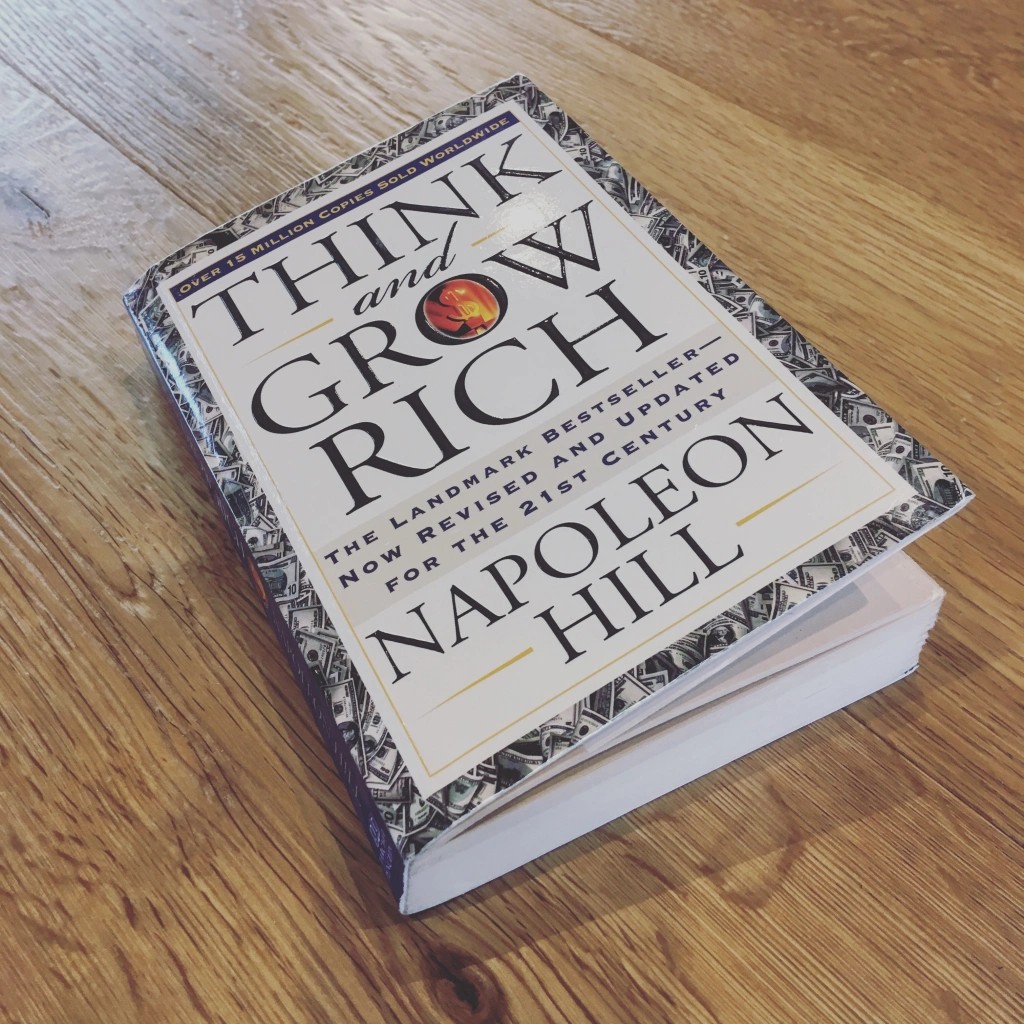
The first book I heard the tail end of was Think and Grow Rich by Napoleon Hill. It sounded intriguing, so I found a used copy and got started reading. Boy, was I in for a ride. Yes, there were some interesting tidbits, but mostly I was repeatedly horrified by the outdated examples of financial geniuses we were supposed to admire. Charles Schwab was regaled for many a chapter. The same Charles Schwab who was just in the news for being in the oval office with President Trump laughing about the enormous amounts of money he made when the stock market plummeted. Yikes.

There are so many things in this book that I find reprehensible that I don’t even know where to begin. Mr. Hill refused to allow his son, who was born without ears, to learn sign language because he believed his son would someday hear. He drilled hard work and determination into his boy and was proud of the fact that he never allowed his son to have accommodations for his hearing loss. His son’s future success is provided as evidence that his way is the right way, and the fact that his theories are based on 20 years of interviews following rich and powerful people.

Robert E. Lee is praised for his courage in siding against the union, knowing he and many others were putting their lives on the line for their cause. Booker T. Washington is praised for his tolerance and described as someone handicapped by race. Anyone in poverty is there because they have accepted poverty as their fate and succumbed to a lowly state rather than doing all the right things to make themselves rich. Unions, organizing, or criticizing capitalism are evidence of stupidity and small minds because there is no possible way to have an organized, civilized, functioning lifestyle if the giant capitalistic machinery is not in charge of it all. All people should gladly praise the powers that be for their brilliance in making our lives better with their riches.

Ahem…I almost couldn’t get through the book. Then I got to the spot I started listening to in the weekly book club gatherings and was reminded that I liked the ending. The last third of the book is much more tolerable and focuses on concepts I can get behind. The ideas center on finding mentors and experts in the fields in which we want to better ourselves or learn more about. There are brilliant examples of visionary exercises that can be done to deepen our awareness of our subconscious connection to wisdom and theories about creativity and drive that are quite excellent. There is an entire section on developing intuition and overcoming fear that are wonderful practices for all areas of life, not just financial growth.

I cannot recommend this book to anyone because the outdated parts are simply too icky, in my opinion. It says it has been revised and updated for the 21st century. If that is so, I don’t even want to imagine what the original version included.

Hill, Napoleon. Think and Grow Rich. Jeremy P Tarcher, 2007.